Chapter 13 Chemical Kinetics PART 2 - Video 1 Integrated rate laws
Summary
TLDRThis section covers the essential concepts of reaction kinetics, starting with the time-dependent form of the rate law and the half-life concept. It delves into the effects of temperature on the rate constant using the Arrhenius equation, followed by an exploration of reaction mechanisms. The tutorial also explains how catalysts function in reactions. Key topics include zero, first, and second-order reactions, with detailed explanations of their respective integrated rate laws. The video emphasizes the practical applications of these laws in industrial settings, especially in predicting reaction behavior over time.
Takeaways
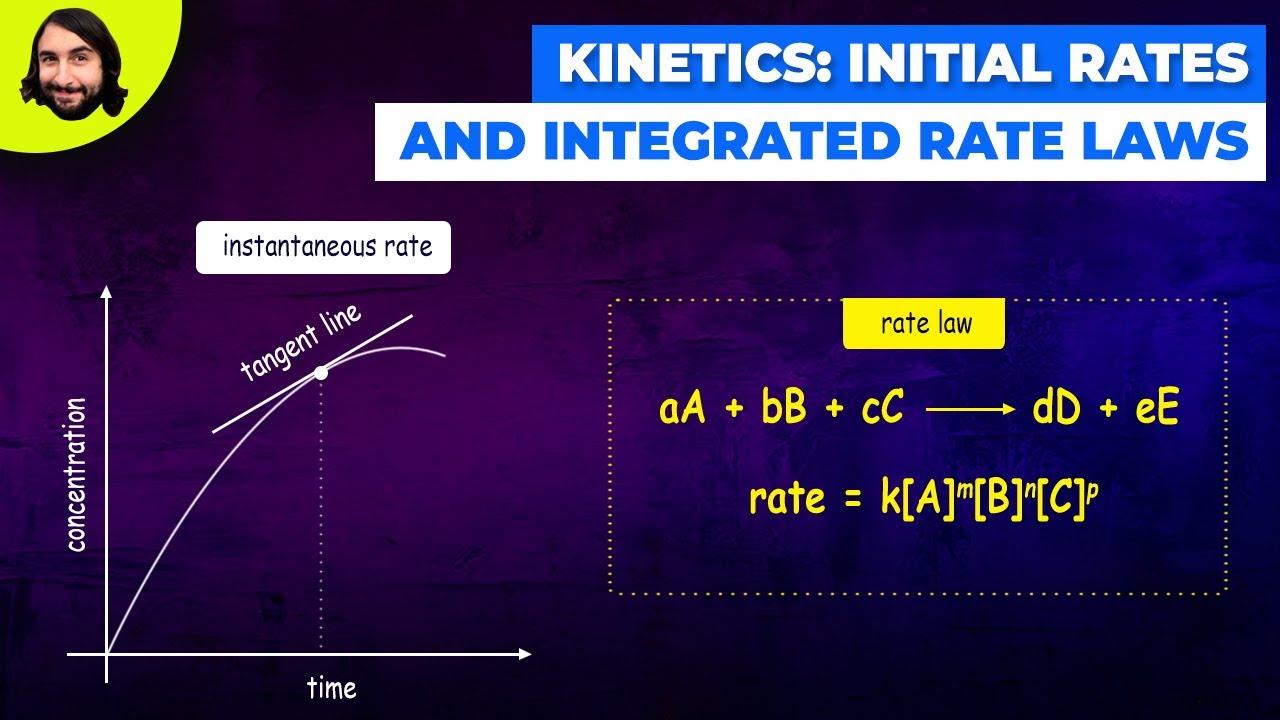
- 😀 Rate law relates the rate of a reaction to the factors affecting it, but does not contain a time-concentration relationship.
- 😀 The integrated rate law provides a time-concentration relationship, essential for applications like industrial chemical reactions.
- 😀 Zero-order reactions have a linear integrated rate law, and concentration decreases proportionally with time.
- 😀 First-order reactions use a logarithmic relationship to relate concentration and time, and the rate constant can be used to calculate time.
- 😀 Second-order reactions follow an inverse relationship for concentration over time, where 1/[A] is directly proportional to time.
- 😀 Understanding the integrated rate laws helps in calculating the time needed for a specific amount of reactant to be converted.
- 😀 The concentration of a reactant at time t is calculated differently for zero-order, first-order, and second-order reactions.
- 😀 The rate constant (k) is crucial in determining the rate of a reaction, and its value is different for reactions of different orders.
- 😀 The derivation of the integrated rate laws requires calculus, but it is important to know their application rather than the derivation itself.
- 😀 Always use the appropriate integrated rate law for a given reaction order (zero, first, or second) to obtain accurate results.
Q & A
What is the main focus of this part of the chapter on reaction kinetics?
-This part of the chapter focuses on time-dependent rate laws (integrated rate laws), the half-life concept, the effect of temperature on the rate constant using the Arrhenius equation, reaction mechanisms, and how catalysts work.
What is a rate law and what is its limitation?
-A rate law is an equation that relates the rate of a reaction to the factors that affect it, such as reactant concentrations. Its limitation is that it does not provide a direct relationship between concentration and time.
Why is the concentration–time relationship important in industrial applications?
-The concentration–time relationship is important because industries need to know how long a reaction must run to convert a certain amount of reactant into product, or how much reactant remains at a given time.
What is an integrated rate law?
-An integrated rate law is an equation that relates the concentration of a reactant to time. It allows us to calculate either the concentration at a given time or the time required to reach a certain concentration.
Why do zero, first, and second order reactions have different integrated rate laws?
-They have different integrated rate laws because their rate laws depend differently on reactant concentration. Each integrated form is derived from its specific differential rate law using calculus.
What do the symbols [A], [A]₀, [A]t, t, and k represent?
-[A] represents the concentration of reactant A, [A]₀ is the initial concentration at time zero, [A]t is the concentration at time t, t is time, and k is the rate constant.
What is the integrated rate law for a zero-order reaction?
-For a zero-order reaction, the integrated rate law is [A]t = [A]₀ − kt. It shows that concentration decreases linearly with time.
What is the integrated rate law for a first-order reaction?
-The integrated rate law for a first-order reaction is ln([A]t/[A]₀) = −kt. It can also be rearranged to [A]t = [A]₀e^(−kt) for calculating concentration directly.
What is the integrated rate law for a second-order reaction?
-For a second-order reaction, the integrated rate law is 1/[A]t = kt + 1/[A]₀. This equation shows a linear relationship between 1/[A] and time.
How can integrated rate laws be used in problem-solving?
-Integrated rate laws can be used to calculate the concentration of a reactant at a specific time or determine the time required for the concentration to reach a certain value.
Why is it important to use the correct integrated rate law for a reaction?
-Each reaction order has a specific mathematical relationship between concentration and time. Using the wrong integrated rate law will lead to incorrect calculations and conclusions.
Why is the first-order integrated rate law often rearranged?
-Because it contains a logarithmic expression, it is often rearranged into an exponential form to directly calculate concentration more conveniently.
Outlines

Cette section est réservée aux utilisateurs payants. Améliorez votre compte pour accéder à cette section.
Améliorer maintenantMindmap

Cette section est réservée aux utilisateurs payants. Améliorez votre compte pour accéder à cette section.
Améliorer maintenantKeywords

Cette section est réservée aux utilisateurs payants. Améliorez votre compte pour accéder à cette section.
Améliorer maintenantHighlights

Cette section est réservée aux utilisateurs payants. Améliorez votre compte pour accéder à cette section.
Améliorer maintenantTranscripts

Cette section est réservée aux utilisateurs payants. Améliorez votre compte pour accéder à cette section.
Améliorer maintenant


5.0 / 5 (0 votes)

