T01 Vídeo 02. Do nome átomo à descoberta do núcleo.
Summary
TLDRThis video offers an insightful historical overview of atomic theory, tracing its evolution from ancient Greek philosophers like Democritus, who proposed the concept of indivisible particles (atoms), to modern atomic theory. It highlights key figures such as Dalton, who introduced the idea of different types of atoms forming elements, and Thomson, Rutherford, and Chadwick, who uncovered the subatomic structure, including electrons, protons, neutrons, and the atomic nucleus. The video emphasizes the development of atomic theory over centuries and its profound impact on modern chemistry and science.
Takeaways
- 😀 The concept of the atom dates back to ancient Greece, with philosophers like Democritus considering the idea of indivisible particles constituting matter.
- 😀 Democritus proposed that matter is composed of tiny, indivisible particles, which he named 'atoms' (from the Greek word for 'indivisible').
- 😀 During the Middle Ages, the focus shifted from atomic theory to alchemy, which sought to transform materials, though it did not contribute much to modern chemistry.
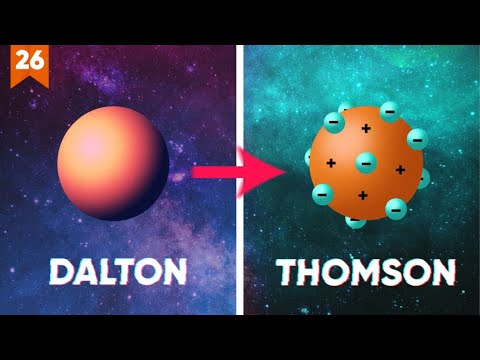
- 😀 John Dalton is credited with advancing atomic theory, proposing that each element is made of atoms of a single, unique type, and these atoms combine to form compounds.
- 😀 Dalton's model saw atoms as solid, indivisible spheres, which was later disproven as more research revealed subatomic structures.
- 😀 J.J. Thomson discovered the electron while experimenting with cathode rays, showing that atoms are divisible and have subatomic particles.
- 😀 Thomson's model depicted the atom as a 'plum pudding' with negatively charged electrons embedded in a positively charged 'soup.'
- 😀 Ernest Rutherford’s gold foil experiment revealed the atom has a small, dense nucleus at its center, containing positive charges (protons), and the rest of the atom is mostly empty space.
- 😀 Rutherford’s findings suggested that the atom consists of a small nucleus (with protons) and a surrounding, much larger, negative charge distribution (the electron cloud).
- 😀 James Chadwick later discovered the neutron, a neutral particle of similar mass to the proton, completing the basic structure of the atom with protons, neutrons, and electrons.
- 😀 The modern model of the atom, as we know it today, includes electrons in a surrounding 'electrosphere,' with protons and neutrons concentrated in the tiny nucleus at the center.
Q & A
Who was Demócrito and what was his contribution to atomic theory?
-Demócrito was an ancient Greek philosopher who proposed that matter is composed of indivisible particles called atoms, laying the foundation for the concept of atoms as fundamental units of matter.
What does the word 'atom' mean and why was it chosen?
-The word 'atom' comes from the Greek 'atomos,' meaning indivisible. It was chosen because Demócrito imagined these particles could not be divided further.
How did John Dalton contribute to the modern understanding of atoms?
-John Dalton introduced the idea that elements are made of identical atoms and that atoms of different elements can combine to form compounds, providing a scientific basis for chemical reactions.
What was the main limitation of Dalton’s atomic model?
-Dalton's model assumed atoms were indivisible solid spheres, which was later disproven by the discovery of subatomic particles like electrons, protons, and neutrons.
What did J.J. Thomson discover and how did it change the atomic model?
-J.J. Thomson discovered the electron through experiments with cathode rays, showing that atoms have internal structure and are divisible, leading to the 'plum pudding' model.
Describe Rutherford's gold foil experiment and its significance.
-Rutherford bombarded a thin gold foil with alpha particles and observed that some were deflected, demonstrating that atoms have a small, dense, positively charged nucleus that contains most of the atom's mass.
What is the structure of the atom according to Rutherford’s model?
-Rutherford's model shows a small, dense nucleus containing protons (and later neutrons) at the center, surrounded by electrons in the larger, mostly empty space called the electron cloud or electrosphere.
What did James Chadwick discover and why was it important?
-James Chadwick discovered the neutron, a neutral particle in the nucleus with mass similar to the proton, which explained the missing mass in atoms and completed the basic picture of the atomic nucleus.
Explain the analogy used in the video to describe the size of the nucleus compared to the atom.
-If an atom were the size of a stadium, the nucleus would be like a small marble in the center, illustrating that the nucleus contains almost all the mass but occupies very little volume.
What are the main components of an atom and where are they located?
-An atom consists of protons and neutrons in the nucleus at the center, which contains almost all the mass, and electrons in the electrosphere, which occupies nearly all the atom's volume.
How did the discoveries of Thomson, Rutherford, and Chadwick build upon each other?
-Thomson discovered electrons, showing atoms are divisible; Rutherford discovered the nucleus, revealing that positive charge and most mass are concentrated centrally; Chadwick discovered neutrons, completing the understanding of the nucleus's composition.
Why is studying the history of atomic theory important for understanding chemistry today?
-Studying the history shows how scientific models evolved through experiments and reasoning, helping students understand atomic structure, chemical reactions, and the principles behind modern chemistry applications like pharmaceuticals and materials.
Outlines

Esta sección está disponible solo para usuarios con suscripción. Por favor, mejora tu plan para acceder a esta parte.
Mejorar ahoraMindmap

Esta sección está disponible solo para usuarios con suscripción. Por favor, mejora tu plan para acceder a esta parte.
Mejorar ahoraKeywords

Esta sección está disponible solo para usuarios con suscripción. Por favor, mejora tu plan para acceder a esta parte.
Mejorar ahoraHighlights

Esta sección está disponible solo para usuarios con suscripción. Por favor, mejora tu plan para acceder a esta parte.
Mejorar ahoraTranscripts

Esta sección está disponible solo para usuarios con suscripción. Por favor, mejora tu plan para acceder a esta parte.
Mejorar ahoraVer Más Videos Relacionados

2.2.1 - Estudo do átomo - Hipótese atômica de Leucipo e Demócrito: Teoria Atomística
O Modelo Atômico de Dalton x Thomson
SCIENCE 8: Q2_WREK 1- DAY 1: GREEK PHILOSOPHERS AND THE ATOMOS ||MATATAG CURRICULUM

Struktur Atom

Perkembangan Teori Atom- materi kimia SMA kelas 10 semester 1

The Atomic Theory: A Timeline Through History
5.0 / 5 (0 votes)

