Perkembangan Teori Atom- materi kimia SMA kelas 10 semester 1
Summary
TLDRThis video explains the development of atomic theory, tracing its evolution from ancient Greek philosophers like Democritus to modern quantum mechanics. It covers key figures such as Dalton, Thomson, Rutherford, and Bohr, each contributing crucial insights into the atomic model. Dalton introduced the idea of indivisible atoms, Thomson discovered electrons, Rutherford revealed the nucleus, and Bohr defined electron orbits. The video also highlights the transition from classical chemistry to modern atomic theory, setting the stage for deeper exploration of quantum mechanics in upcoming lessons.
Takeaways
- 😀 Atoms are the smallest units of matter, but they are composed of smaller particles: protons, neutrons, and electrons.
- 😀 Modern tools like scanning tunneling microscopes allow us to visualize atoms, which cannot be seen with the naked eye.
- 😀 The development of atomic theory is divided into classical and modern chemistry periods.
- 😀 Ancient philosophers like Democritus proposed that atoms are indivisible, while Aristotle classified elements into fire, air, earth, and water.
- 😀 Alchemists focused on transforming metals into gold and used symbolic representations of elements.
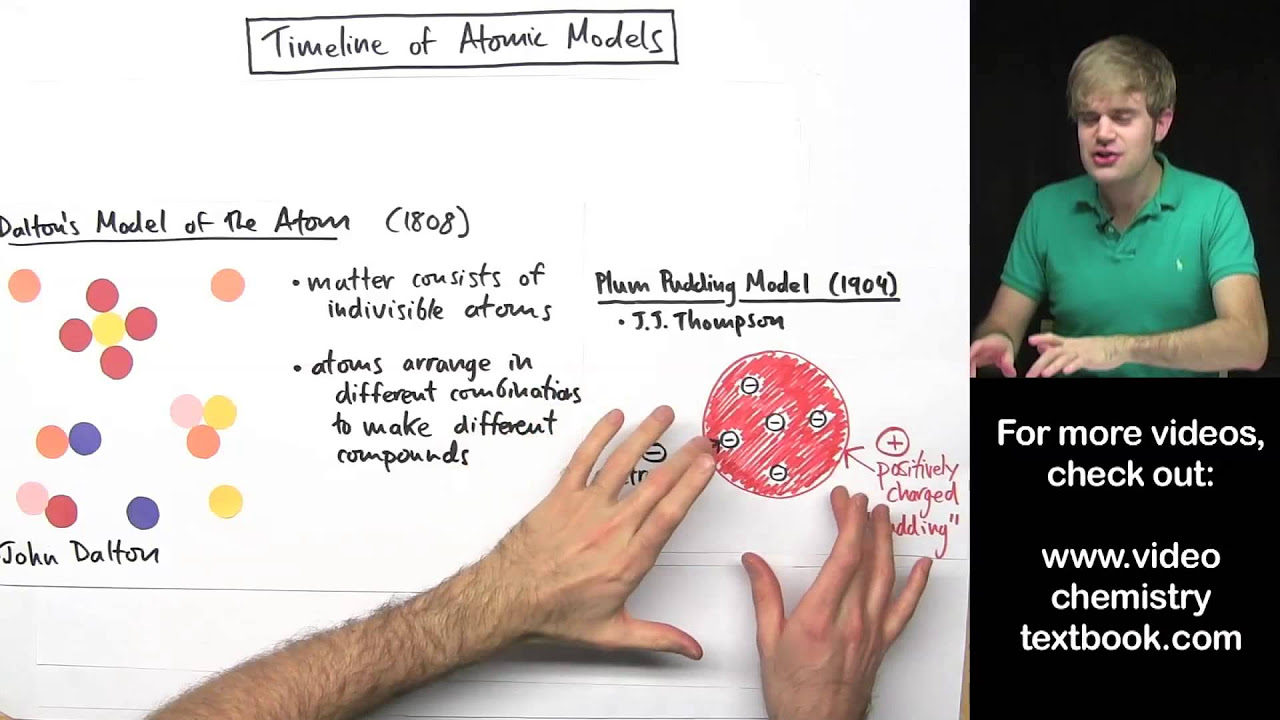
- 😀 Dalton's atomic theory (1833) introduced four postulates about atoms, including their indivisibility, identity within elements, and combination to form molecules.
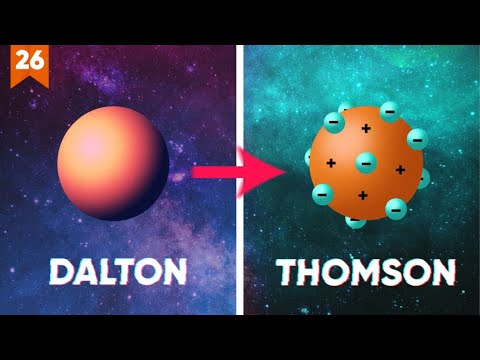
- 😀 Thomson's model explained the existence of electrons and the need for balancing positive and negative charges within atoms.
- 😀 Rutherford's experiment with alpha particles showed that most of an atom is empty space, with a small, positively charged nucleus.
- 😀 Bohr improved upon Rutherford's model by introducing fixed electron orbits (stationary states) that prevent electrons from collapsing into the nucleus.
- 😀 Electron transitions between Bohr’s orbits involve energy absorption or emission, explaining spectral lines, while modern quantum mechanics further refines our understanding of atomic behavior.
Q & A
What is the simplest definition of an atom according to the video?
-An atom is the smallest part of a substance, though it can be divided further into subatomic particles such as protons, neutrons, and electrons.
Which tool allows scientists to visualize atoms directly?
-The Scanning Tunneling Microscope (STM) enables scientists to see individual atoms.
Who were the first philosophers to propose the idea of atoms, and what did they believe?
-Leukippos and Democritus proposed that atoms are the indivisible building blocks of matter.
How did Aristotle's view of matter differ from the early atomists?
-Aristotle divided matter into four elements—fire, air, earth, and water—rather than indivisible atoms.
What are the main postulates of Dalton's atomic theory?
-1. Matter is made of indivisible atoms. 2. Atoms of a single element are identical in mass, volume, and properties. 3. Atoms of different elements differ. 4. Chemical reactions involve the rearrangement of atoms. 5. Atoms combine in simple whole-number ratios to form compounds.
What was the main limitation of Dalton's atomic theory?
-It could not explain electrical phenomena observed in matter.
How did Thomson describe the structure of the atom?
-Thomson proposed that atoms are spheres of positive charge with negatively charged electrons embedded within, like 'plums in a pudding.'
What key experiment led Rutherford to propose the nuclear model of the atom?
-Rutherford's gold foil experiment, where alpha particles were directed at thin gold foil, showed that atoms are mostly empty space with a dense, positively charged nucleus.
What problem in Rutherford's model did Bohr address?
-Bohr explained why electrons do not spiral into the nucleus by proposing that they move in fixed orbits, or stationary energy levels, around the nucleus.
How do electrons transition between energy levels in Bohr's model?
-Electrons can move to higher or lower energy levels by absorbing or emitting a precise amount of energy.
What are the names of the electron shells in Bohr's model?
-The shells are labeled K (first), L (second), M (third), and so on.
How has the understanding of the atom evolved from classical to modern chemistry?
-The understanding has progressed from philosophical ideas of indivisible particles (atomists) and elemental theories (Aristotle) to experimental and evidence-based models: Dalton's atomic theory, Thomson's electron, Rutherford's nuclear model, Bohr's quantized orbits, and eventually quantum mechanics.
Outlines

This section is available to paid users only. Please upgrade to access this part.
Upgrade NowMindmap

This section is available to paid users only. Please upgrade to access this part.
Upgrade NowKeywords

This section is available to paid users only. Please upgrade to access this part.
Upgrade NowHighlights

This section is available to paid users only. Please upgrade to access this part.
Upgrade NowTranscripts

This section is available to paid users only. Please upgrade to access this part.
Upgrade Now



5.0 / 5 (0 votes)
