Computer Network and Security Chapter 2 Types of Computer Networks
Summary
TLDRThis video covers various types of computer networks, highlighting their differences based on geographical scope. It introduces Personal Area Networks (PAN), Local Area Networks (LAN), Metropolitan Area Networks (MAN), Wide Area Networks (WAN), and the Internet. PANs are small, personal networks like Bluetooth devices, while LANs are commonly used in offices and schools. MANs expand across cities, and WANs cover vast areas like countries. The Internet, the largest network, connects everything using protocols like TCP/IP and IPv6. The video also explains the technologies and protocols used in each network, emphasizing the evolution from IPv4 to IPv6.
Takeaways
- 😀 PAN (Personal Area Network) is the smallest network, covering distances of up to 10 meters, typically used with Bluetooth and infrared-enabled devices.
- 😀 LAN (Local Area Network) covers small geographical areas like offices or schools, allowing devices to share resources like printers and file servers.
- 😀 A LAN can include up to 16 million devices and is often based on Ethernet or token ring technology.
- 😀 MAN (Metropolitan Area Network) covers an entire city, connecting multiple LANs with high-speed connections like fiber optics.
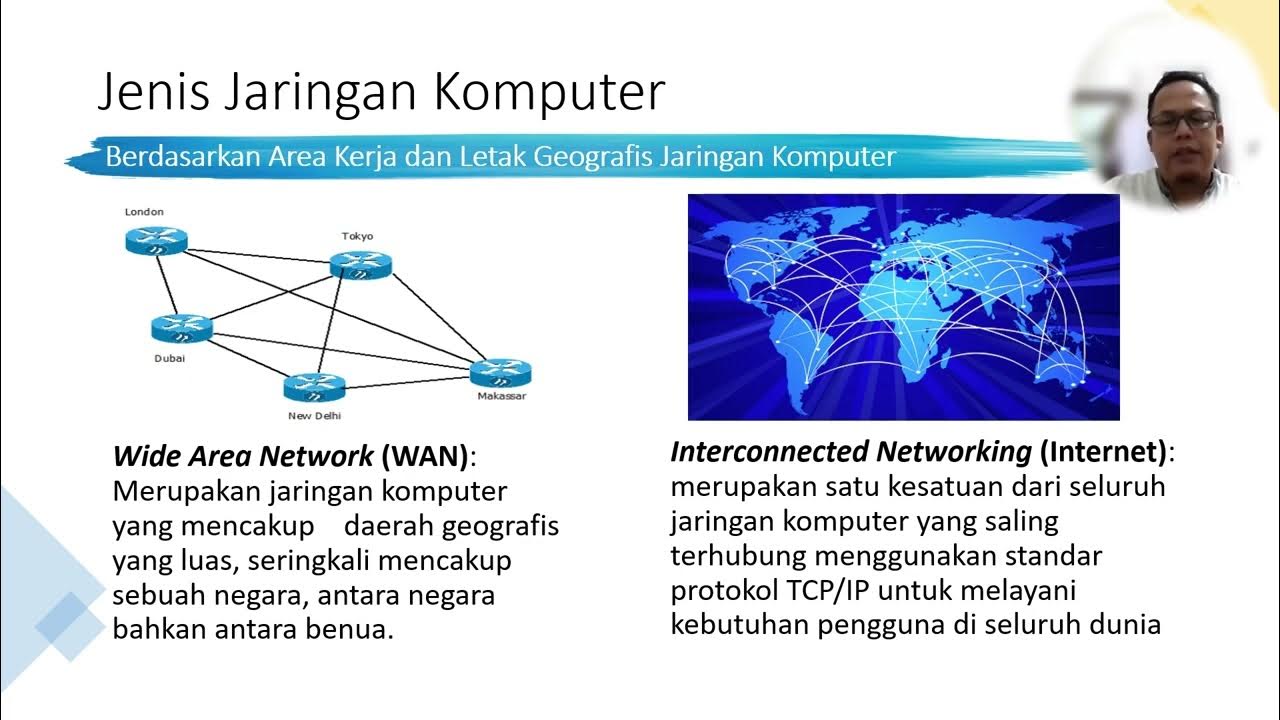
- 😀 WAN (Wide Area Network) connects LANs and MANs over large geographical distances, such as provinces or entire countries.
- 😀 The Internet is the largest network, connecting millions of smaller networks globally using TCP/IP protocols.
- 😀 The Internet is transitioning from IPv4 to IPv6 due to a shortage of IPv4 addresses, enabling more address space for devices.
- 😀 The Internet supports various services like email, FTP, web browsing, audio, and video streaming.
- 😀 The Internet relies on the client-server model, where users (clients) access resources hosted on web servers.
- 😀 Technologies like ATM, Frame Relay, and fiber optics are commonly used in WANs for high-speed data transfer.
- 😀 Communication on the Internet is often facilitated through submarine cables, enabling global connectivity between continents.
Q & A
What is a Personal Area Network (PAN)?
-A Personal Area Network (PAN) is the smallest type of network, typically covering a range of up to 10 meters. It connects personal devices such as Bluetooth-enabled keyboards, mice, headphones, printers, and TV remotes.
What is the maximum number of devices that can be connected in a PAN, and how are they arranged?
-A PAN can connect up to 8 devices, typically arranged in a master-slave configuration. One device acts as the master, controlling the network, while others act as slaves.
What are the main characteristics of a Local Area Network (LAN)?
-A LAN is a network that covers a small geographical area, such as a building or office. It allows devices to share resources like printers and file servers. LANs typically use private IP addresses and are usually based on Ethernet or Token Ring technologies.
Can a LAN be wired, wireless, or both?
-Yes, a LAN can be either wired, wireless, or a combination of both. This flexibility allows for different types of connectivity depending on the needs of the organization.
What is the role of a Metropolitan Area Network (MAN)?
-A MAN connects multiple LANs within a city or metropolitan area. It is typically used to provide high-speed internet and interconnect various local networks. MANs use technologies such as Ethernet, FDDI, and Metro Ethernet services.
How does a MAN differ from a WAN?
-A MAN spans a city and connects LANs within that area, whereas a WAN covers much larger areas, including entire countries or continents. MANs are used for city-level connections, while WANs interconnect broader regions.
What technologies are commonly used in a WAN?
-Common technologies used in WANs include Frame Relay, Asynchronous Transfer Mode (ATM), and high-speed fiber optics. These technologies allow WANs to provide fast, reliable connectivity over large geographical distances.
How does the Internet relate to WANs and LANs?
-The Internet is a global network of WANs, which interconnect LANs and smaller networks like home networks. It enables worldwide connectivity and communication, using the TCP/IP protocol suite and IP addressing.
What is the difference between IPv4 and IPv6?
-IPv4 is the current version of the Internet Protocol, but it has limited address space, which is being exhausted due to the growing number of devices. IPv6 was developed to address this issue, offering a much larger address space and gradually replacing IPv4.
What types of services are commonly used on the Internet?
-The Internet supports a wide range of services, including websites, email, instant messaging, blogging, social media, and audio/video streaming. These services are essential for communication, entertainment, and information sharing on a global scale.
Outlines

This section is available to paid users only. Please upgrade to access this part.
Upgrade NowMindmap

This section is available to paid users only. Please upgrade to access this part.
Upgrade NowKeywords

This section is available to paid users only. Please upgrade to access this part.
Upgrade NowHighlights

This section is available to paid users only. Please upgrade to access this part.
Upgrade NowTranscripts

This section is available to paid users only. Please upgrade to access this part.
Upgrade Now


5.0 / 5 (0 votes)
