ADC and DAC (Analog to Digital and Digital to Analog converters)
Summary
TLDRThis video explains the concepts of Analog to Digital Converters (ADC) and Digital to Analog Converters (DAC), exploring how they transform signals between analog and digital forms. It covers the advantages and disadvantages of analog versus digital signals, the steps involved in ADC like sampling, quantization, and encoding, and the role of Nyquist's theorem. The video also dives into the working of a 2-bit ADC and 4-bit DAC using weighted resistor methods. Practical applications in devices such as smartphones and audio systems are highlighted, demonstrating the importance of these circuits in everyday electronics.
Takeaways
- 😀 Analog signals are continuous and can represent infinite values, while digital signals are discrete and only have two possible states: 0 and 1.
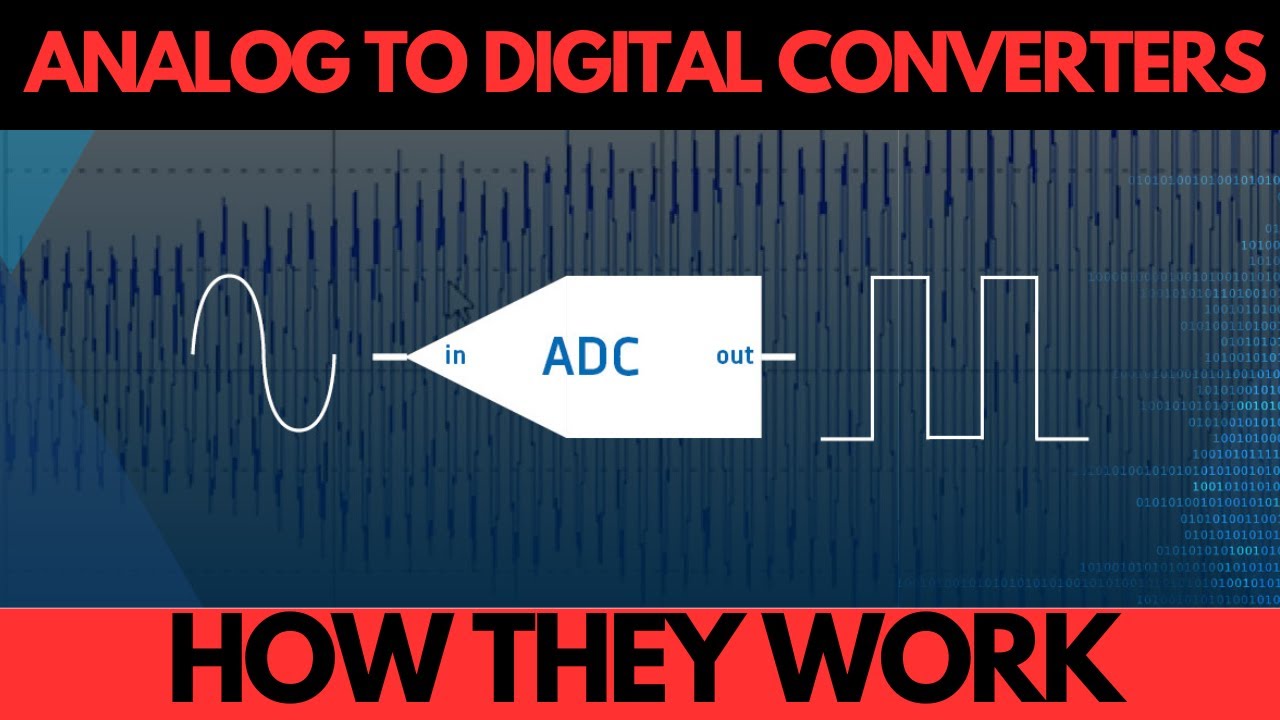
- 😀 ADC (Analog to Digital Converter) converts continuous analog signals into discrete digital signals, making them easier to process, store, and transmit.
- 😀 DAC (Digital to Analog Converter) converts digital signals back into analog signals, enabling devices like speakers to output sound from digital data.
- 😀 Analog signals are more prone to interference (e.g., radio waves, lightning), whereas digital signals are less affected by noise and easier to encrypt and store.
- 😀 The Nyquist theorem states that the sampling rate of an ADC should be at least twice the highest frequency of the analog signal to avoid aliasing errors.
- 😀 Aliasing occurs when the sampling rate is too low, leading to incorrect or distorted signal reconstruction. An anti-aliasing filter can prevent this.
- 😀 Quantization in ADC refers to converting sampled analog values to the nearest digital value, but this process introduces a quantization error.
- 😀 The resolution of an ADC determines how finely it can detect changes in an analog signal. Higher resolution means the ADC can detect smaller changes.
- 😀 The number of bits in an ADC (e.g., 3-bit, 8-bit) determines its resolution. More bits provide higher resolution but reduce the full-scale range.
- 😀 DACs, such as the weighted resistor DAC and R2R ladder DAC, convert binary digital values into corresponding analog voltages, with the resolution determined by the number of bits.
- 😀 ADCs and DACs are integral components of modern electronic devices like smartphones, audio/video systems, and communication gadgets, enabling the conversion of real-world signals into digital form and vice versa.
Q & A
What is the primary function of an ADC (Analog to Digital Converter)?
-The primary function of an ADC is to convert analog signals, which are continuous, into digital signals, which are discrete. This conversion is necessary for processing and storing data in digital systems.
Why are digital signals preferred over analog signals in modern electronic systems?
-Digital signals are preferred because they are less susceptible to noise and interference, easier to store, encrypt, and compress, and more efficient for processing. Analog signals are prone to errors and interference, making them less reliable in communication systems.
What are the main types of ADC circuits?
-The main types of ADC circuits include Successive Approximation ADC, Flash ADC, Delta-Sigma ADC, and more. These types vary in terms of speed, accuracy, and complexity.
How does a DAC (Digital to Analog Converter) work?
-A DAC converts digital signals into analog signals. It uses a weighted resistor or R2R ladder circuit to generate corresponding analog voltages from binary input values. The digital input determines the output voltage by summing up the weighted contributions of each bit.
What is the role of sampling in the ADC process?
-Sampling in ADC involves taking discrete snapshots of an analog signal at specific time intervals. The number of samples taken per second is called the sampling rate, which determines how accurately the analog signal is represented in digital form.
What is the Nyquist theorem, and why is it important in ADC?
-The Nyquist theorem states that an analog signal must be sampled at a rate that is at least twice the maximum frequency of the signal to avoid data loss. This ensures that the sampled signal accurately represents the original signal without distortion or aliasing.
What is aliasing, and how can it be prevented during ADC?
-Aliasing occurs when the sampling rate is too low to accurately capture the details of the signal, causing distortion. It can be prevented by following the Nyquist theorem, ensuring the sampling rate is at least twice the maximum frequency of the signal. Additionally, an anti-aliasing filter can be used to remove high-frequency components before sampling.
What is quantization in the ADC process, and how does it affect the accuracy of conversion?
-Quantization is the process of mapping continuous sampled values to discrete levels during ADC. The accuracy of conversion is affected by the number of discrete levels (or bits) used in the quantization process. A higher number of bits reduces quantization error and improves resolution.
How does increasing the number of bits in an ADC improve its resolution?
-Increasing the number of bits in an ADC increases the number of discrete levels it can represent, which reduces the minimum detectable change in input voltage. This results in higher resolution and more accurate representation of the analog signal.
What are the common applications of ADCs and DACs?
-ADCs and DACs are used in various applications, including smartphones, audio-video devices, control systems, digital printers, and measuring instruments. They play a critical role in converting real-world analog signals into digital format for processing and vice versa.
Outlines

This section is available to paid users only. Please upgrade to access this part.
Upgrade NowMindmap

This section is available to paid users only. Please upgrade to access this part.
Upgrade NowKeywords

This section is available to paid users only. Please upgrade to access this part.
Upgrade NowHighlights

This section is available to paid users only. Please upgrade to access this part.
Upgrade NowTranscripts

This section is available to paid users only. Please upgrade to access this part.
Upgrade Now




5.0 / 5 (0 votes)
