TRIGONOMETRI PART 1: DEFINISI, SUDUT, KUADRAN
Summary
TLDRThis video provides a comprehensive guide to trigonometry, covering fundamental concepts, definitions, and practical applications. It explains sine, cosine, and tangent functions, along with their reciprocals, and introduces key identities like sin²θ + cos²θ = 1. The tutorial demonstrates how to calculate values for right-angled triangles, convert between degrees and radians, and use special angles (0°, 30°, 45°, 60°, 90°). It also explores quadrant-based sign rules, methods for evaluating angles beyond the first quadrant using 180° ± x and 90° ± x formulas, and practical tips for handling trigonometric expressions, making it an essential foundation for learners.
Takeaways
- 😀 Trigonometry is fundamentally the study of ratios between the sides of a right-angled triangle, with sine (sin), cosine (cos), and tangent (tan) defined as opposite/hypotenuse, adjacent/hypotenuse, and opposite/adjacent respectively.
- 😀 In a Cartesian coordinate system, a triangle's opposite side is y, adjacent side is x, and hypotenuse is r; thus sin θ = y/r, cos θ = x/r, and tan θ = y/x.
- 😀 Tangent can also be expressed as the ratio of sine to cosine: tan θ = sin θ / cos θ.
- 😀 The Pythagorean identity holds for all angles in right triangles: sin²θ + cos²θ = 1.
- 😀 Reciprocal trigonometric functions include cosecant (csc = 1/sin), secant (sec = 1/cos), and cotangent (cot = 1/tan).
- 😀 For any right triangle, the complementary angle relationship applies: cos(90° - θ) = sin θ and sin(90° - θ) = cos θ; similarly, tan θ = cot(90° - θ).
- 😀 Angles can be measured in degrees or radians, with the conversion formulas: radians = degrees × π / 180 and degrees = radians × 180 / π.
- 😀 Special angles 0°, 30°, 45°, 60°, and 90° have standard, easily memorizable trigonometric values that can be used directly for calculations.
- 😀 Understanding quadrants is crucial: Quadrant I (all positive), Quadrant II (sin positive), Quadrant III (tan positive), Quadrant IV (cos positive); this helps determine the sign of trigonometric functions for angles beyond 90°.
- 😀 Angles can be expressed using 180° ± x or 360° − x formulas to find their sine, cosine, or tangent values based on quadrant, and using 90° ± x formulas to convert between sin, cos, tan, and their co-functions.
- 😀 For practical calculations of trigonometric values beyond special angles, using 180° ± x is recommended for simplicity, while 90° ± x is useful for converting between trigonometric functions in expressions.
- 😀 Mastery of these basic definitions, relationships, quadrants, and conversion techniques forms the foundation for solving more advanced trigonometric problems, including equations and applications.
Q & A
What is the basic definition of trigonometry?
-Trigonometry is the study of the relationships between the sides and angles of triangles, particularly right-angled triangles. It primarily involves the ratios of the sides, like sine, cosine, and tangent.
How are sine, cosine, and tangent defined in a right triangle?
-In a right triangle, the sine of an angle (sin θ) is the ratio of the length of the opposite side to the hypotenuse, cosine (cos θ) is the ratio of the adjacent side to the hypotenuse, and tangent (tan θ) is the ratio of the opposite side to the adjacent side.
What is the Pythagorean identity in trigonometry?
-The Pythagorean identity states that for any angle θ in a right triangle, the sum of the squares of sine and cosine equals 1: sin²(θ) + cos²(θ) = 1.
How can sine, cosine, and tangent be expressed on the unit circle?
-On the unit circle, sine (sin θ) is equal to the y-coordinate, cosine (cos θ) is equal to the x-coordinate, and tangent (tan θ) is equal to y/x, where r (radius) is 1.
What are the reciprocal trigonometric functions and how are they defined?
-The reciprocal trigonometric functions are cosecant (csc), secant (sec), and cotangent (cot). Cosecant is the reciprocal of sine (1/sin θ), secant is the reciprocal of cosine (1/cos θ), and cotangent is the reciprocal of tangent (1/tan θ).
How does the value of trigonometric functions change in different quadrants?
-In the unit circle, the sign of the trigonometric functions changes depending on the quadrant. In Quadrant I, all functions are positive; in Quadrant II, only sine is positive; in Quadrant III, only tangent is positive; and in Quadrant IV, only cosine is positive.
What is the relationship between degrees and radians?
-Degrees and radians are two units used to measure angles. One full circle is 360 degrees, which is equivalent to 2π radians. To convert degrees to radians, multiply by π/180. To convert radians to degrees, multiply by 180/π.
How do you calculate trigonometric values for angles outside the special angles (0°, 30°, 45°, 60°, 90°)?
-For angles outside the special angles, use quadrant identities or express the angle as a sum or difference of special angles. For example, sin(135°) can be rewritten as sin(180° - 45°), using the property that sin(180° - x) = sin(x).
What are 'special angles' in trigonometry and why are they important?
-Special angles, such as 0°, 30°, 45°, 60°, and 90°, are important because their sine, cosine, and tangent values are easy to memorize. These angles often simplify calculations and form the basis for more complex angle evaluations.
What is the advantage of using the identities involving 90° and 180° in trigonometric calculations?
-Using identities like sin(90° + x) = cos(x) and cos(180° - x) = -cos(x) simplifies the process of calculating trigonometric values for angles that are not part of the special angles. These identities help express more complex angles in terms of known values.
Outlines

Этот раздел доступен только подписчикам платных тарифов. Пожалуйста, перейдите на платный тариф для доступа.
Перейти на платный тарифMindmap

Этот раздел доступен только подписчикам платных тарифов. Пожалуйста, перейдите на платный тариф для доступа.
Перейти на платный тарифKeywords

Этот раздел доступен только подписчикам платных тарифов. Пожалуйста, перейдите на платный тариф для доступа.
Перейти на платный тарифHighlights

Этот раздел доступен только подписчикам платных тарифов. Пожалуйста, перейдите на платный тариф для доступа.
Перейти на платный тарифTranscripts

Этот раздел доступен только подписчикам платных тарифов. Пожалуйста, перейдите на платный тариф для доступа.
Перейти на платный тарифПосмотреть больше похожих видео
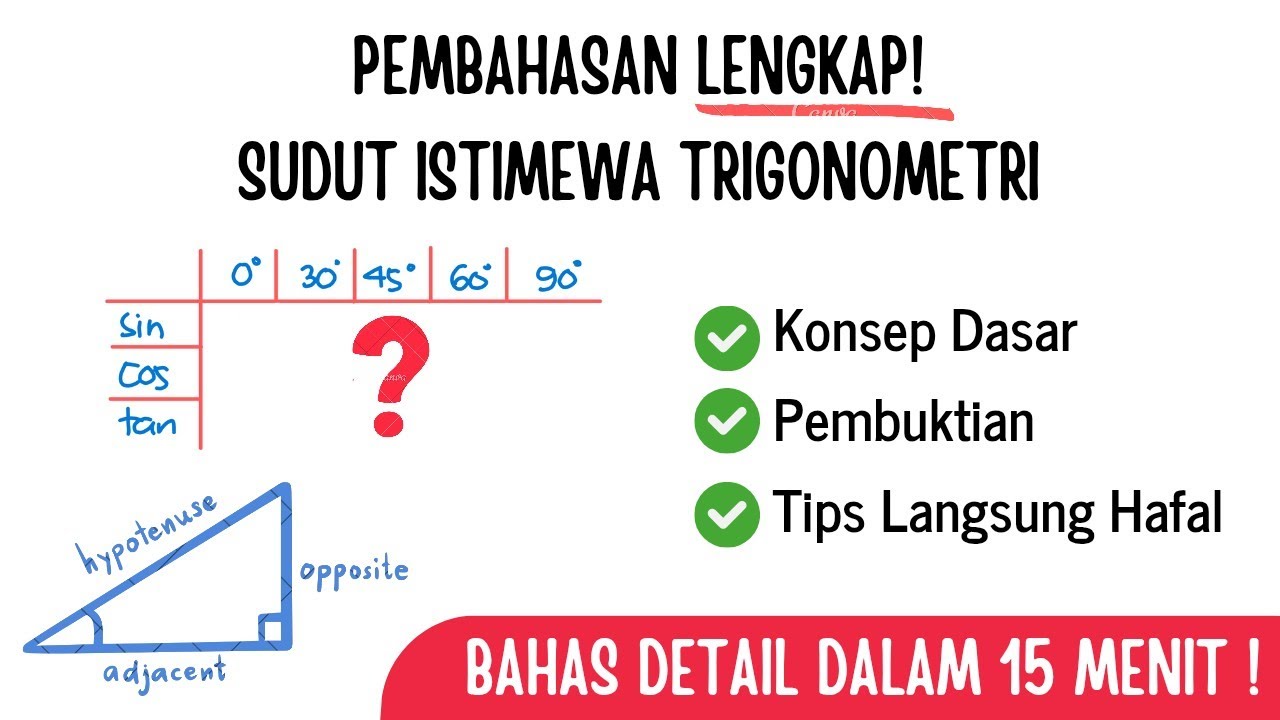
BAHAS LENGKAP SUDUT ISTIMEWA TRIGONOMETRI DALAM 15 MENIT!
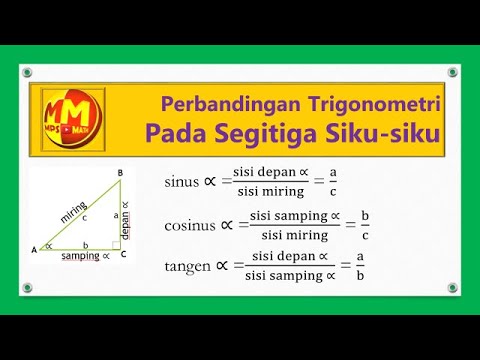
Perbandingan Trigonometri Pada Segitiga SIku-siku #Trigonometri
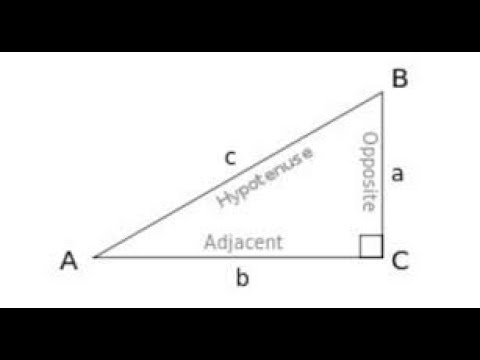
Materi Trigonometri
Electrolysis: All you need to know for the GCSE

Pertumbuhan dan Pembangunan Ekonomi 1 - Pengertian, Teori, dan Menghitung Pertumbuhan Ekonomi
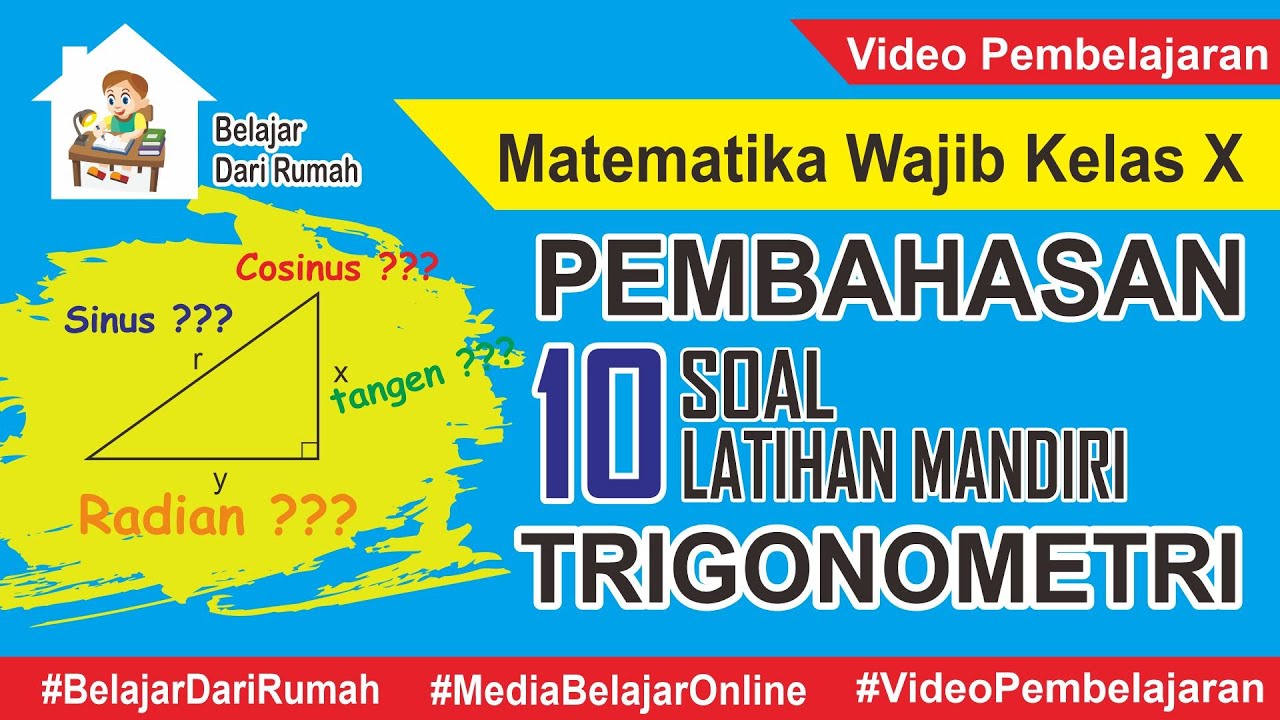
Pembahasan Soal Latihan Mandiri Trigonometri Dasar Matematika Wajib Kelas X
5.0 / 5 (0 votes)

