BAHAS LENGKAP SUDUT ISTIMEWA TRIGONOMETRI DALAM 15 MENIT!
Summary
TLDRThis video provides a comprehensive guide to special angles in trigonometry, covering 0°, 30°, 45°, 60°, and 90°. It explains the fundamental definitions of sine, cosine, and tangent using right-angled triangles, detailing how each function is derived and their interrelationships, such as tan θ = sin θ / cos θ. The tutorial demonstrates calculating values through examples with specific triangles and introduces a practical method for memorizing these key trigonometric values. By combining visual reasoning, step-by-step derivations, and tips for easy recall, the video simplifies understanding trigonometry, making it less intimidating and more accessible for learners.
Takeaways
- 😀 Trigonometry involves special angles: 0°, 30°, 45°, 60°, and 90°, and functions sin, cos, and tan.
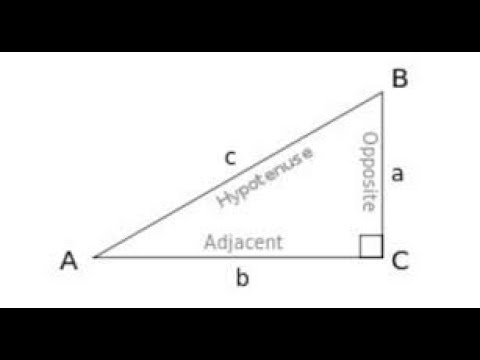
- 😀 In a right triangle, sin θ = opposite/hypotenuse, cos θ = adjacent/hypotenuse, and tan θ = opposite/adjacent.
- 😀 The relationship tan θ = sin θ / cos θ can simplify calculations and help understand the functions.
- 😀 Using a triangle with sides 3, 4, 5, we can compute sin, cos, and tan as practical examples.
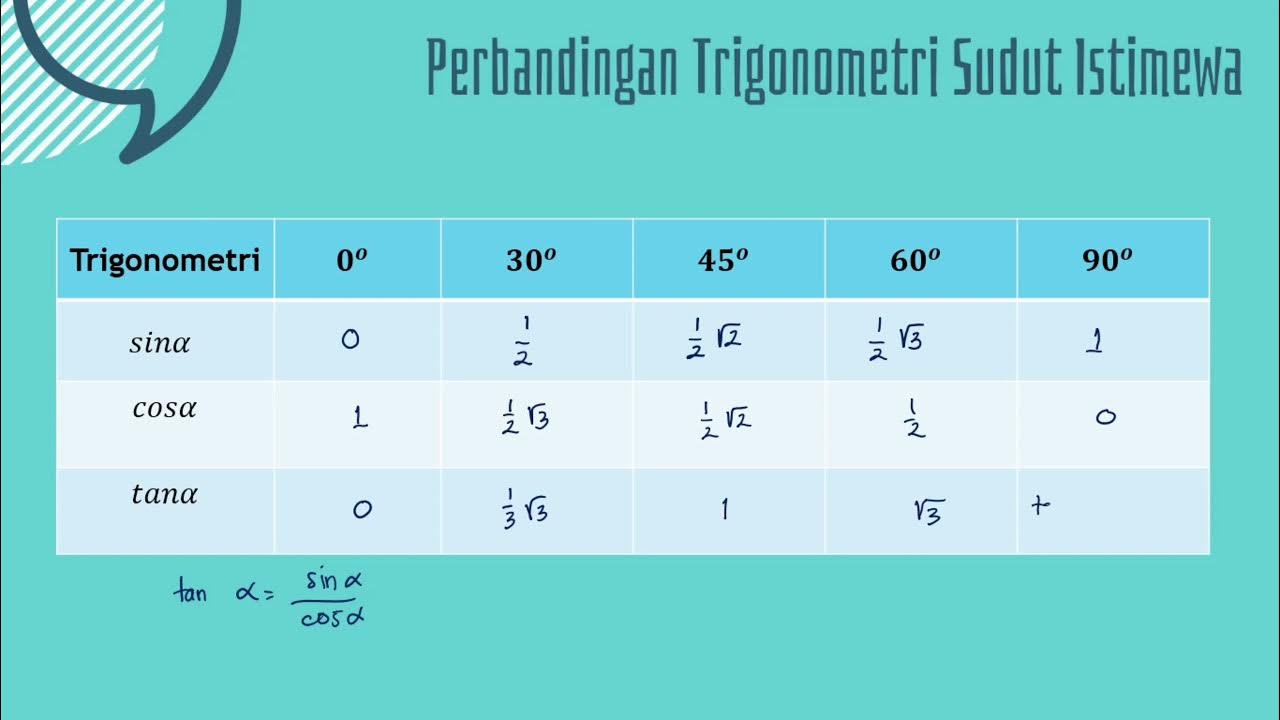
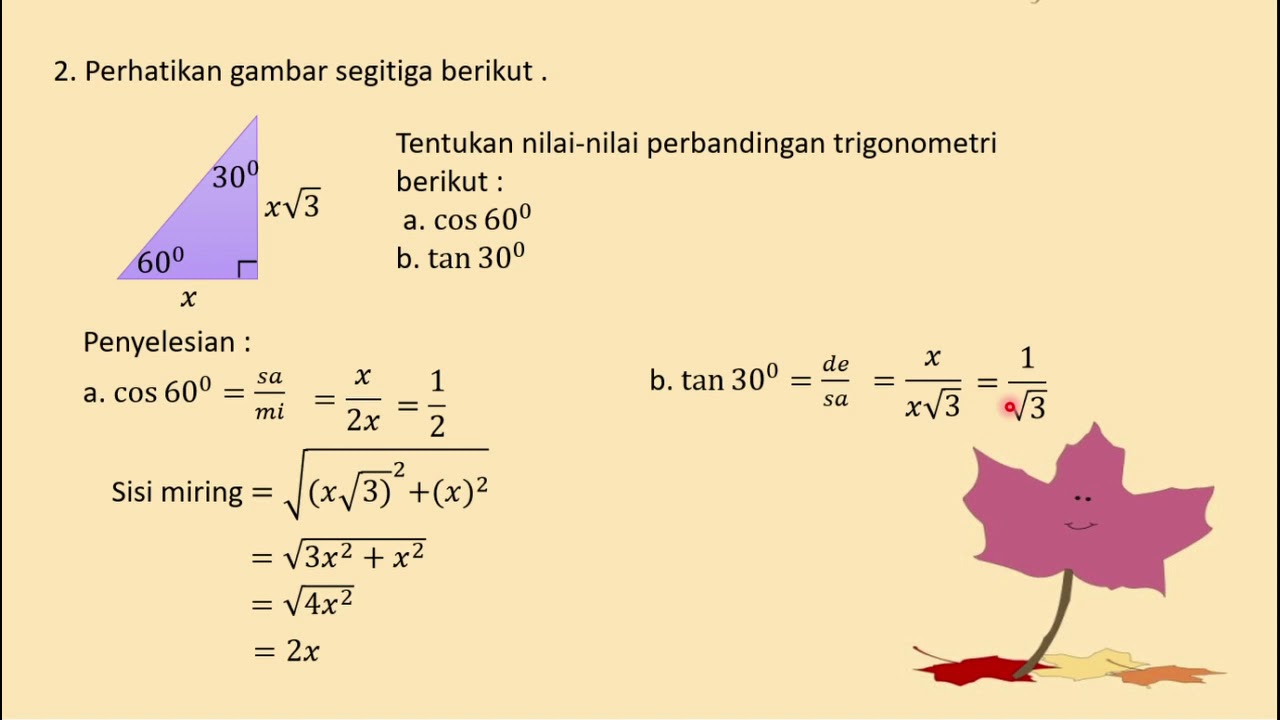
- 😀 For 30° and 60°, a split equilateral triangle provides values: sin 30° = 1/2, cos 30° = √3/2, tan 30° = 1/√3; sin 60° = √3/2, cos 60° = 1/2, tan 60° = √3.
- 😀 For 45°, a right isosceles triangle gives: sin 45° = cos 45° = 1/√2, tan 45° = 1.
- 😀 At 0°: sin 0° = 0, cos 0° = 1, tan 0° = 0; at 90°: sin 90° = 1, cos 90° = 0, tan 90° is undefined.
- 😀 Special angles can be memorized by observing patterns in sin and cos: sin increases from 0 to 1, cos decreases from 1 to 0.
- 😀 Tan values are obtained by dividing sin by cos, noting that tan 90° is undefined due to division by zero.
- 😀 Practicing problems regularly is the most effective method to memorize and understand special angle values in trigonometry.
Q & A
What are the special angles in trigonometry discussed in the video?
-The special angles discussed are 0°, 30°, 45°, 60°, and 90°.
How is sine (sin) defined for a right-angled triangle?
-Sine of an angle θ is defined as the length of the side opposite the angle divided by the hypotenuse: sin θ = opposite / hypotenuse.
How is cosine (cos) defined for a right-angled triangle?
-Cosine of an angle θ is defined as the length of the side adjacent to the angle divided by the hypotenuse: cos θ = adjacent / hypotenuse.
How is tangent (tan) defined and how is it related to sine and cosine?
-Tangent of an angle θ is defined as the length of the side opposite divided by the side adjacent: tan θ = opposite / adjacent. It is also related to sine and cosine as tan θ = sin θ / cos θ.
What are the sine, cosine, and tangent values for a 30° angle?
-For 30°: sin 30° = 1/2, cos 30° = √3/2, tan 30° = 1/√3.
What are the sine, cosine, and tangent values for a 45° angle?
-For 45°: sin 45° = 1/√2, cos 45° = 1/√2, tan 45° = 1.
What are the sine, cosine, and tangent values for a 60° angle?
-For 60°: sin 60° = √3/2, cos 60° = 1/2, tan 60° = √3.
How do you determine sin, cos, and tan for 0° and 90° angles?
-For 0°: sin 0° = 0, cos 0° = 1, tan 0° = 0. For 90°: sin 90° = 1, cos 90° = 0, tan 90° is undefined because it involves division by zero.
What is the purpose of using a triangle with sides 3, 4, 5 in the video?
-The 3-4-5 triangle is used as a simple example to illustrate how to calculate sin, cos, and tan using the triangle side lengths.
What technique is suggested to quickly memorize the sine and cosine values of special angles?
-A suggested technique is to write sin θ as 1/2√n with n = 0, 1, 2, 3, 4 and cos θ as the reverse sequence. Then, calculate tan θ using tan θ = sin θ / cos θ.
Why is practice emphasized as the best way to remember special angle values?
-Practice is emphasized because repeatedly solving problems helps reinforce memory, making it easier to recall sine, cosine, and tangent values naturally without relying solely on memorization tricks.
How is a 30°-60°-90° triangle derived from an equilateral triangle?
-By dividing an equilateral triangle in half along its height, a 30°-60°-90° right triangle is formed, where the shorter side is half the base, the height is √3/2 of the side, and the hypotenuse is the original side length.
Outlines

Cette section est réservée aux utilisateurs payants. Améliorez votre compte pour accéder à cette section.
Améliorer maintenantMindmap

Cette section est réservée aux utilisateurs payants. Améliorez votre compte pour accéder à cette section.
Améliorer maintenantKeywords

Cette section est réservée aux utilisateurs payants. Améliorez votre compte pour accéder à cette section.
Améliorer maintenantHighlights

Cette section est réservée aux utilisateurs payants. Améliorez votre compte pour accéder à cette section.
Améliorer maintenantTranscripts

Cette section est réservée aux utilisateurs payants. Améliorez votre compte pour accéder à cette section.
Améliorer maintenantVoir Plus de Vidéos Connexes


5.0 / 5 (0 votes)

