How Shift Registers Work - The Learning Circuit
Summary
TLDRThis video introduces shift registers, a key component in electronics for expanding input/output (I/O) capabilities. Shift registers are sequential logic devices built from flip-flops and latches that can store multiple bits of data and transfer them to different outputs. The video explains how shift registers work, their various modes of operation (serial-in parallel-out, parallel-in serial-out, etc.), and how they can be used to add more I/O to projects like those using microcontrollers. It also explores the clock pulse mechanism, enable pins, and how to chain multiple shift registers together for larger applications.
Takeaways
- 😀 Shift registers are devices that store and transfer data between multiple inputs and outputs in a sequential manner.
- 😀 A shift register is made up of flip-flops and latches, which are logic devices that hold one bit of data each.
- 😀 Data in a shift register can be processed either in series (one bit at a time) or in parallel (multiple bits at once).
- 😀 The number of bits a shift register can process depends on how many flip-flops or stages it contains (e.g., 4-bit, 8-bit, or 12-bit).
- 😀 Shift registers require a clock signal to change outputs, making them sequential devices that rely on clock pulses to transfer data.
- 😀 The clock pulse in a shift register ensures that data moves from one flip-flop to the next in synchronization with the clock's edges.
- 😀 Shift registers can operate in four modes: Series-In Parallel-Out, Series-In Series-Out, Parallel-In Series-Out, and Parallel-In Parallel-Out.
- 😀 In the Series-In Parallel-Out mode, data enters one bit at a time but exits across multiple outputs simultaneously.
- 😀 Some shift registers have additional control pins like 'enable' pins that help control the shifting and output of data selectively.
- 😀 Shift registers can be stacked together by connecting the output of one to the input of another, expanding the number of I/O pins for a project.
- 😀 The use of multiple clock pins, like in certain shift registers, allows for independent control over input data shifting and output data storage.
Q & A
What is a shift register and why is it useful in electronics projects?
-A shift register is a sequential logic device that stores and shifts data bits across multiple stages, typically made up of flip-flops. It's useful in electronics projects when more inputs or outputs are needed than a microcontroller can directly handle, allowing data to be moved efficiently between devices.
What are the key components inside a shift register?
-A shift register is made up of flip-flops and latches, which are memory elements that store one bit of data each. The flip-flops are triggered by a clock signal and store data which shifts from one stage to the next with each pulse.
How does a flip-flop work in the context of a shift register?
-A flip-flop stores a single bit of data (either 0 or 1). It has two main inputs: 'set' (which sets the output to 1) and 'reset' (which sets it to 0). The state of the flip-flop only changes on the rising edge of the clock signal.
What is the difference between a latch and a flip-flop?
-The primary difference between a latch and a flip-flop is that a latch is level-triggered, meaning it changes its state when the enable signal is active. A flip-flop, on the other hand, is edge-triggered, meaning it changes its state only on the rising or falling edge of a clock pulse.
What are the different modes of operation for shift registers?
-Shift registers have four main modes of operation: Serial-In Parallel-Out (SIPO), Serial-In Serial-Out (SISO), Parallel-In Serial-Out (PISO), and Parallel-In Parallel-Out (PIPO). Each mode determines how data is input and output through the register.
What is the function of the clock signal in a shift register?
-The clock signal controls when the data stored in the flip-flops of the shift register changes. Each flip-flop only updates its output on the rising edge of the clock signal, ensuring data shifts sequentially from one stage to the next.
What is the significance of the enable pins in a shift register?
-Enable pins in a shift register control whether data is allowed to shift through the register. These pins can selectively enable certain inputs, allowing data to shift in a specific direction or to disable the inputs entirely, preventing data from being transferred.
How do shift registers allow for expanding the number of inputs and outputs in a project?
-Shift registers allow you to connect multiple chips in series, with the output of one shift register feeding into the input of another. This enables you to increase the number of inputs and outputs in a project without using additional microcontroller pins.
What is the role of the 'reset' or 'clear' pin in a shift register?
-The reset or clear pin in a shift register, when activated, resets all the outputs to a low state (0). This ensures that the data in the register is cleared and the outputs are set to a known state.
How do serial and parallel data transfer modes differ in a shift register?
-In serial mode, data is input or output one bit at a time (SISO or SIPO), requiring fewer connections. In parallel mode, multiple bits are transferred simultaneously (PIPO or PISO), requiring more input and output pins but allowing faster data handling.
Outlines

Cette section est réservée aux utilisateurs payants. Améliorez votre compte pour accéder à cette section.
Améliorer maintenantMindmap

Cette section est réservée aux utilisateurs payants. Améliorez votre compte pour accéder à cette section.
Améliorer maintenantKeywords

Cette section est réservée aux utilisateurs payants. Améliorez votre compte pour accéder à cette section.
Améliorer maintenantHighlights

Cette section est réservée aux utilisateurs payants. Améliorez votre compte pour accéder à cette section.
Améliorer maintenantTranscripts

Cette section est réservée aux utilisateurs payants. Améliorez votre compte pour accéder à cette section.
Améliorer maintenantVoir Plus de Vidéos Connexes
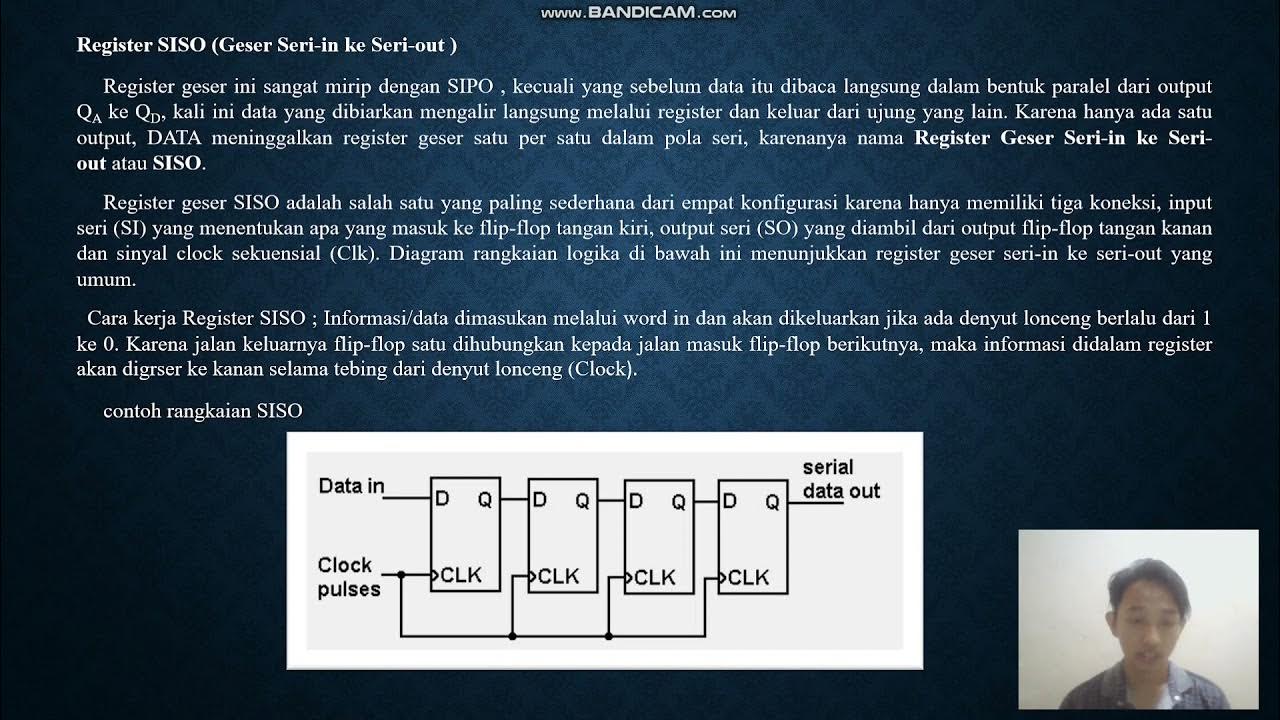
Mengenal Register Siso ,Sipo,Piso ,Pipo

L-4.1 I/O Interface | Input Output Interface | I/O Commands | Computer Architecture | COA | CSA

Introduction to Registers | What is Shift Register? Types of Shift Registers

Shift Register : Serial In Serial Out (SISO) Register Explained | Bidirectional Shift Register

L-1.8: Data Transfer Instructions in Computer Organisation and Architecture

Introduction to Sequential Circuits | Important
5.0 / 5 (0 votes)

