Mengenal Register Siso ,Sipo,Piso ,Pipo
Summary
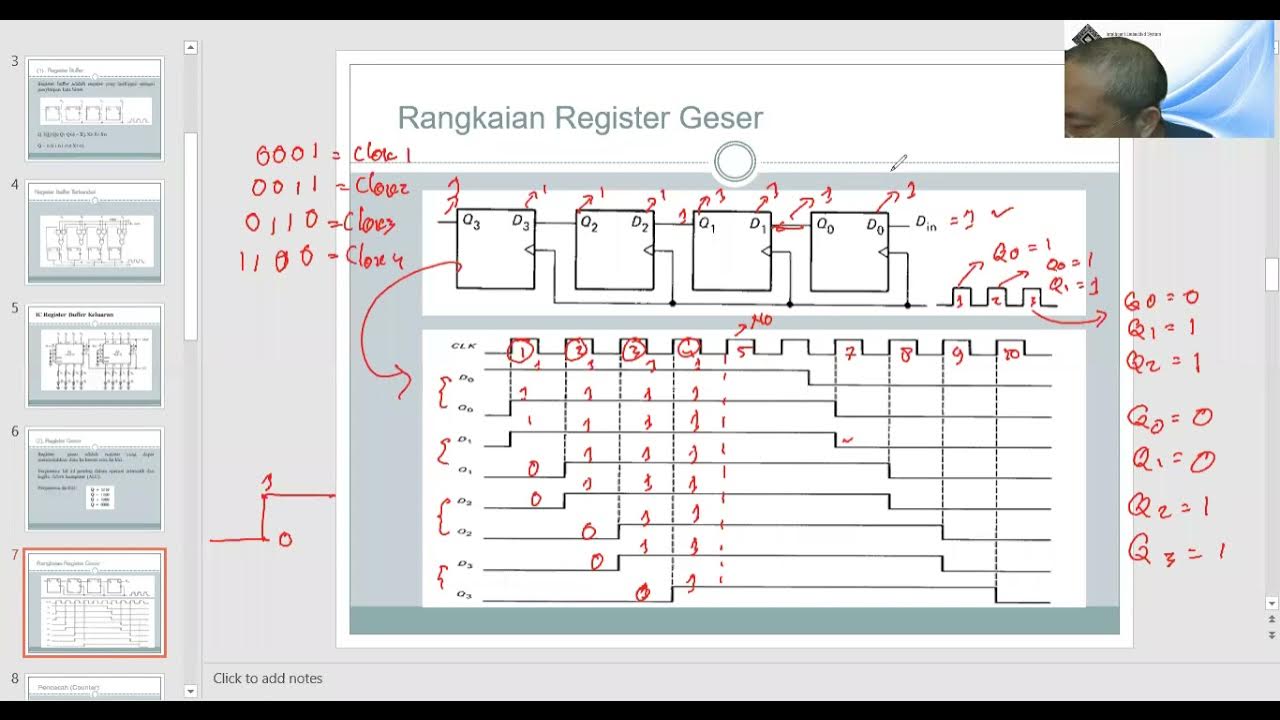
TLDRThis video script explains the concept and functionality of shift registers, focusing on various types like serial input/output, parallel input/output, and their configurations. The script elaborates on how data is shifted, either serially or in parallel, and how different registers work with clock pulses and logic gates to store and output data. Various examples of shift register circuits are provided, demonstrating their applications in data transformation and storage, and how they can be utilized in digital systems for parallel or serial data handling. The script concludes with an overview of different shift register types and their operations.
Takeaways
- 😀 Registers are devices that allow information to shift between flip-flops in response to clock pulses.
- 😀 A shift register can move data either serially or parallel, depending on the configuration.
- 😀 Four main types of shift registers: SISO (Serial Input, Serial Output), SIPO (Serial Input, Parallel Output), PISO (Parallel Input, Serial Output), and PIPO (Parallel Input, Parallel Output).
- 😀 SISO registers move data serially in and out, shifting bit by bit with each clock pulse.
- 😀 SIPO registers take serial data and output it in parallel form after being shifted in.
- 😀 PISO registers take parallel data and shift it out serially, one bit at a time.
- 😀 PIPO registers handle data entry and output in parallel, using flip-flops for simultaneous processing of bits.
- 😀 Shift registers can be implemented using flip-flops, with data flowing through them based on clock pulses.
- 😀 The data in shift registers can be controlled using set/reset inputs to manage data entry and exit.
- 😀 Shift registers are useful in various applications where data needs to be converted from serial to parallel or vice versa.
Q & A
What is a register in digital electronics?
-A register in digital electronics is a storage element that holds data and allows for the shifting of that data across flip-flops, either to the left or right, based on clock pulses.
What are the four types of registers mentioned in the transcript?
-The four types of registers are: Serial Input / Serial Output (SISO), Serial Input / Parallel Output (SIPO), Parallel Input / Serial Output (PISO), and Parallel Input / Parallel Output (PIPO).
How does a Serial Input / Serial Output (SISO) register work?
-In a SISO register, data is entered and exited one bit at a time, moving sequentially through the flip-flops, controlled by clock pulses.
What distinguishes a Serial Input / Parallel Output (SIPO) register from others?
-A SIPO register accepts data serially (one bit at a time) but outputs data in parallel, all at once, once the register is filled.
What is the purpose of a Parallel Input / Serial Output (PISO) register?
-A PISO register allows data to enter in parallel but outputs the data serially, typically used in systems that convert parallel data to serial format.
How does a Parallel Input / Parallel Output (PIPO) register function?
-A PIPO register allows both input and output of data to occur in parallel, meaning multiple bits are entered and exited simultaneously.
What is the role of the clock signal in a shift register?
-The clock signal controls the shifting of data within a shift register, determining when the data should move between flip-flops, either serially or in parallel, depending on the register type.
What is the significance of the set and reset functions in shift registers?
-The set and reset functions in shift registers are used to initialize the register (setting all values to zero) and control the behavior of the flip-flops, ensuring data is correctly loaded or cleared as needed.
What does the term 'serially' mean in the context of shift registers?
-'Serially' means that data is processed bit by bit, with each bit entering or exiting one after another in a sequence, unlike parallel processing where multiple bits are handled at once.
How is data managed in a shift register when a clock pulse is provided?
-When a clock pulse is provided, data is shifted within the register either left or right, moving through the flip-flops based on the configuration of the register (serial or parallel). This process continues with each clock pulse until all bits have been processed or outputted.
Outlines

This section is available to paid users only. Please upgrade to access this part.
Upgrade NowMindmap

This section is available to paid users only. Please upgrade to access this part.
Upgrade NowKeywords

This section is available to paid users only. Please upgrade to access this part.
Upgrade NowHighlights

This section is available to paid users only. Please upgrade to access this part.
Upgrade NowTranscripts

This section is available to paid users only. Please upgrade to access this part.
Upgrade NowBrowse More Related Video





5.0 / 5 (0 votes)
