Chi-Square Test [Simply explained]
Summary
TLDRThis video provides a clear and accessible explanation of the chi-square test, a statistical method used to determine if a relationship exists between two categorical variables. It introduces categorical variables, offers practical examples like gender and education level, and demonstrates how to create a survey and organize data in a cross table. The tutorial covers both using statistical software (DataTab) for automatic calculation and performing the chi-square test by hand, including calculating observed and expected frequencies, the chi-square value, and comparing it with the critical value. Viewers gain a step-by-step guide to interpreting results and understanding p-values in context.
Takeaways
- 😀 The chi-square test is a hypothesis test used to determine if there is a relationship between two categorical variables.
- 😀 Categorical variables are discrete categories, such as gender, preferred newspaper, TV watching frequency, or highest educational level.
- 😀 Non-categorical variables include continuous measurements like weight, salary, or electricity consumption.
- 😀 The chi-square test is appropriate whenever you want to check for a correlation between two categorical variables.
- 😀 Example research questions include relationships between gender and newspaper preference, or TV watching frequency and education level.
- 😀 Data for a chi-square test is collected in a table where each row represents one participant and their responses for the variables of interest.
- 😀 A cross-tabulation (cross table) shows the frequency of each combination of variable categories and is essential for the chi-square test.
- 😀 The chi-square statistic can be calculated either using software like DataTab or manually using the formula χ² = Σ((Oᵢ − Eᵢ)² / Eᵢ).
- 😀 Using software simplifies the process by providing observed frequencies, expected frequencies, chi-square value, and the p-value for easy interpretation.
- 😀 To interpret results: a p-value greater than the significance level (e.g., 0.05) means the null hypothesis is not rejected, indicating no significant relationship between variables.
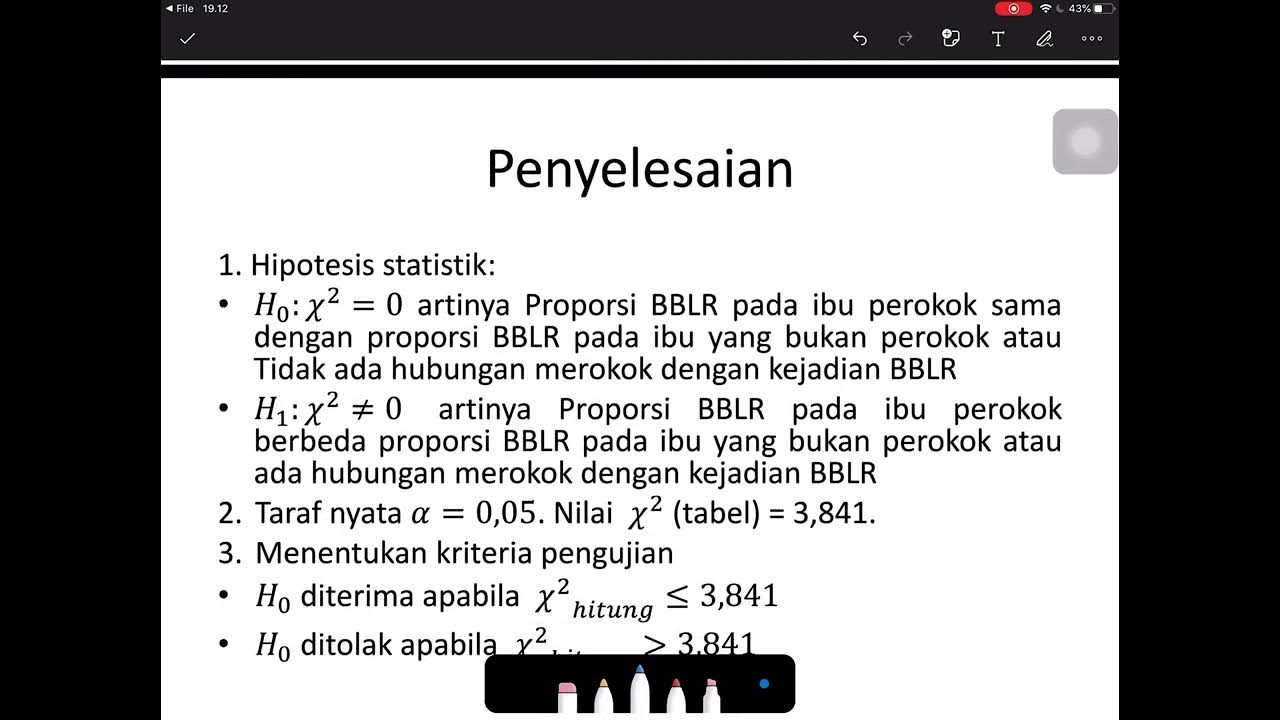
- 😀 Manual calculation involves determining expected frequencies, computing the chi-square value, and comparing it to a critical value from a chi-square distribution table based on degrees of freedom.
- 😀 Understanding categorical vs. continuous variables is crucial for correctly applying the chi-square test and interpreting its results.
Q & A
What is the purpose of the chi-square test?
-The chi-square test is a hypothesis test used to determine whether there is a statistically significant relationship between two categorical variables.
What are categorical variables, and can you give examples?
-Categorical variables are variables that represent distinct categories or groups. Examples include gender (male/female), preferred newspaper (Washington Post, New York Times, USA Today), frequency of television viewing (several times a week, rarely, never), and highest educational level.
Which types of variables are not suitable for a chi-square test?
-Variables that are continuous or numeric, such as weight, salary, or electricity consumption, are not suitable for a chi-square test.
How is survey data organized for a chi-square test?
-Survey data is organized in a table with one participant per row, recording each person's categorical responses. This data is then converted into a cross table showing the frequency of each combination of categories.
What does a cross table display in the context of a chi-square test?
-A cross table shows the observed frequencies of all combinations of the two categorical variables, and it helps to visualize the relationship between them.
How can the chi-square test be calculated using software like DataTab?
-In DataTab, you copy your data into the tool, select the two categorical variables, and the software automatically suggests the chi-square test. It then outputs the cross table, expected frequencies, chi-square statistic, and p-value.
How is the chi-square value calculated by hand?
-The chi-square value is calculated using the formula χ² = Σ((Oᵢ - Eᵢ)² / Eᵢ), where Oᵢ is the observed frequency and Eᵢ is the expected frequency for each cell in the cross table. The values for all cells are summed to get the total chi-square statistic.
How do you determine the expected frequencies for a chi-square test?
-Expected frequencies are calculated under the assumption that the two variables are independent. Each cell’s expected frequency is derived from the row total, column total, and overall total of the table.
How are degrees of freedom calculated for a chi-square test?
-Degrees of freedom (df) are calculated using the formula df = (number of rows − 1) × (number of columns − 1).
How do you interpret the chi-square test results?
-If the chi-square statistic is smaller than the critical value from the chi-square table, or if the p-value is greater than the chosen significance level (e.g., 0.05), the null hypothesis is not rejected, indicating no significant relationship between the variables. Conversely, a larger chi-square statistic or smaller p-value indicates a significant relationship.
What is the role of the significance level in a chi-square test?
-The significance level (commonly 5%) sets the threshold for determining whether the results are statistically significant. A p-value below this threshold indicates rejection of the null hypothesis, while a p-value above indicates failure to reject it.
Why is calculating the p-value by hand not feasible?
-Calculating the exact p-value by hand is impractical because it requires complex probability distributions. Instead, the chi-square statistic is compared to a critical value from a chi-square distribution table.
Outlines

Esta sección está disponible solo para usuarios con suscripción. Por favor, mejora tu plan para acceder a esta parte.
Mejorar ahoraMindmap

Esta sección está disponible solo para usuarios con suscripción. Por favor, mejora tu plan para acceder a esta parte.
Mejorar ahoraKeywords

Esta sección está disponible solo para usuarios con suscripción. Por favor, mejora tu plan para acceder a esta parte.
Mejorar ahoraHighlights

Esta sección está disponible solo para usuarios con suscripción. Por favor, mejora tu plan para acceder a esta parte.
Mejorar ahoraTranscripts

Esta sección está disponible solo para usuarios con suscripción. Por favor, mejora tu plan para acceder a esta parte.
Mejorar ahoraVer Más Videos Relacionados





5.0 / 5 (0 votes)

