CARA MENENTUKAN MEAN, MEDIAN, DAN MODUS DATA KELOMPOK
Summary
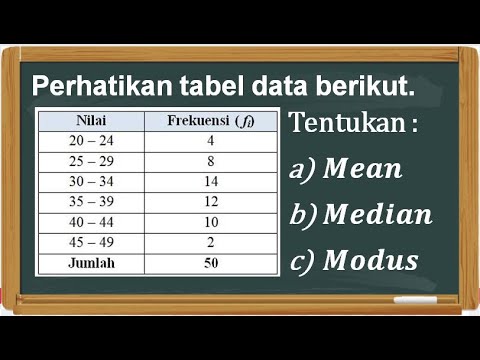
TLDRIn this tutorial, Kak Nunu teaches how to calculate the mean, median, and mode for grouped data using frequency tables. The lesson begins by explaining the formula for the mean, followed by steps to calculate the median using cumulative frequencies. Finally, it covers the method for finding the mode by identifying the modal class and applying the formula. Through clear examples and step-by-step instructions, the tutorial simplifies these key statistical concepts, making them accessible for students. The explanation is easy to follow, with practical examples to ensure understanding.
Takeaways
- 😀 Mean (Min) of grouped data is calculated using the formula: X̄ = Σ(Fi * Xi) / ΣFi, where Fi is the frequency and Xi is the midpoint of each class.
- 😀 The midpoint of each class is determined by averaging the lower and upper boundaries of the class (e.g., for class 34-38, midpoint = (34+38)/2 = 36).
- 😀 The mean is calculated by multiplying the frequency of each class by its midpoint, summing these products, and dividing by the total frequency.
- 😀 The formula for calculating the median of grouped data is: Median = TB + ((n/2 - FK) / Fi) * P, where TB is the lower boundary of the median class, n is the total number of data, and P is the class width.
- 😀 To find the median class, first calculate the cumulative frequency and locate the class where the cumulative frequency exceeds n/2.
- 😀 The median calculation involves identifying the cumulative frequency before the median class (FK), then applying the formula to find the exact median value.
- 😀 The mode of grouped data is calculated using the formula: Mode = TB + (D1 / (D1 + D2)) * P, where D1 is the difference between the frequency of the mode class and the class before it, and D2 is the difference with the class after it.
- 😀 The mode is always found by identifying the class with the highest frequency, called the mode class.
- 😀 The formula for calculating the mode involves using the differences in frequency (D1 and D2) and the class width (P).
- 😀 Understanding and calculating the mean, median, and mode for grouped data is crucial in statistical analysis, as they provide insights into the central tendency of data.
Q & A
What is the formula for calculating the mean (average) in grouped data?
-The formula for calculating the mean is: x̄ = Σ (fᵢ * xᵢ) / Σ fᵢ, where fᵢ is the frequency of each class, xᵢ is the midpoint of each class, and Σ fᵢ is the sum of all frequencies.
How do you determine the midpoint (xᵢ) of a class in a grouped frequency table?
-To determine the midpoint (xᵢ) of a class, you add the lower boundary and upper boundary of the class and then divide the sum by 2.
What does the Σ (fᵢ * xᵢ) represent in the mean formula?
-Σ (fᵢ * xᵢ) represents the sum of the products of the frequencies (fᵢ) and the midpoints (xᵢ) of each class in the data.
How do you calculate the cumulative frequency in a frequency table?
-To calculate the cumulative frequency, you start with the first frequency and then add the frequency of the next class to the cumulative total, continuing this process for each class.
What is the formula for determining the median in grouped data?
-The formula for calculating the median is: Median = T_b + [(n/2 - F_k) / F_i] * P, where T_b is the lower boundary of the median class, n is the total number of data, F_k is the cumulative frequency before the median class, F_i is the frequency of the median class, and P is the class width.
How do you identify the median class in a frequency table?
-To identify the median class, divide the total number of data (n) by 2. The class where this value falls in the cumulative frequency distribution is the median class.
How is the median calculated once the median class is identified?
-Once the median class is identified, apply the median formula: plug in the values for the lower boundary (T_b), cumulative frequency (F_k), frequency (F_i), and class width (P) to calculate the median.
What is the formula for calculating the mode in grouped data?
-The formula for calculating the mode is: Mode = T_b + [(D₁) / (D₁ + D₂)] * P, where T_b is the lower boundary of the modal class, D₁ is the difference between the frequency of the modal class and the frequency of the class before it, D₂ is the difference between the frequency of the modal class and the frequency of the class after it, and P is the class width.
What is the modal class, and how do you identify it?
-The modal class is the class with the highest frequency in the frequency table. It is identified by finding the class with the largest frequency value.
Why is the class width (P) important in the formulas for mean, median, and mode?
-The class width (P) is important because it standardizes the calculation across different classes, ensuring that the midpoint adjustments and differences in frequencies are properly accounted for in the final results.
Outlines

Esta sección está disponible solo para usuarios con suscripción. Por favor, mejora tu plan para acceder a esta parte.
Mejorar ahoraMindmap

Esta sección está disponible solo para usuarios con suscripción. Por favor, mejora tu plan para acceder a esta parte.
Mejorar ahoraKeywords

Esta sección está disponible solo para usuarios con suscripción. Por favor, mejora tu plan para acceder a esta parte.
Mejorar ahoraHighlights

Esta sección está disponible solo para usuarios con suscripción. Por favor, mejora tu plan para acceder a esta parte.
Mejorar ahoraTranscripts

Esta sección está disponible solo para usuarios con suscripción. Por favor, mejora tu plan para acceder a esta parte.
Mejorar ahoraVer Más Videos Relacionados

STATISTIKA CARA MENCARI NILAI MEAN, MEDIAN, MODUS DATA KELOMPOK PART 1
Menentukan Mean, Median, dan Modus Data Kelompok
Ukuran Pemusatan Data Kelompok
Statistika Matematika Kelas X Kurikulum Merdeka
Statistika - Ukuran Pemusatan Data (Mean, Median, Modus)

Measure of Central Tendency of Grouped Data for beginners
5.0 / 5 (0 votes)

