HUKUM KEKEKALAN MASSA ( Antoine Laurent de Lavoisier ) : HUKUM DASAR KIMIA
Summary
TLDRIn this engaging chemistry lesson, Naftalina introduces the fundamental laws of chemistry for 10th-grade students under the Merdeka curriculum, focusing on the Law of Conservation of Mass discovered by Antoine Lavoisier. She explains that in a closed system, the mass of substances remains constant before and after a chemical reaction, illustrated through examples like burning paper and rusting iron. The video includes practical experiments using lead nitrate and potassium iodide, as well as simple home-based activities with Betadine and vitamin C to demonstrate the law in action. Naftalina also provides problem-solving exercises to reinforce understanding, emphasizing careful observation and accurate measurements.
Takeaways
- 😀 The topic of discussion is 'The Law of Conservation of Mass' in Chemistry, part of the 10th-grade curriculum under the Merdeka system.
- 😀 Antoine Lavoisier is introduced as the scientist who proposed the Law of Conservation of Mass.
- 😀 The Law of Conservation of Mass states that in a closed system, the mass of substances before a reaction is equal to the mass after the reaction.
- 😀 The script explores the law through everyday examples like burning paper and rusting iron, where mass appears to change in an open system.
- 😀 A demonstration is provided where two reactants, lead nitrate and potassium iodide, are mixed in a sealed tube, showing that mass remains constant before and after the reaction.
- 😀 A practical experiment is suggested, involving simple materials like a plastic bottle, iodine, and vitamin C to demonstrate mass conservation in a closed system.
- 😀 Burning paper results in a loss of mass, but the law applies only in a closed system, where gases like carbon dioxide cannot escape to the outside.
- 😀 The rusting of iron increases mass, as oxygen from the air combines with iron to form iron oxide, and this process occurs in an open system.
- 😀 The concept of closed systems is emphasized—mass must remain constant in these systems, and any loss or gain in mass outside of a sealed environment is due to escaped particles.
- 😀 The script concludes with a recap of the Law of Conservation of Mass and provides practice problems to test understanding, encouraging the viewers to review and apply the law.
Q & A
Who discovered the Law of Conservation of Mass?
-The Law of Conservation of Mass was discovered by Antoine Laurent de Lavoisier.
What is the main principle of the Law of Conservation of Mass?
-The main principle is that in a closed system, the total mass of substances before a chemical reaction is equal to the total mass after the reaction.
Why does the mass of ash appear lighter than the original paper when burned in an open system?
-Because the reaction produces gases like carbon dioxide that escape into the air, making the remaining solid mass appear lighter.
What happens to the mass of iron when it rusts?
-The mass of iron increases because it reacts with oxygen in the air to form iron oxide, which adds to the total mass of the material.
Why is it important to use a closed system when demonstrating the Law of Conservation of Mass?
-A closed system prevents any particles or gases from escaping, ensuring that the total mass remains constant before and after the reaction.
What visual change indicates that a chemical reaction has occurred in the Pb(NO₃)₂ and KI experiment?
-The formation of a yellow precipitate indicates that a reaction has occurred between Pb(NO₃)₂ and KI.
How can students perform a simple practical demonstration of the Law of Conservation of Mass at home?
-Students can use a small bottle with water, add betadine, and vitamin C in a closed system. They can observe changes like color change while weighing the total mass to see that it remains constant.
In the copper burning example, if the mass of Cu is 32 g and CuO formed is 40 g, what is the mass of O₂ that reacted?
-The mass of O₂ that reacted is 8 g, calculated as 40 g (CuO) - 32 g (Cu) = 8 g.
How does the Law of Conservation of Mass apply to magnesium reacting with oxygen to form MgO?
-The total mass of magnesium and oxygen before the reaction equals the mass of MgO formed after the reaction, demonstrating that mass is conserved.
What are the five main chemical laws introduced in this lesson?
-The five main chemical laws are: 1) Law of Conservation of Mass (Lavoisier), 2) Law of Definite Proportions (Proust), 3) Law of Multiple Proportions (Dalton), 4) Law of Combining Volumes (Gay-Lussac), and 5) Avogadro's Law.
Why might the mass appear to change in reactions that occur in an open system?
-Because gases or particles produced in the reaction can escape from the system, making the measured mass lower or higher than the original.
What should students remember about mass changes and reaction systems?
-Students should remember that mass before and after a reaction is equal only in a closed system. In open systems, escaping gases or interactions with the environment can change the apparent mass.
Outlines

هذا القسم متوفر فقط للمشتركين. يرجى الترقية للوصول إلى هذه الميزة.
قم بالترقية الآنMindmap

هذا القسم متوفر فقط للمشتركين. يرجى الترقية للوصول إلى هذه الميزة.
قم بالترقية الآنKeywords

هذا القسم متوفر فقط للمشتركين. يرجى الترقية للوصول إلى هذه الميزة.
قم بالترقية الآنHighlights

هذا القسم متوفر فقط للمشتركين. يرجى الترقية للوصول إلى هذه الميزة.
قم بالترقية الآنTranscripts

هذا القسم متوفر فقط للمشتركين. يرجى الترقية للوصول إلى هذه الميزة.
قم بالترقية الآنتصفح المزيد من مقاطع الفيديو ذات الصلة

Praktikum Konsep Mol (Hukum Kekekalan Massa)

Hukum-Hukum Dasar Kimia - Hukum Kekekalan Massa (Lavoisier)
Hukum Lavoisier (Hukum Kekekalan Massa) | Kimia SMA | Tetty Afianti
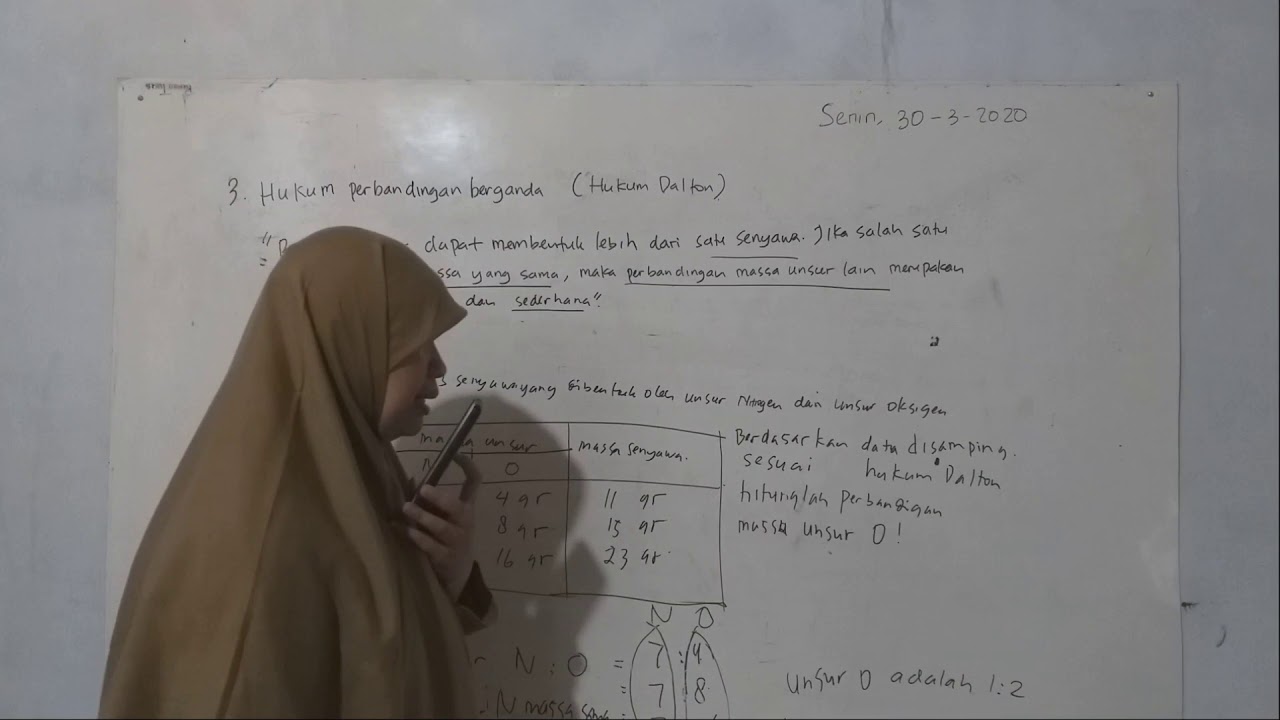
Hukum Hukum Kimia part 1

Hukum Dasar Kimia (Hukum Kekekalan Massa/Hukum Lavoisier) – [Kimia X Semester 2]

Hukum Dasar dan Perhitungan Kimia | Kelas X|
5.0 / 5 (0 votes)

