Atomic Numbers, Mass Numbers and Isotopes - Chemistry Tutorial
Summary
TLDRThis tutorial explains fundamental concepts in chemistry, including atomic numbers, mass numbers, isotopes, and ions. It covers how atomic numbers correspond to the number of protons in an atom, how mass numbers represent the total number of protons and neutrons, and how isotopes differ based on neutron count. The video also demonstrates how to calculate the number of protons, neutrons, and electrons for neutral atoms and ions, explaining the process of gaining or losing electrons to form cations and anions. Practical examples of elements like uranium, neodymium, and mercury are provided throughout.
Takeaways
- 😀 The atomic number of an atom is the same as the number of protons it has.
- 😀 The mass number is the total number of protons and neutrons in an atom.
- 😀 Isotopes are atoms of the same element with different numbers of neutrons, resulting in different mass numbers.
- 😀 The number of protons defines the element, and all atoms of the same element have the same number of protons.
- 😀 For neutral atoms, the number of protons equals the number of electrons.
- 😀 To calculate the number of neutrons in an atom, subtract the atomic number from the mass number.
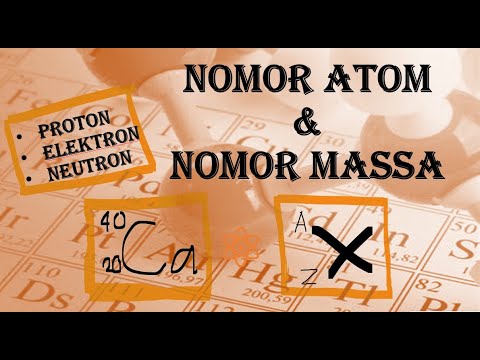
- 😀 The chemical symbol for an element often includes only the mass number (A) and not the atomic number (Z), as the atomic number is redundant.
- 😀 A neutral atom of an element always has the same number of protons and electrons.
- 😀 An ion is formed when an atom gains or loses electrons, resulting in a positive (cation) or negative (anion) charge.
- 😀 To calculate the number of neutrons in an isotope, subtract the atomic number from the mass number (A - Z).
- 😀 Example: For uranium-238 (U), the atomic number is 92, and the mass number is 238, so it has 146 neutrons.
Q & A
What defines the type of atom an element is?
-The type of atom is defined by the number of protons in the nucleus, which is represented by the atomic number.
What is the difference between the atomic number and the mass number?
-The atomic number is the number of protons in an atom, while the mass number is the total number of protons and neutrons in the atom.
How are isotopes of the same element different from each other?
-Isotopes of the same element have the same number of protons but different numbers of neutrons, leading to different mass numbers.
Why is the atomic number often not included in the chemical symbol of an element?
-The atomic number is usually omitted because it is always the same for all atoms of a given element, making it redundant.
How can we determine the number of neutrons in an atom?
-To determine the number of neutrons, subtract the atomic number from the mass number. This gives the number of neutrons.
How does the number of electrons compare to the number of protons in a neutral atom?
-In a neutral atom, the number of electrons is always equal to the number of protons.
What happens to an atom when it forms an ion?
-When an atom gains or loses electrons, it becomes an ion. Gaining electrons creates a negatively charged ion (anion), while losing electrons creates a positively charged ion (cation).
How do we calculate the number of neutrons in an ion?
-The number of neutrons in an ion is calculated the same way as in a neutral atom: subtract the atomic number from the mass number.
What does a '2+' charge on an ion indicate about its electrons?
-A '2+' charge means the atom has lost two electrons, making it positively charged.
Why is the number of protons important for determining an element's identity?
-The number of protons in an atom determines the element's identity because it defines the atomic number, which is unique to each element.
Outlines

هذا القسم متوفر فقط للمشتركين. يرجى الترقية للوصول إلى هذه الميزة.
قم بالترقية الآنMindmap

هذا القسم متوفر فقط للمشتركين. يرجى الترقية للوصول إلى هذه الميزة.
قم بالترقية الآنKeywords

هذا القسم متوفر فقط للمشتركين. يرجى الترقية للوصول إلى هذه الميزة.
قم بالترقية الآنHighlights

هذا القسم متوفر فقط للمشتركين. يرجى الترقية للوصول إلى هذه الميزة.
قم بالترقية الآنTranscripts

هذا القسم متوفر فقط للمشتركين. يرجى الترقية للوصول إلى هذه الميزة.
قم بالترقية الآن


5.0 / 5 (0 votes)

