Thyroid hormone secretion | Endocrinology | Synthesis of Thyroid Hormone
Summary
TLDRThis video explains the process of thyroid hormone production and secretion. It starts by introducing the thyroid gland and its role in producing hormones like T3 and T4, which regulate metabolism, growth, and various bodily functions. The video details the cellular process within thyroid follicles, from the pituitary gland signaling thyroid hormone production to iodine being absorbed and iodinated in the colloid. The hormones are then stored in the thyroid gland in a precursor form and eventually secreted into the bloodstream. The video also mentions the transport of these hormones by carrier proteins to their target tissues.
Takeaways
- 🧠 The thyroid gland is composed of two lobes on either side of the trachea, connected by a thin tissue called the isthmus.
- 💊 Thyroid hormones include triiodothyronine (T3) and thyroxine (T4), which are tyrosine derivatives with multiple physiological functions.
- ⚡ Thyroid hormones regulate basal metabolic rate, erythropoiesis, and metabolism of carbohydrates, fats, and proteins.
- 💧 They also contribute to water and electrolyte balance, while thyrocalcitonin regulates blood calcium levels.
- 🏗️ Thyroid follicles contain cuboidal thyroid follicular cells and a colloid rich in thyroglobulin, the precursor of thyroid hormones.
- 🧬 Thyroid hormone production is stimulated by TSH from the pituitary, which binds to TSH receptors on follicular cells.
- 🧪 Iodine uptake into the colloid is essential for hormone production, facilitated by sodium co-transporters and processed by thyroperoxidase and hydrogen peroxide.
- 🔗 Thyroglobulin is secreted into the colloid and undergoes iodination to form mono- and di-iodotyrosine, which combine to produce T3 and T4.
- 📦 Mature iodinated thyroglobulin is taken back into follicular cells via pinocytosis, where lysosomal proteases cleave it to release active hormones.
- 🩸 In the bloodstream, most thyroid hormones bind to carriers like TBG, albumin, or transthyretin, with only a small fraction circulating freely.
- 📚 The thyroid gland uniquely stores hormone precursors for long periods, allowing regulated secretion as needed.
Q & A
What are the primary lobes of the thyroid gland and how are they connected?
-The thyroid gland consists of two lobes located on either side of the trachea, connected by a thin tissue called the isthmus.
Which hormones are produced by the thyroid gland and what are their general functions?
-The thyroid gland produces T3 (triiodothyronine), T4 (thyroxine), and calcitonin. T3 and T4 regulate basal metabolic rate, erythropoiesis, and metabolism of carbohydrates, fats, and proteins. Calcitonin helps regulate blood calcium levels.
What is the structural composition of a thyroid follicle?
-A thyroid follicle consists of cuboidal thyroid follicular cells surrounding a central colloid, which contains thyroglobulin, a precursor of thyroid hormones.
How does TSH stimulate thyroid hormone production?
-TSH from the pituitary binds to TSH receptors on thyroid follicular cells, triggering a signaling cascade that promotes processing of thyroglobulin into thyroid hormones.
What role does iodine play in thyroid hormone synthesis?
-Iodine is essential for thyroid hormone production. It is co-transported with sodium into the follicular cells and colloid, then converted into molecular iodine (I2) by thyroperoxidase and hydrogen peroxide.
What is thyroglobulin and how is it processed in thyroid hormone synthesis?
-Thyroglobulin is a chain of tyrosine molecules secreted by follicular cells into the colloid. It undergoes iodination to form MIT and DIT, which are then coupled to produce T3 and T4.
How are T3 and T4 formed from iodinated thyroglobulin?
-Mono-iodotyrosine (MIT) and di-iodotyrosine (DIT) undergo coupling reactions: MIT + DIT produces T3, while DIT + DIT produces T4. These hormones remain bound to thyroglobulin until released.
Describe the storage and release process of thyroid hormones.
-Iodinated thyroglobulin is stored in the colloid. When hormone secretion is needed, it is reabsorbed by pinocytosis into follicular cells and cleaved by lysosomal proteases to release T3 and T4 into the bloodstream.
How are thyroid hormones transported in the bloodstream?
-Most thyroid hormones bind to carriers such as thyroxine-binding globulin (TBG), albumin, or transthyretin, which deliver them to target tissues. Only a small fraction circulates freely.
What is unusual about the thyroid gland in terms of hormone storage?
-Unlike many other glands, the thyroid gland stores hormones in precursor form (thyroglobulin) for long periods, allowing rapid hormone release when needed.
Which enzyme facilitates the conversion of iodine into its active form for hormone synthesis?
-Thyroperoxidase, in the presence of hydrogen peroxide, converts iodine into molecular iodine (I2), which is essential for thyroid hormone synthesis.
What types of molecules are thyroid hormones derived from?
-Thyroid hormones are derivatives of the amino acid tyrosine, synthesized from iodinated tyrosine residues within thyroglobulin.
Outlines

此内容仅限付费用户访问。 请升级后访问。
立即升级Mindmap

此内容仅限付费用户访问。 请升级后访问。
立即升级Keywords

此内容仅限付费用户访问。 请升级后访问。
立即升级Highlights

此内容仅限付费用户访问。 请升级后访问。
立即升级Transcripts

此内容仅限付费用户访问。 请升级后访问。
立即升级浏览更多相关视频

You need Iodine | Thyroid Function

Understanding the Hypothalamus and Pituitary
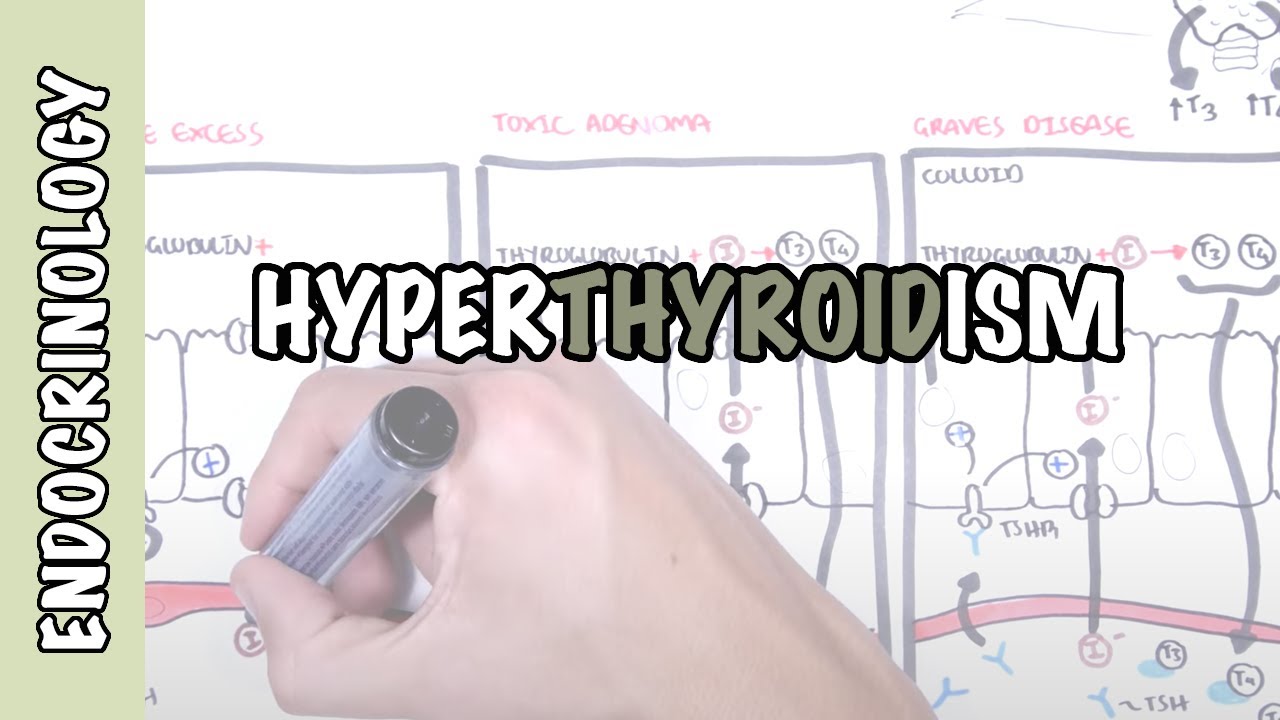
Hyperthyroidism Overview (causes, pathophysiology)

Thyroïde et Hormones Thyroïdiennes - Métabolisme, Régulation, Hyperthyroïdie et Hypothyroïdie
Tireóide e Paratireóides: Sistema Endócrino

Male Reproductive System | Spermatogenesis
5.0 / 5 (0 votes)

