Pengertian Ancaman Militer
Summary
TLDRIn this lesson, the topic of national threats to Indonesia is discussed, focusing on the categorization of threats. Threats are divided into internal and external based on their source. Additionally, threats are classified as military and non-military. Military threats involve armed and organized force, while non-military threats are abstract and can stem from multiple dimensions such as ideology, politics, economics, and technology. Examples of military threats include invasions and terrorism, while non-military threats are more difficult to detect but equally dangerous. The lesson encourages students to stay aware and engaged in further discussions.
Takeaways
- 😀 TheTranscript Analysis Request lesson focuses on the concept of 'threats to the state of Indonesia' as part of a national education course on Pancasila and Citizenship.
- 😀 Threats are categorized into two main types: those originating from within Indonesia and those from outside the country.
- 😀 Threats from within the country are referred to as 'internal threats', while threats from foreign countries or foreign citizens are called 'external threats'.
- 😀 There are two main types of threats: military and non-military. These distinctions are based on the nature and tactics of the threat.
- 😀 Military threats involve the use of armed force and organized power, which poses a direct danger to the country’s sovereignty.
- 😀 Non-military threats are abstract in nature and do not involve the use of weapons. They can be harder to detect and are more complex.
- 😀 Non-military threats span across multiple dimensions including ideology, politics, economics, society, culture, technology, and public safety.
- 😀 Military threats include acts like invasions, violations of territorial boundaries, armed rebellions, sabotage, espionage, and terrorist attacks.
- 😀 The lesson emphasizes that non-military threats, while less visible, can be just as dangerous as military ones and require collective awareness.
- 😀 The lesson encourages students to engage further with the material through online resources and group discussions, inviting questions and comments for deeper understanding.
Q & A
What is the main topic of the video?
-The main topic of the video is threats to Indonesia, focusing on their classification according to source and type, as part of the PPKN (Pancasila and Civic Education) curriculum for grade 10 students.
How are threats classified according to their source?
-Threats are classified into two categories based on their source: domestic threats, which originate from within Indonesia, and foreign threats, which come from other countries or foreign entities.
What is a military threat according to the video?
-A military threat is a type of threat that uses armed and organized force, capable of endangering the entire nation or state. It is concrete and visible because it involves weapons and strategic planning.
Can you provide examples of military threats mentioned in the video?
-Examples of military threats include aggression, invasion, territorial violations, armed rebellions, sabotage, espionage, armed terrorist actions, and threats to maritime security.
What distinguishes a non-military threat from a military threat?
-Non-military threats are abstract and do not involve the use of armed force. They are harder to detect because they are intangible, yet they can be as serious as military threats.
What areas can non-military threats come from?
-Non-military threats can arise from multiple dimensions including ideology, politics, economy, social issues, culture, technology, information, and public safety.
Why are non-military threats considered difficult to handle?
-Non-military threats are difficult to handle because they are abstract, less visible, and often spread across multiple dimensions, making detection and response more complex than military threats.
How does the video suggest students review previous lessons?
-The video suggests that students can review previous lessons by watching the prior video linked in the description section to reinforce their understanding of threats to Indonesia.
What approach does the video encourage students to take regarding non-military threats?
-The video encourages students to remain vigilant and aware of non-military threats, understanding that these threats can be serious and require collective attention and response.
What additional resources does the video offer for deeper understanding?
-The video provides additional resources through Google Classroom links where students can explore topics more deeply, ask questions, and participate in group discussions.
What is the significance of understanding both military and non-military threats for students?
-Understanding both military and non-military threats is important for students to develop awareness of national security challenges, recognize diverse forms of threats, and prepare for informed civic engagement.
Outlines

此内容仅限付费用户访问。 请升级后访问。
立即升级Mindmap

此内容仅限付费用户访问。 请升级后访问。
立即升级Keywords

此内容仅限付费用户访问。 请升级后访问。
立即升级Highlights

此内容仅限付费用户访问。 请升级后访问。
立即升级Transcripts

此内容仅限付费用户访问。 请升级后访问。
立即升级浏览更多相关视频

Contoh Ancaman Integrasi Nasional diberbagai Bidang-XI MIPA 7-Ahsan Hafizh A.G

Ancaman Terhadap Integrasi Nasional

CompTIA Security+ Full Course: Attack and Attacker Categories
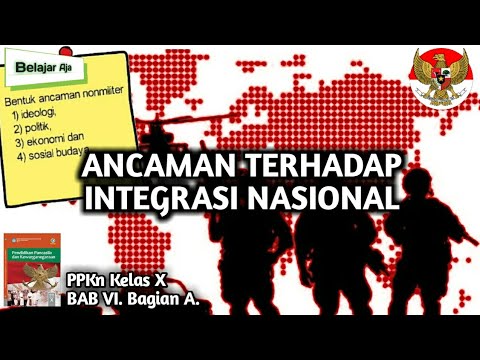
Ancaman terhadap Integrasi Nasional - PPKn Kelas 10

Geostrategi Indonesia - Video Pembelajaran

Mewaspadai Ancaman Terhadap Kedudukan NKRI | PKn Kelas XI
5.0 / 5 (0 votes)

