(Part 4b) ASIMTOT VERTIKAL HORIZONTAL FUNGSI DAN PEMODELANNYA MATEMATIKA TINGKAT LANJUT KELAS 11
Summary
TLDRThis video lesson explores vertical and horizontal asymptotes in rational functions, using clear examples and visual aids from GeoGebra. It explains how to identify vertical asymptotes by setting the denominator equal to zero and horizontal asymptotes by comparing the degrees of the numerator and denominator polynomials. Step-by-step examples illustrate the behavior of functions near asymptotes, including limits approaching positive and negative infinity. The lesson also introduces the concept of slant asymptotes for future study. Multiple practice problems reinforce these concepts, offering both detailed explanations and a streamlined method for quickly finding asymptotes, making the topic accessible and engaging for learners.
Takeaways
- 😀 The video explains the concepts of horizontal and vertical asymptotes in rational functions.
- 😀 The function example given is f(x) = (x + 3) / (x - 2), with visual aids showing the graph and its properties.
- 😀 The correct graph for the function was confirmed using Geogebra, as the book's graph was incorrect.
- 😀 The function intersects the x-axis at (-3, 0) and the y-axis at (0, -3/2).
- 😀 The function approaches the vertical line x = 2 but never crosses it, representing a vertical asymptote.
- 😀 As x approaches 2 from the left, the value of y tends to negative infinity; from the right, it tends to positive infinity.
- 😀 The function also approaches a horizontal asymptote at y = 1 as x tends to positive or negative infinity.
- 😀 Vertical asymptotes are defined as the lines x = a, where y approaches either positive or negative infinity.
- 😀 Horizontal asymptotes are defined as the lines y = b, where y approaches a constant value as x tends to positive or negative infinity.
- 😀 The video concludes by introducing the concept of slant asymptotes, which will be discussed in the next video.
Q & A
What is a rational function?
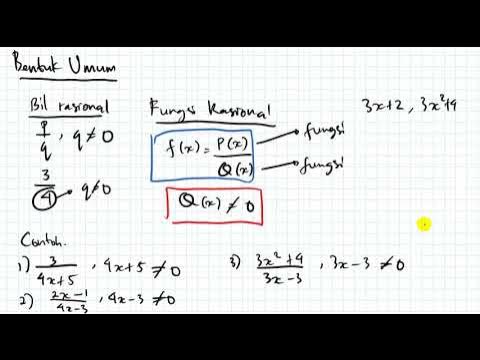
-A rational function is a function that can be expressed as the ratio of two polynomials, i.e., f(x) = P(x)/Q(x), where P(x) and Q(x) are polynomials.
What is the main topic of the video?
-The main topic of the video is about understanding vertical and horizontal asymptotes of rational functions, including how to identify and interpret them through graphical examples.
What is an asymptote?
-An asymptote is a line that a graph approaches but never touches. It can be either vertical or horizontal, and it helps describe the behavior of a function as it approaches specific values.
What is a vertical asymptote?
-A vertical asymptote occurs when the graph of a rational function approaches a vertical line (x = a) but never crosses it. This typically happens when the denominator of the function equals zero, making the function undefined at that point.
What is a horizontal asymptote?
-A horizontal asymptote occurs when the graph of a function approaches a horizontal line (y = b) as x tends to positive or negative infinity. It describes the behavior of the function at large values of x.
How do you determine the vertical asymptote of a rational function?
-To find the vertical asymptote of a rational function, set the denominator equal to zero and solve for x. The values of x that make the denominator zero are the vertical asymptotes.
What is the significance of the value x = 2 in the example given in the video?
-In the example function f(x) = (x + 3)/(x - 2), x = 2 represents a vertical asymptote. As x approaches 2 from the left, the function approaches negative infinity, and as x approaches 2 from the right, the function approaches positive infinity.
How do horizontal asymptotes relate to the degrees of polynomials?
-The horizontal asymptote depends on the degrees of the polynomials in the numerator and denominator. If the degree of the numerator is less than the degree of the denominator, the horizontal asymptote is y = 0. If the degrees are equal, the horizontal asymptote is the ratio of the leading coefficients.
What is the difference between vertical and horizontal asymptotes?
-Vertical asymptotes are lines that the graph approaches but never crosses as the function becomes unbounded, typically when the denominator equals zero. Horizontal asymptotes describe the behavior of the function as x approaches positive or negative infinity and are determined by the degrees of the polynomials.
How do you determine the horizontal asymptote when the degrees of the numerator and denominator are equal?
-When the degrees of the numerator and denominator are equal, the horizontal asymptote is the ratio of the leading coefficients of the numerator and denominator polynomials.
Outlines

此内容仅限付费用户访问。 请升级后访问。
立即升级Mindmap

此内容仅限付费用户访问。 请升级后访问。
立即升级Keywords

此内容仅限付费用户访问。 请升级后访问。
立即升级Highlights

此内容仅限付费用户访问。 请升级后访问。
立即升级Transcripts

此内容仅限付费用户访问。 请升级后访问。
立即升级浏览更多相关视频
Fungsi Rasional kelas XI Matematika Tingkat Lanjut (Kurikulum Merdeka)
Lesson 3 Rational Function (Part 1)

Graphing Rational Functions Step-by-Step (Complete Guide 3 Examples)

Asimtot Datar, Asimtot Tegak dan Asimtot Miring Fungsi Rasional Matematika Peminatan Kelas XII

Menggambar Grafik Fungsi Rasional #fazanugas
Fungsi Rasional Bentuk 1 (Domain, Range, Cara Menggambar)
5.0 / 5 (0 votes)

