Kimia Kelas 11: Faktor-Faktor Yang Mempengaruhi Laju Reaksi | Portal Sekolah
Summary
TLDRThis educational video explores the concept of reaction rates in chemistry, demonstrating how factors like temperature, surface area, concentration, pressure, and catalysts influence the speed of chemical reactions. Through practical examples—such as sugar dissolving faster in hot tea, calcium carbonate reacting with hydrochloric acid, and the effect of catalysts—the video illustrates the mechanisms behind faster or slower reactions. It also explains special catalysts like enzymes and autocatalysts, emphasizing their role in biological and chemical processes. The content combines theoretical explanations with relatable everyday examples, helping learners understand how reaction rates can be controlled and optimized in real-life scenarios.
Takeaways
- 😀 Temperature affects the rate at which sugar dissolves in tea, with hot water dissolving sugar faster than cold water.
- 😀 The rate of a chemical reaction is influenced by several factors including temperature, surface area, concentration, pressure, and catalysts.
- 😀 Reaction rate is defined as the change in the concentration of reactants over time.
- 😀 The dissolution of sugar in hot tea is an example of how temperature increases the rate of a reaction.
- 😀 Surface area plays a key role in reaction rates: smaller particles (e.g., powder) react faster than larger particles (e.g., chunks).
- 😀 The experiment with calcium carbonate shows that powdered calcium carbonate reacts more quickly with hydrochloric acid than in chunk form.
- 😀 Higher concentration of reactants leads to more frequent particle collisions, thus increasing the reaction rate.
- 😀 In reactions involving gases, increasing pressure can accelerate the reaction by increasing the concentration of gas molecules.
- 😀 Catalysts are substances that speed up a reaction without being consumed in the process, by lowering the activation energy.
- 😀 Enzymes, a type of biocatalyst, help speed up biochemical reactions by binding specifically with substrates in a manner described by the 'lock and key' model.
- 😀 Auto-catalysts are products of a reaction that can act as catalysts, accelerating the reaction without external input.
Q & A
What is the relationship between temperature and the rate of dissolution of sugar in tea?
-The rate of dissolution of sugar in tea is faster when the tea is warm compared to when it is cold. This demonstrates that temperature increases the rate of dissolution due to faster molecular movement.
How does surface area affect the rate of chemical reactions?
-Surface area plays a crucial role in the rate of chemical reactions, particularly when one reactant is a solid. A larger surface area provides more contact between particles, leading to faster reactions. For example, powdered calcium carbonate reacts faster with hydrochloric acid than its solid form.
What experiment demonstrates the effect of surface area on the rate of reaction?
-The experiment involving calcium carbonate shows that powdered calcium carbonate reacts more quickly with hydrochloric acid compared to its solid chunk form. The powdered form has a larger surface area, increasing the rate of reaction.
How does the concentration of reactants influence the rate of a chemical reaction?
-Higher concentrations of reactants result in more particles in a given volume, leading to more frequent collisions between particles. This increases the chances of successful reactions, thus speeding up the reaction rate.
What was the experiment involving magnesium and hydrochloric acid designed to demonstrate?
-The experiment involving magnesium and hydrochloric acid was designed to show that higher concentrations of hydrochloric acid lead to faster production of hydrogen gas. The reaction is quicker when using a 2 molar concentration of hydrochloric acid compared to a 1 molar solution.
How does temperature influence the rate of chemical reactions?
-Increasing the temperature causes the particles in a substance to move faster, leading to more frequent and energetic collisions between them. This increases the rate of reaction. For example, sugar dissolves faster in warm tea than in cold tea.
How is the rate of reaction affected by a 10°C increase in temperature?
-For every 10°C increase in temperature, the rate of reaction typically doubles. This relationship can be calculated using the formula: R2 = R1 * N^((T2 - T1) / ΔT), where R2 is the rate at the higher temperature and R1 is the rate at the lower temperature.
What role does pressure play in the rate of gas-phase reactions?
-Increasing the pressure of a gas typically increases the concentration of gas molecules in a given volume. This results in more frequent collisions between molecules, speeding up the reaction. This is commonly observed in cooking with a pressure cooker.
What is a catalyst and how does it affect the rate of a reaction?
-A catalyst is a substance that speeds up a chemical reaction without being consumed or permanently altered in the process. It works by lowering the activation energy required for the reaction to occur, enabling the reaction to proceed more efficiently.
What are the differences between homogeneous and heterogeneous catalysts?
-Homogeneous catalysts are in the same phase as the reactants, such as in a liquid solution. Heterogeneous catalysts, on the other hand, are in a different phase than the reactants, often in a solid form that interacts with gases or liquids. An example of a heterogeneous catalyst is nickel in hydrogenation reactions.
Outlines

此内容仅限付费用户访问。 请升级后访问。
立即升级Mindmap

此内容仅限付费用户访问。 请升级后访问。
立即升级Keywords

此内容仅限付费用户访问。 请升级后访问。
立即升级Highlights

此内容仅限付费用户访问。 请升级后访问。
立即升级Transcripts

此内容仅限付费用户访问。 请升级后访问。
立即升级浏览更多相关视频
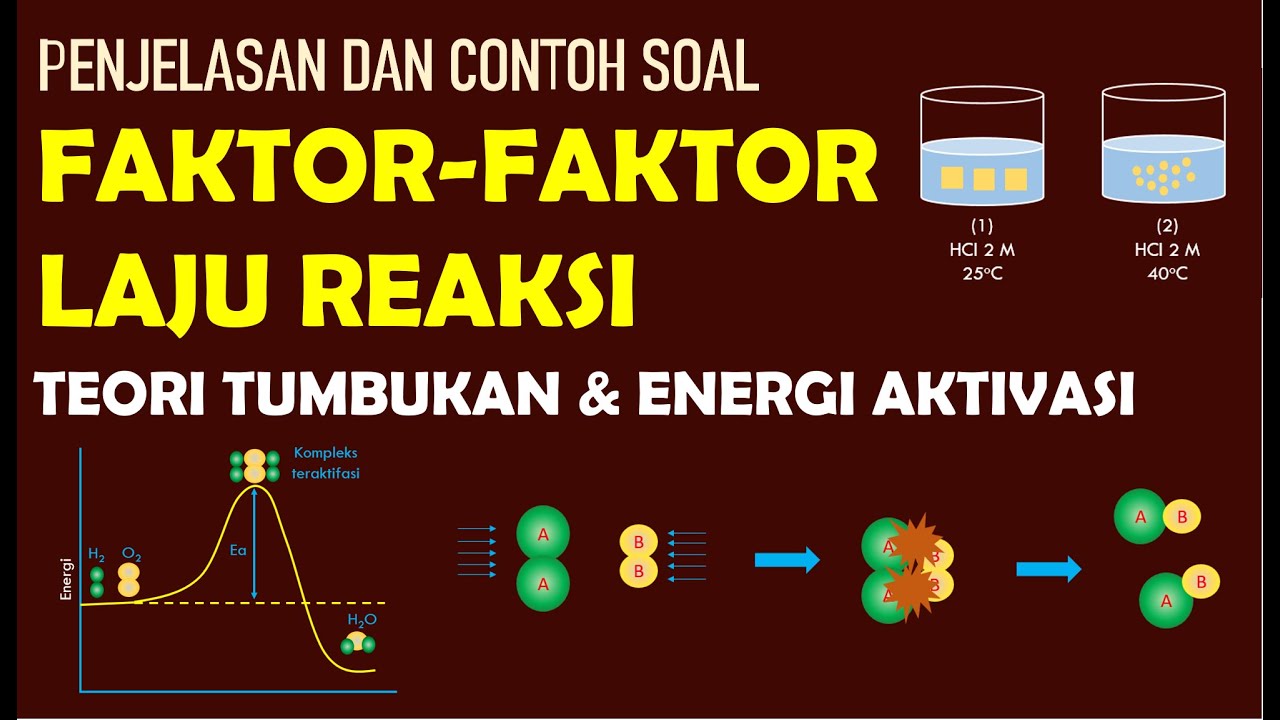
FAKTOR LAJU REAKSI, TEORI TUMBUKAN DAN ENERGI AKTIVASI | KIMIA SMA KELAS 11

Faktor-faktor Yang Mempengaruhi Laju Reaksi
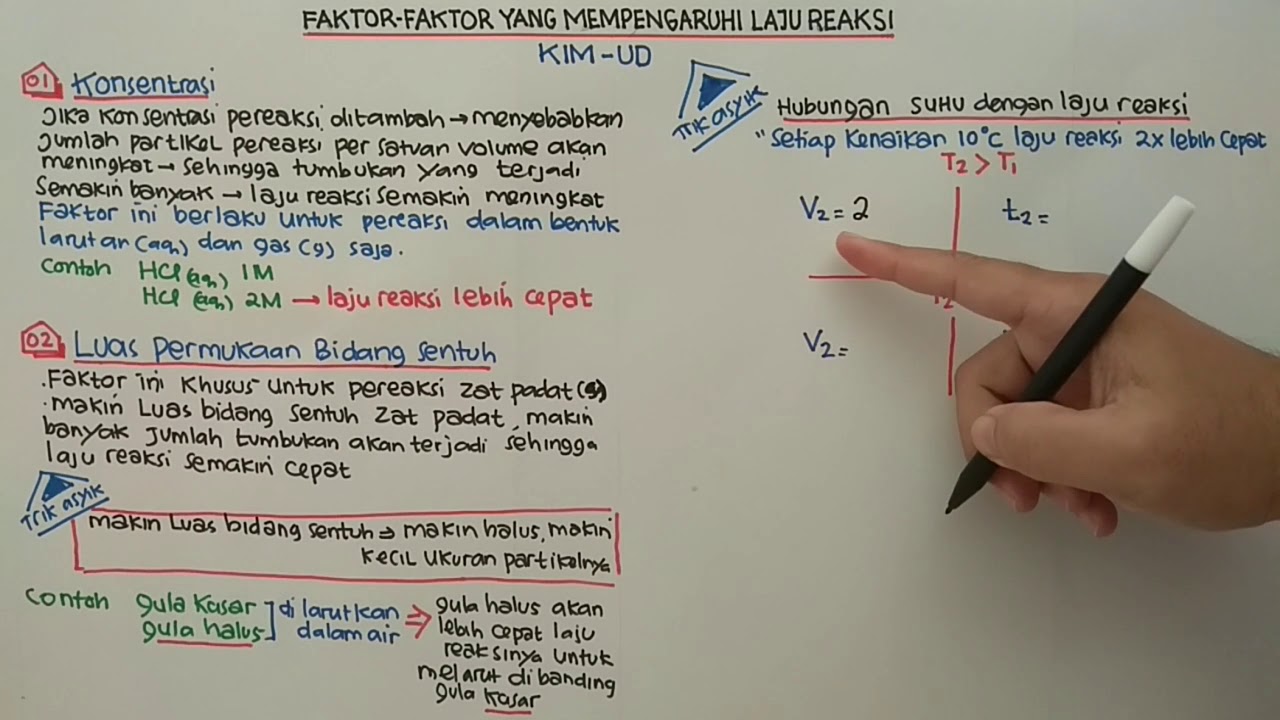
FAKTOR - FAKTOR YANG MEMPENGARUHI LAJU REAKSI

PRAKTIKUM FAKTOR-FAKTOR YANG MEMPENGARUHI LAJU REAKSI

5.1. Reaction Rates | College Board | AP Chemistry
Belajar Faktor faktor Laju Reaksi pakai Analogi
5.0 / 5 (0 votes)

