Praktikum Geologi Struktur 2024 - Modul 7. - Pemetaan Struktur Geologi - 2. Pembuatan Lintasan
Summary
TLDRThis video focuses on the fundamentals of geological structural mapping, specifically exploring traverses in geological fieldwork. It explains the concept of traverse maps, including open and closed traverses, and how to record observations during exploration. The video covers practical techniques like measuring distances, calculating azimuths, and adjusting for slope to ensure accurate data collection. The importance of creating these traverse maps for geological interpretation is emphasized, helping to reconstruct geological features and aiding in exploration. The session also includes exercises and tasks to practice these skills.
Takeaways
- 😀 The video focuses on geological mapping, particularly the concept of 'lintasan' (traverses) used during field surveys.
- 😀 Traverses are routes that geologists follow during surveys, recording findings such as rock types and geological features.
- 😀 There are two types of traverses: open and closed. Open traverses start and end at different points, while closed traverses return to the starting point.
- 😀 Closed traverses are preferred in geological mapping since they allow for easier verification and correction of data.
- 😀 When creating a traverse, geologists need to record the distance, azimuth, and elevation changes between points.
- 😀 Azimuths and back azimuths are essential in determining the direction between two points in the field.
- 😀 To calculate horizontal distances when traversing uphill or downhill, simple trigonometry is used to adjust for elevation changes.
- 😀 In the field, a compass is used to record the azimuth (direction), and a measuring tape or steps can be used to track distances.
- 😀 The importance of 'lintasan' is in its ability to help reconstruct geological maps without needing complex software, as field data alone can reveal key geological features.
- 😀 The speaker emphasizes the importance of teamwork, as at least two people are needed: one to hold the compass and another to walk the route and measure distances.
Q & A
What is the main purpose of creating a geological traverse (lintasan) in the field?
-The main purpose of a geological traverse is to systematically record and map the observations of rock types, contacts, orientations, and other geological features along a path in the field, allowing for accurate interpretation and reconstruction of geological structures.
What is the difference between an open traverse and a closed traverse?
-An open traverse starts and ends at different points, while a closed traverse starts and ends at the same point. Closed traverses allow for correction and validation of the data, whereas open traverses are more flexible but harder to verify.
Why is azimuth important in creating a traverse?
-Azimuth is important because it provides the horizontal direction between points in the field, ensuring accurate mapping of the traverse path and correct placement of geological features on the map.
How is slope (kemiringan) considered when measuring distances in a traverse?
-Slope is used to correct measured distances to obtain horizontal distances. If the slope is greater than 5 degrees, trigonometric correction is applied using the formula: horizontal distance = measured distance × cos(slope angle). Slopes under 5 degrees usually do not require correction.
What information should be included in a traverse data table?
-A traverse data table should include: line segment (e.g., point 1 to point 2), azimuth, back azimuth, measured distance, slope, and corrected horizontal distance (if necessary).
How can a traverse help identify geological contacts and faults in the field?
-By recording observations at multiple points along the traverse, geologists can identify changes in rock type, orientations, and structures, which indicate contacts between different lithologies and the presence of faults, such as normal or reverse faults.
What tools are commonly used to measure distance and azimuth in the field?
-Common tools include a geological compass for azimuth, tape measures or meter sticks for distance, and smartwatches or step-counting methods as practical alternatives for estimating distances.
Why might one choose a closed traverse over an open traverse for a field project?
-A closed traverse is chosen when validation and correction of the traverse are necessary because it allows geologists to return to the starting point and check the consistency of the recorded data, minimizing errors in mapping.
How can step-counting be used as a practical alternative to measuring distance?
-Step-counting involves measuring the distance by counting steps over a known distance, averaging step length, and applying this average to estimate distances between points when tools like tapes are unavailable or to save time in the field.
What is the significance of orienting the traverse perpendicular to strike (stkn) in geological mapping?
-Orienting the traverse perpendicular to the strike ensures that variations in lithology and structural features are accurately captured along the profile, avoiding misrepresentation of the geological sequence.
How can traverse data be used without the need for immediate computer software processing?
-By recording rock types, orientations, azimuths, distances, and slopes along the traverse, geologists can interpret geological structures and contacts directly from the data without relying on software, allowing field-based analysis and mapping.
What is the role of teamwork when conducting a field traverse?
-Teamwork is essential for efficiency and accuracy. Typically, one person stays at the starting point while another moves to the endpoint to measure azimuth and distance. This ensures precise alignment and prevents errors during field measurements.
Outlines

此内容仅限付费用户访问。 请升级后访问。
立即升级Mindmap

此内容仅限付费用户访问。 请升级后访问。
立即升级Keywords

此内容仅限付费用户访问。 请升级后访问。
立即升级Highlights

此内容仅限付费用户访问。 请升级后访问。
立即升级Transcripts

此内容仅限付费用户访问。 请升级后访问。
立即升级浏览更多相关视频

23 Februari 2025

Praktikum Geologi Struktur 2024 - Modul 1. Pendahuluan Modul Geologi Struktur - 2. Pengukuran Data

Praktikum Geologi Struktur 2024 - Modul 7. - Pemetaan Struktur Geologi - 3. Penarikan Kelurusan

Praktikum Geologi Struktur - Modul Tambahan - PETA GEOLOGI
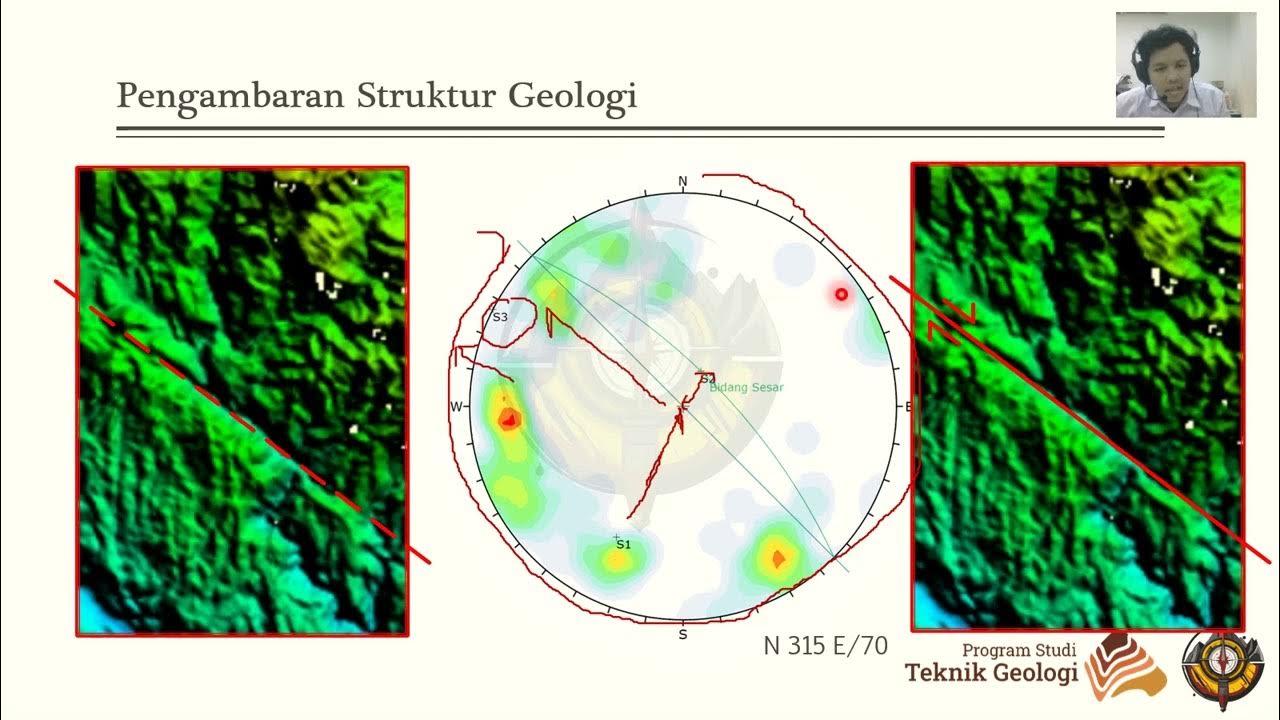
Praktikum Geologi Struktur 2024 - Modul 10. Prediksi Singkapan - 2. Penggambaran Struktur Geologi

Trend and Plunge : Gores Garis Pada Sesar
5.0 / 5 (0 votes)

