📐 Trigonometri Dasar - Part 2
Summary
TLDRThis video explains trigonometric functions such as sine, cosine, and tangent, focusing on angles of 0°, 30°, 45°, 60°, and 90°. It demonstrates how to memorize key trigonometric values for these angles and how to apply them to solve real-life problems, such as calculating the height of a tree based on its angle of elevation. The video also walks through examples of applying trigonometric ratios to find unknown sides in right-angled triangles. The importance of memorizing these values for exams is emphasized, along with step-by-step problem-solving methods.
Takeaways
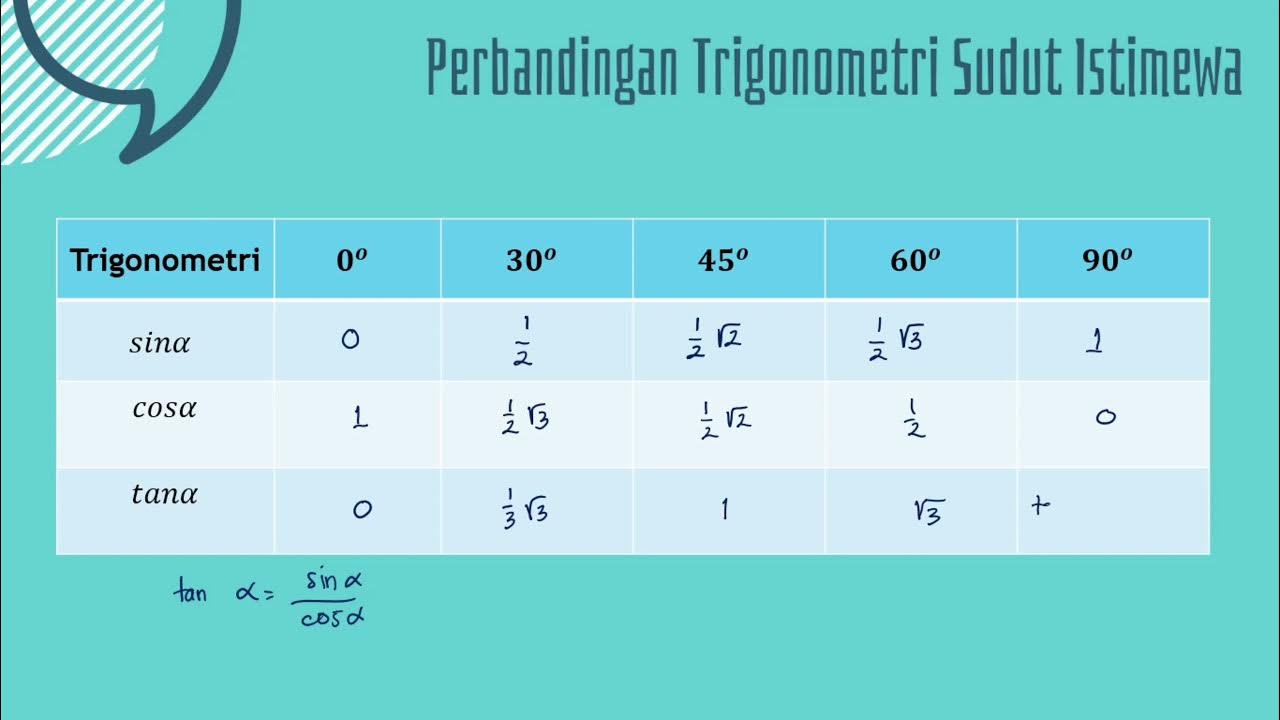
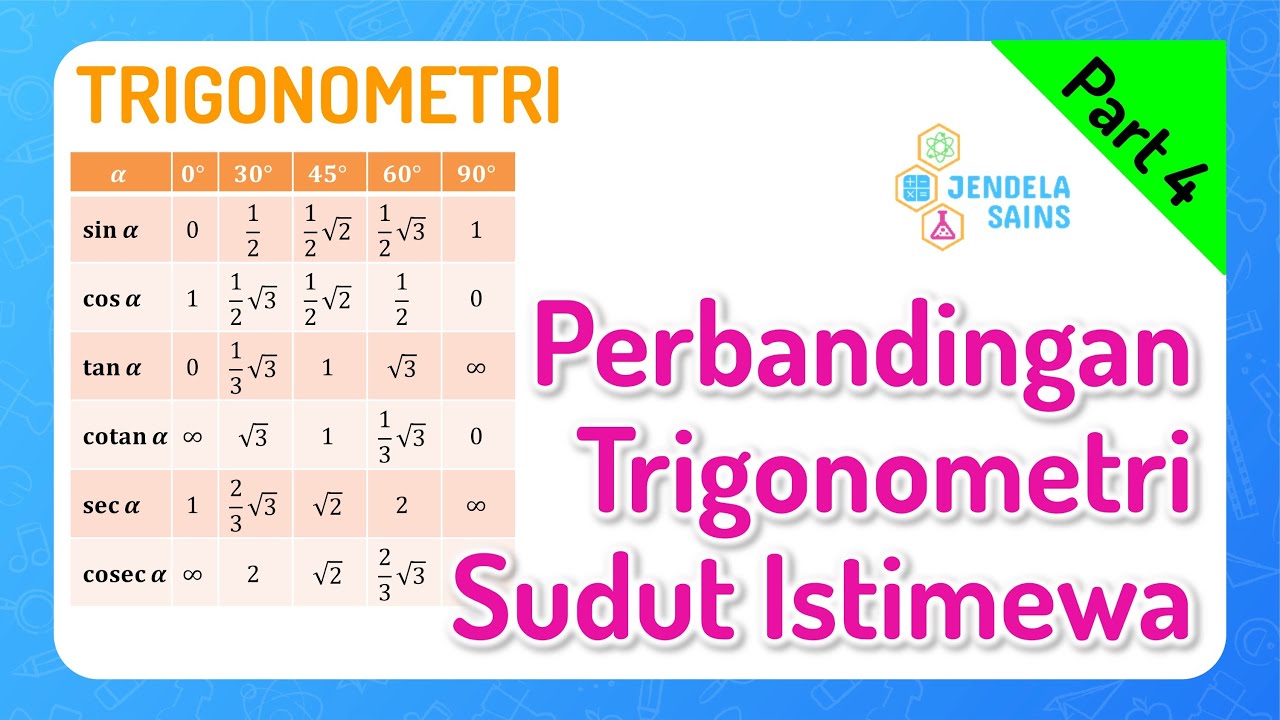
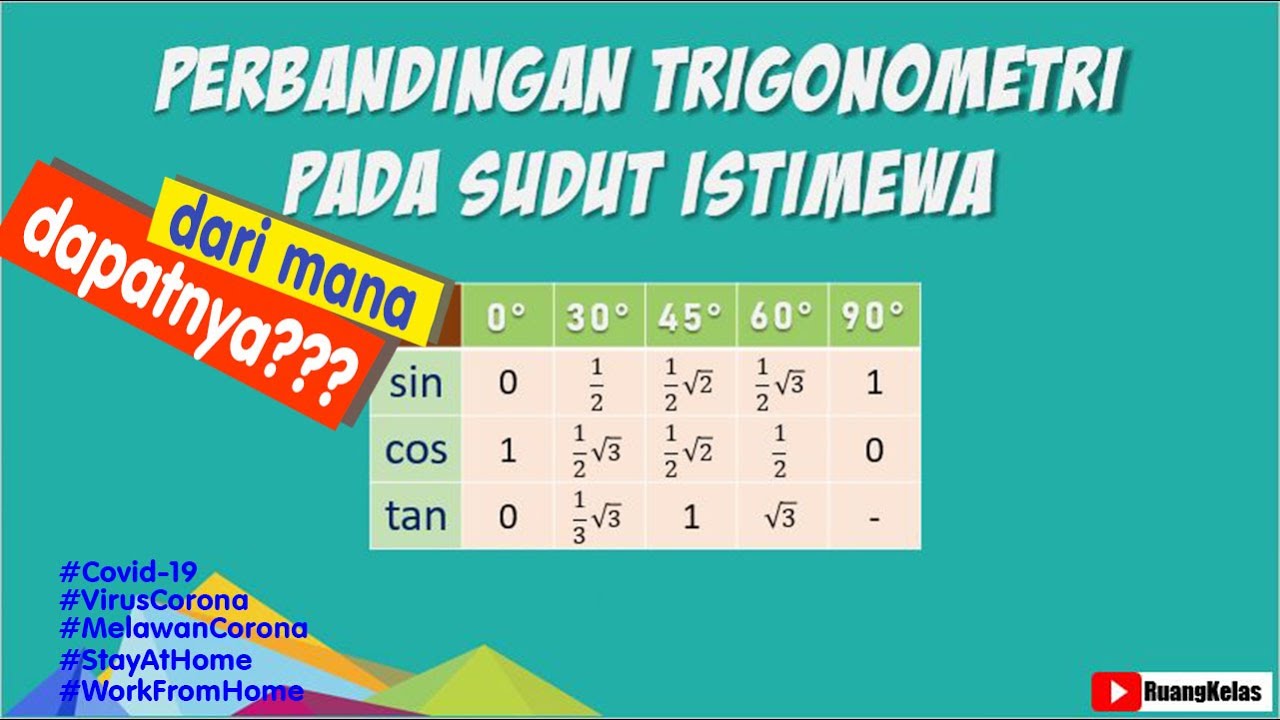
- 😀 The video explains the values of sine, cosine, and tangent for common angles: 0°, 30°, 45°, 60°, and 90°.
- 😀 Sine values increase from 0 to 1 as the angle goes from 0° to 90°.
- 😀 Cosine values decrease from 1 to 0 as the angle goes from 0° to 90°.
- 😀 Tangent values can be calculated as sin/cos, with 0° = 0, 45° = 1, 90° = undefined.
- 😀 A simple method is provided for memorizing the sine, cosine, and tangent values using patterns.
- 😀 Trigonometry can be applied to real-life problems, such as calculating the height of a tree using angles and distances.
- 😀 To find a side of a triangle, use the appropriate trigonometric ratio based on the known angle and sides.
- 😀 Example: To calculate the height of a tree with a 30° observation angle and 6 m distance, use tan 30° = opposite/adjacent.
- 😀 Example: To find the hypotenuse when sin θ and the opposite side are known, rearrange the formula to hypotenuse = opposite / sin θ.
- 😀 Practicing and memorizing these trigonometric values is essential because they frequently appear in exams.
- 😀 Always write the formula first and rearrange it to isolate the unknown side before substituting known values.
Q & A
What are the angles for which the values of sin, cos, and tan are discussed in the transcript?
-The angles discussed are 0°, 30°, 45°, 60°, and 90°.
How is the value of sin 30° derived?
-The value of sin 30° is derived as 1/2.
What is the value of cos 0°?
-The value of cos 0° is 1.
What is the behavior of sin as the angle increases from 0° to 90°?
-The value of sin increases from 0 to 1, with intermediate values being 1/2, 1/2√2, 1/2√3, and 1.
What is the relationship between tan and sin or cos?
-Tan is the ratio of sin to cos, or the ratio of the opposite side to the adjacent side in a right triangle.
How do you memorize the values of sin, cos, and tan for common angles?
-For sin, the values increase from 0 to 1 as the angle goes from 0° to 90°, while cos decreases from 1 to 0. For tan, it starts at 0 for 0°, reaches 1 at 45°, and becomes infinite at 90°.
In the example involving the height of the tree, how is the height calculated?
-The height of the tree is calculated using the tangent function: tan(30°) = height / 6 meters. Rearranging the formula, the height of the tree is found to be approximately 2√3 meters.
What is the formula for calculating the height of the tree using tan?
-The formula is tan(30°) = height / 6 meters. Using the known value of tan(30°), the height is calculated as 2√3 meters.
In the second example, how is the hypotenuse of the triangle determined using sin?
-The hypotenuse is calculated by rearranging the sine formula: sin(θ) = opposite / hypotenuse. For sin(θ) = 3/5 and the opposite side as 18, the hypotenuse is found to be 30 cm.
What is the value of tan at 45° and why is it significant?
-The value of tan at 45° is 1, which is significant because it represents the point where the opposite and adjacent sides of a right triangle are equal.
Outlines

此内容仅限付费用户访问。 请升级后访问。
立即升级Mindmap

此内容仅限付费用户访问。 请升级后访问。
立即升级Keywords

此内容仅限付费用户访问。 请升级后访问。
立即升级Highlights

此内容仅限付费用户访问。 请升级后访问。
立即升级Transcripts

此内容仅限付费用户访问。 请升级后访问。
立即升级浏览更多相关视频
Perbandingan Trigonometri Sudut Istimewa
Trigonometri Matematika Kelas 10 • Part 4: Perbandingan Trigonometri Sudut Istimewa
Sum and Difference Identities & Formulas - Sine, Cosine, Tangent - Degrees & Radians, Trigonometry

Trigonometri : Pembuktian Sudut Istimewa | Pengetahuan Kuantitatif | Alternatifa
Video Pembelajaran Matematika Materi Trigonometri Kelas 10 - Nilai Trigonometri pada Sudut Istimewa
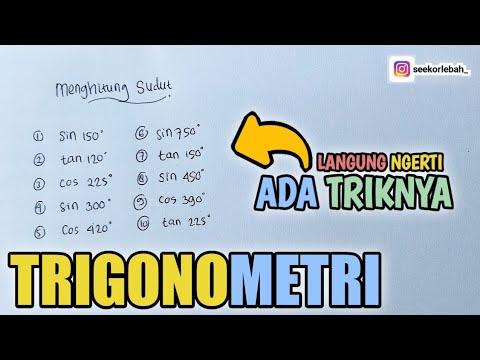
CARA MENGHITUNG SUDUT TRIGONOMETRI‼️
5.0 / 5 (0 votes)

