Biokimia - Asam Nukleat
Summary
TLDRThis video discusses nucleic acids, focusing on DNA and RNA, their structures, and their roles in protein synthesis. The process begins with DNA replication, followed by transcription into mRNA, which is then translated into amino acids to form proteins. The video also explains the differences between nucleosides and nucleotides, the structures of purine and pyrimidine bases, and the distinct roles of ribose in RNA and deoxyribose in DNA. Furthermore, the video covers the function of nucleases in metabolism and energy transfer within the body. Overall, it provides an informative overview of nucleic acid biology.
Takeaways
- 🧬 DNA and RNA are the two main types of nucleic acids, with DNA containing deoxyribose and RNA containing ribose as their sugar component.
- 🔄 Protein synthesis occurs in three main stages: DNA replication, transcription into mRNA, and translation into amino acids by ribosomes.
- 📜 Transcription converts DNA into mRNA by copying one strand of DNA, which then serves as a template for protein synthesis.
- 🧩 Translation involves tRNA bringing amino acids to the ribosome, where they are assembled into proteins according to the mRNA codons.
- 💎 Nucleosides are compounds formed by a nitrogenous base (purine or pyrimidine) attached to a sugar molecule (ribose or deoxyribose).
- ⚡ Nucleotides are nucleosides with an added phosphate group, forming the building blocks of DNA and RNA.
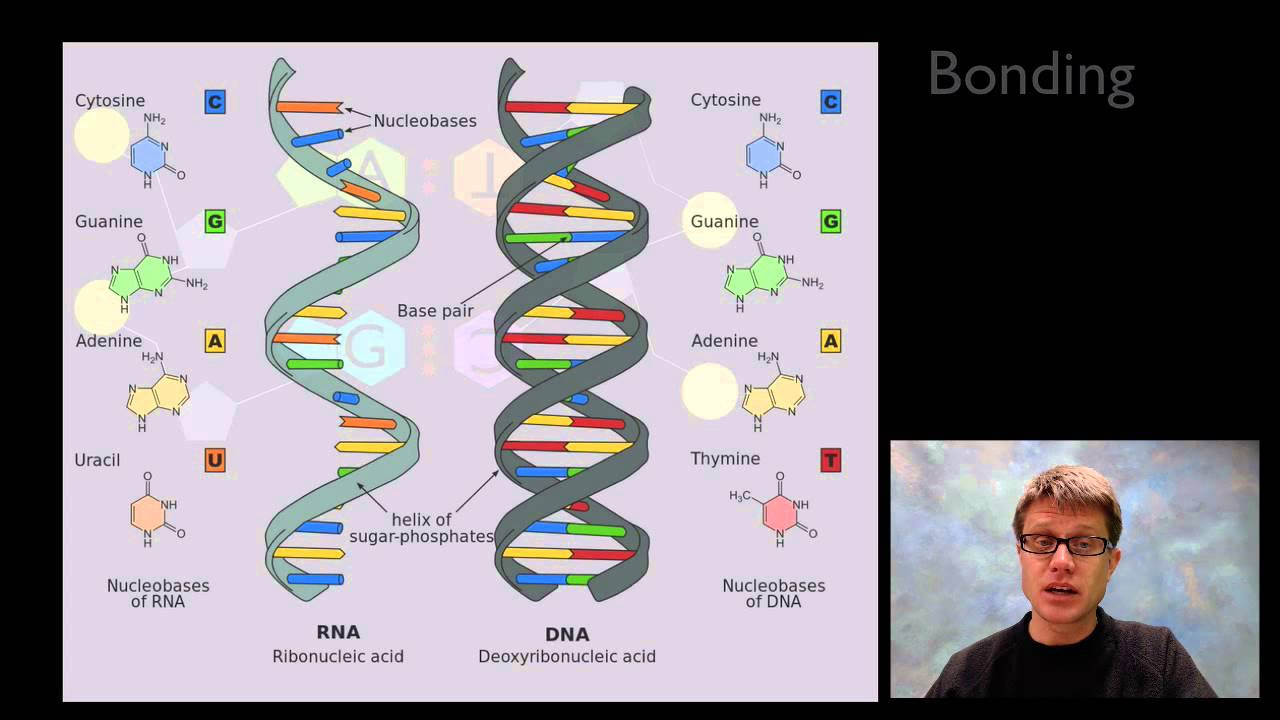
- 🔤 Nitrogenous bases are classified as purines (adenine, guanine) with a double-ring structure, and pyrimidines (cytosine, thymine, uracil) with a single-ring structure.
- 🧬 DNA is double-stranded (double helix) and contains adenine, guanine, cytosine, and thymine, whereas RNA is single-stranded and contains uracil instead of thymine.
- 🧪 Enzymes like nucleases are involved in breaking down nucleic acids, and molecules like NAD+ and FAD, which contain nucleotides, play key roles in cellular metabolism and energy transfer.
- 🔗 The phosphate group in nucleotides forms phosphodiester bonds, linking nucleotides together to create DNA and RNA polymers.
Q & A
What are the two main types of nucleic acids, and what is their primary difference?
-The two main types of nucleic acids are DNA (Deoxyribonucleic Acid) and RNA (Ribonucleic Acid). The primary difference is in the sugar component: DNA contains deoxyribose, whereas RNA contains ribose. Additionally, DNA is double-stranded while RNA is single-stranded, and DNA contains thymine whereas RNA contains uracil.
What is the role of DNA in protein synthesis?
-DNA stores genetic information and guides protein synthesis through two main processes: transcription, where DNA is converted into mRNA, and translation, where mRNA is read by ribosomes to assemble amino acids into proteins.
Can you explain the process of transcription and its product?
-Transcription is the process where a segment of DNA is copied into messenger RNA (mRNA). During this process, the double-stranded DNA unwinds, and one strand serves as a template for synthesizing a complementary RNA strand, which carries the genetic code to the ribosome.
What is the difference between a nucleoside and a nucleotide?
-A nucleoside consists of a nitrogenous base (purine or pyrimidine) attached to a sugar (ribose or deoxyribose). A nucleotide is a nucleoside with one or more phosphate groups attached to the 5' carbon of the sugar.
What are purine and pyrimidine bases, and which nucleotides contain them?
-Purines have a two-ring structure and include adenine (A) and guanine (G). Pyrimidines have a single-ring structure and include cytosine (C), thymine (T, only in DNA), and uracil (U, only in RNA).
Describe the process of translation in protein synthesis.
-Translation occurs at the ribosome, where transfer RNA (tRNA) molecules bring amino acids corresponding to codons on the mRNA. Each codon of three nucleotides on mRNA is matched with the complementary anticodon on tRNA, and the amino acids are linked together via peptide bonds to form a protein.
How does the sugar component differ between DNA and RNA?
-DNA contains deoxyribose, which lacks an oxygen atom on the 2' carbon of the sugar ring. RNA contains ribose, which has a hydroxyl (-OH) group on the 2' carbon. This difference affects the stability and structure of the nucleic acids.
What structural features distinguish DNA from RNA?
-DNA is typically double-stranded, forming a double helix, while RNA is single-stranded and may fold into complex three-dimensional shapes. DNA contains thymine, whereas RNA contains uracil instead of thymine.
What is the function of nucleases in the cell?
-Nucleases are enzymes that hydrolyze nucleic acids into nucleotides or smaller fragments. They are involved in processes like DNA repair, RNA degradation, and energy metabolism through cofactors such as NAD+ (nicotinamide adenine dinucleotide) and FAD (flavin adenine dinucleotide).
What is the significance of the phosphate group in nucleotides?
-The phosphate group in nucleotides enables the formation of phosphodiester bonds between nucleotides, which link them into long polymer chains to form DNA and RNA. It also plays a key role in energy transfer and signaling in the cell.
How do codons in mRNA relate to amino acids in proteins?
-Codons are sequences of three nucleotides in mRNA that correspond to specific amino acids. During translation, each codon is recognized by a complementary anticodon on tRNA, which carries the corresponding amino acid to the growing protein chain.
Why is inosine considered an unusual nucleoside?
-Inosine is an unusual nucleoside because it consists of ribose linked to hypoxanthine, a purine base not commonly found in standard DNA or RNA. It plays roles in RNA editing and wobble base pairing during translation.
Outlines

This section is available to paid users only. Please upgrade to access this part.
Upgrade NowMindmap

This section is available to paid users only. Please upgrade to access this part.
Upgrade NowKeywords

This section is available to paid users only. Please upgrade to access this part.
Upgrade NowHighlights

This section is available to paid users only. Please upgrade to access this part.
Upgrade NowTranscripts

This section is available to paid users only. Please upgrade to access this part.
Upgrade Now



5.0 / 5 (0 votes)
