(Trigono I)perbandingan trigono
Summary
TLDRIn this engaging lesson on trigonometry, the instructor introduces the basic trigonometric ratios: sine (sin), cosine (cos), and tangent (tan), explaining them through practical examples with right-angled triangles. The teacher emphasizes the importance of understanding their reciprocal functions: cosecant (csc), secant (sec), and cotangent (cot). Through clear step-by-step problem-solving, students learn how to apply these ratios in real-life scenarios, solidifying their understanding of how to find sides and angles in triangles. The session concludes with a reminder to practice and master these essential concepts for further mathematical success.
Takeaways
- 😀 Trigonometry is a favorite and essential topic in mathematics, applicable throughout high school and beyond.
- 😀 The basic trigonometric ratios are sine (sin), cosine (cos), and tangent (tan), used to relate the sides of a right triangle to its angles.
- 😀 Sine (sin) is the ratio of the opposite side to the hypotenuse, with the formula: sin(θ) = opposite / hypotenuse.
- 😀 Cosine (cos) is the ratio of the adjacent side to the hypotenuse, with the formula: cos(θ) = adjacent / hypotenuse.
- 😀 Tangent (tan) is the ratio of the opposite side to the adjacent side, with the formula: tan(θ) = opposite / adjacent.
- 😀 Inverse trigonometric functions are cosecant (csc), secant (sec), and cotangent (cot), which are the reciprocals of sin, cos, and tan respectively.
- 😀 Cosecant (csc) is the reciprocal of sine: csc(θ) = 1 / sin(θ).
- 😀 Secant (sec) is the reciprocal of cosine: sec(θ) = 1 / cos(θ).
- 😀 Cotangent (cot) is the reciprocal of tangent: cot(θ) = 1 / tan(θ).
- 😀 A practical example was given to calculate the trigonometric ratios (sin, cos, tan) using the known sine value, with the help of the Pythagorean theorem to solve for the missing side of the triangle.
Q & A
What is the main topic discussed in the script?
-The main topic discussed in the script is trigonometry, specifically the basic trigonometric ratios: sine (sin), cosine (cos), tangent (tan), and their reciprocal functions: cosecant (csc), secant (sec), and cotangent (cot).
Why is trigonometry considered an important topic in mathematics?
-Trigonometry is important because it is used consistently throughout high school and beyond. The concepts are foundational and remain applicable in various fields of study, especially in advanced mathematics and physics.
What is the definition of sine (sin) in trigonometry?
-Sine (sin) is defined as the ratio of the length of the side opposite an angle to the length of the hypotenuse in a right triangle. The formula is: sin(θ) = opposite / hypotenuse.
How is cosine (cos) different from sine (sin)?
-Cosine (cos) is the ratio of the length of the adjacent side to the length of the hypotenuse in a right triangle, while sine (sin) involves the opposite side. The formula for cosine is: cos(θ) = adjacent / hypotenuse.
What is the tangent (tan) function and how is it calculated?
-Tangent (tan) is the ratio of the length of the opposite side to the length of the adjacent side in a right triangle. The formula is: tan(θ) = opposite / adjacent.
Can you explain the inverse functions of sine, cosine, and tangent?
-Yes, the inverse functions are the reciprocals of the basic trigonometric ratios: - Cosecant (csc) is the reciprocal of sine: csc(θ) = 1/sin(θ) = hypotenuse / opposite. - Secant (sec) is the reciprocal of cosine: sec(θ) = 1/cos(θ) = hypotenuse / adjacent. - Cotangent (cot) is the reciprocal of tangent: cot(θ) = 1/tan(θ) = adjacent / opposite.
What does it mean to find the cosecant of an angle, and how is it different from sine?
-To find the cosecant of an angle, you take the reciprocal of sine. This means that if sine (sin) is the ratio of opposite/hypotenuse, cosecant (csc) will be hypotenuse/opposite.
In the script, how do we calculate the value of cosine for an angle when sine is given?
-In the example, when sine is given as sin(α) = 6/10, we use Pythagoras' theorem to calculate the adjacent side (x). Once the adjacent side is found, cosine is calculated as cos(α) = adjacent / hypotenuse, which simplifies to 8/10 or 4/5.
What role does Pythagoras' theorem play in solving trigonometric problems?
-Pythagoras' theorem helps in finding the length of the third side of a right triangle when two sides are known. It is used to calculate either the opposite or adjacent side when the hypotenuse and one of the other sides are provided.
How do you calculate the tangent of an angle, and how was it done in the example?
-To calculate the tangent of an angle, you divide the opposite side by the adjacent side. In the example, with sin(α) = 6/10, after finding the adjacent side (8), tangent is calculated as tan(α) = opposite / adjacent = 6/8, which simplifies to 3/4.
Outlines

This section is available to paid users only. Please upgrade to access this part.
Upgrade NowMindmap

This section is available to paid users only. Please upgrade to access this part.
Upgrade NowKeywords

This section is available to paid users only. Please upgrade to access this part.
Upgrade NowHighlights

This section is available to paid users only. Please upgrade to access this part.
Upgrade NowTranscripts

This section is available to paid users only. Please upgrade to access this part.
Upgrade NowBrowse More Related Video
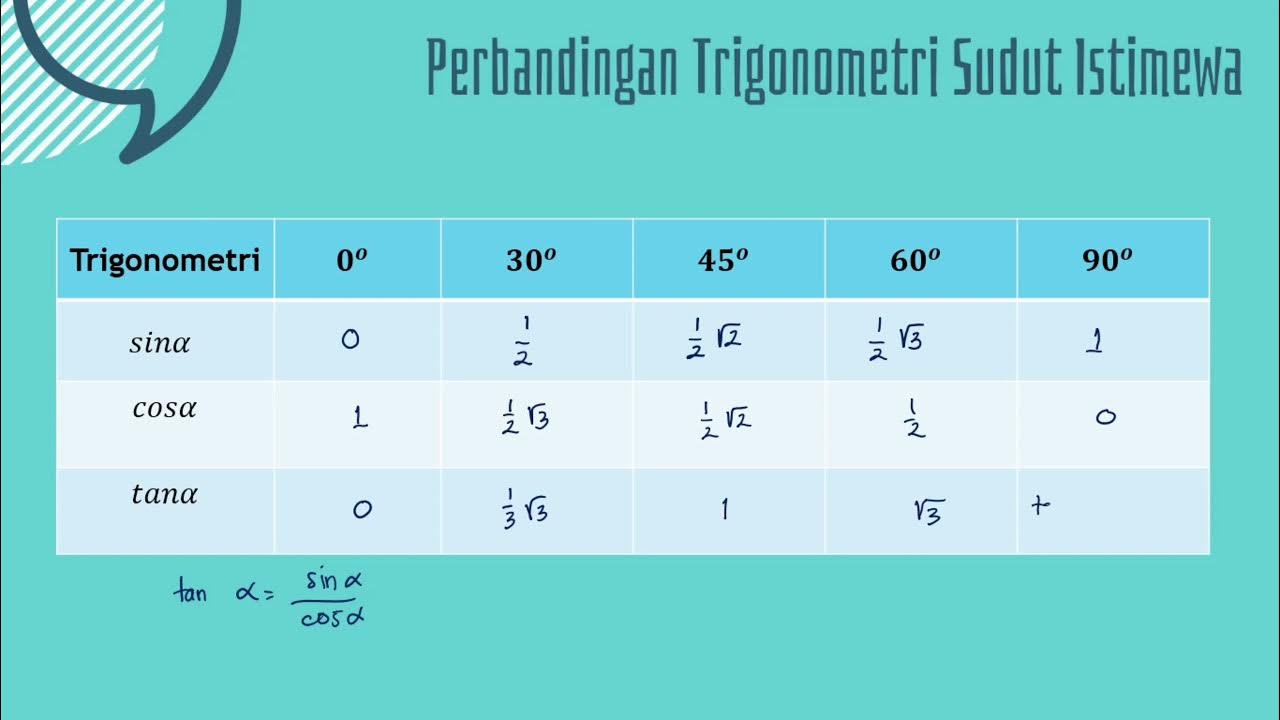
Perbandingan Trigonometri Sudut Istimewa
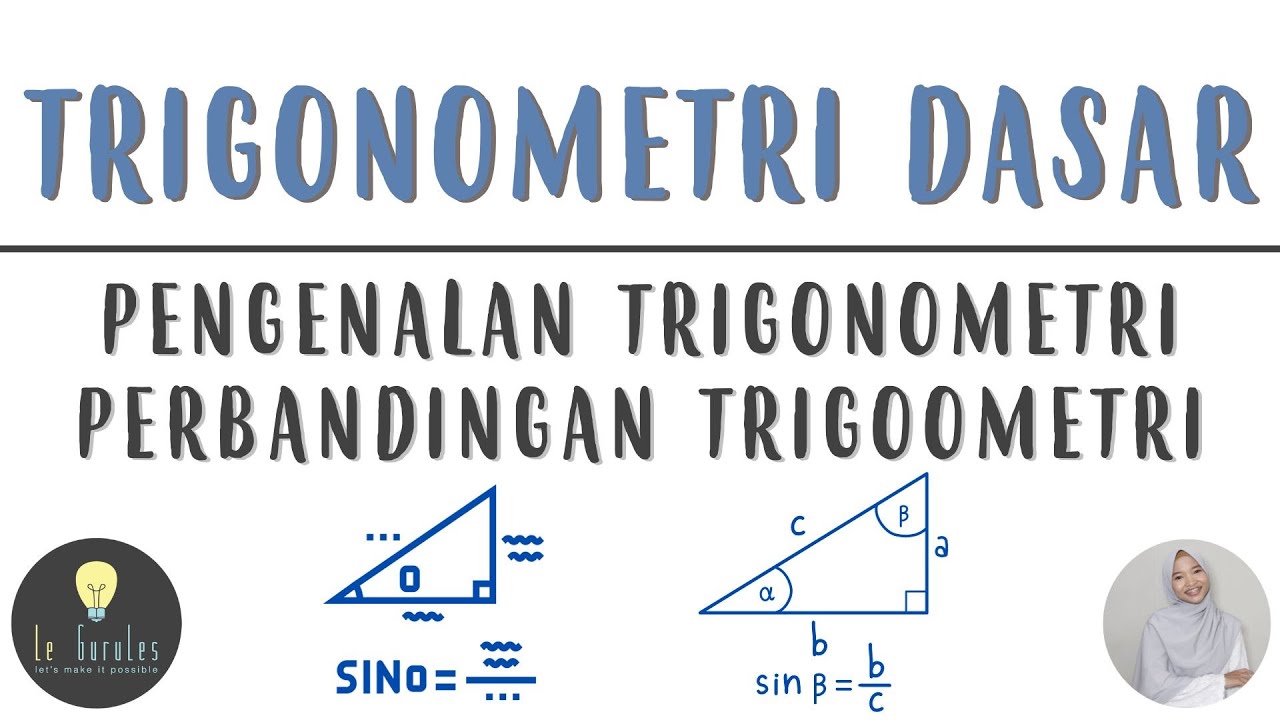
Matematika SMA - Trigonometri (1) - Pengenalan Trigonometri, Perbandingan Trigonometri (A)
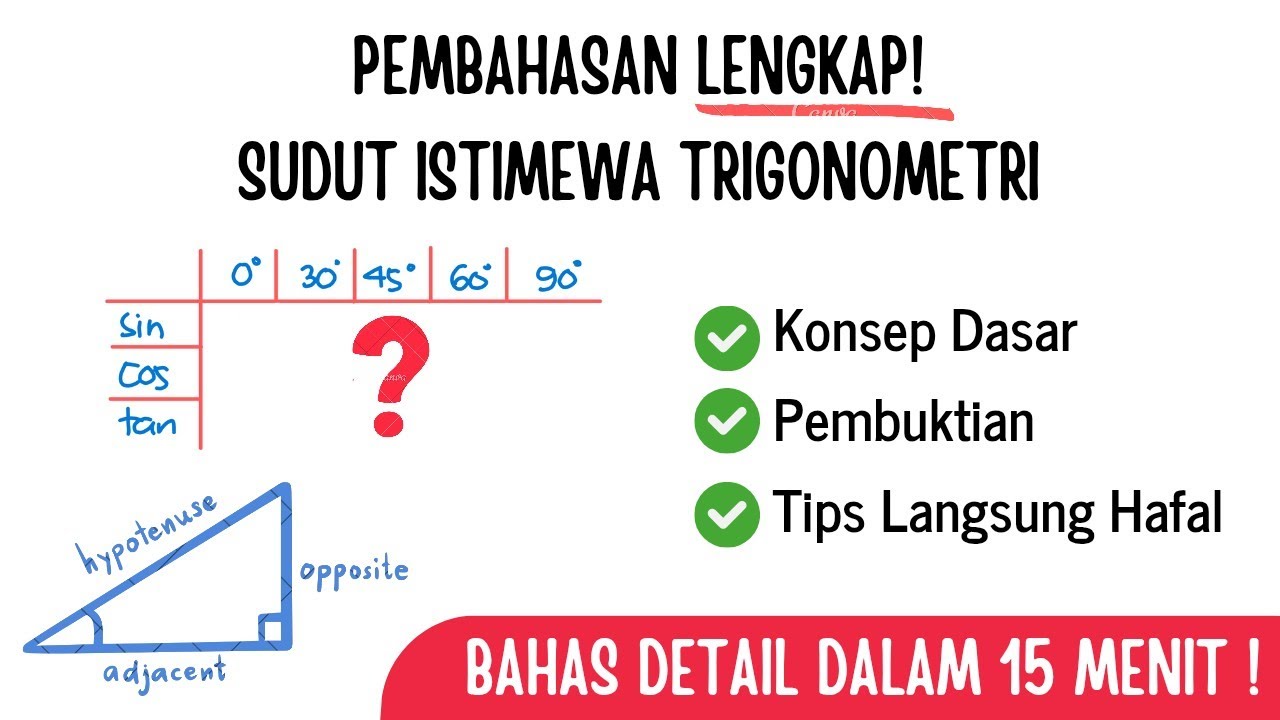
BAHAS LENGKAP SUDUT ISTIMEWA TRIGONOMETRI DALAM 15 MENIT!

Grade 10 Trigonometry: Trig Ratios Sin, Cos and Tan
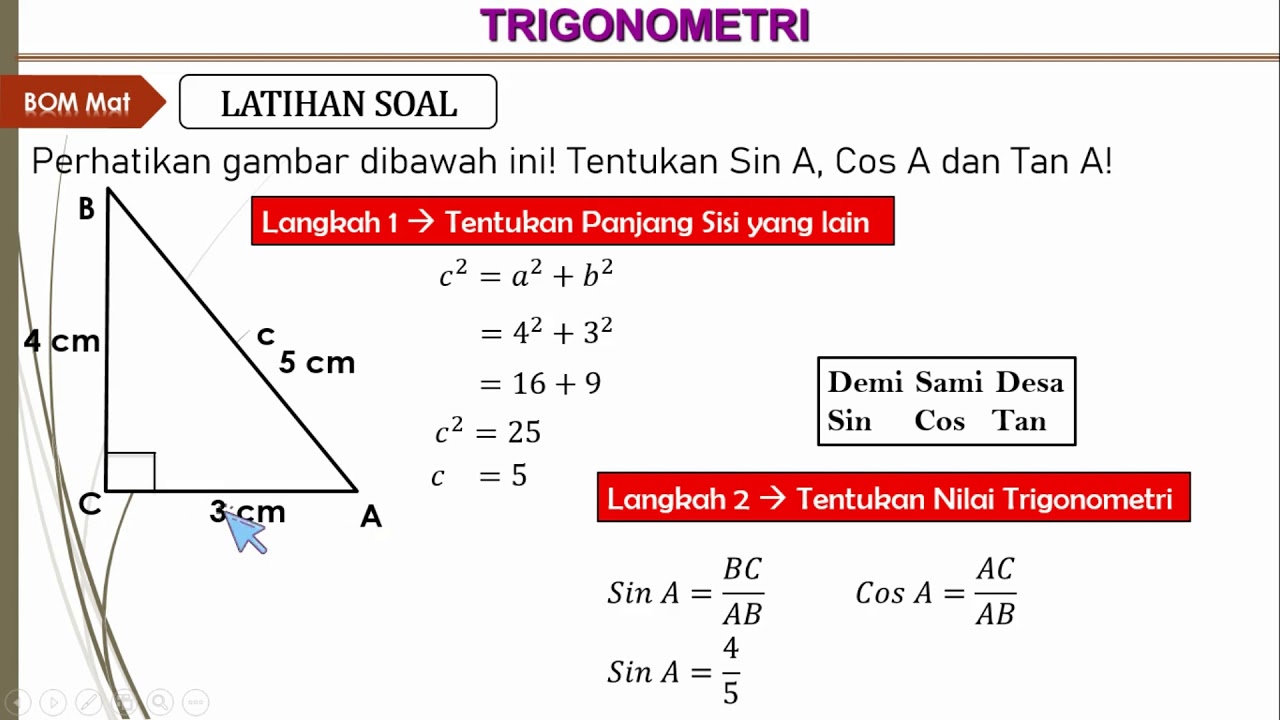
Perbandingan trigonometri pada segitiga siku siku, Menjelaskan rasio trigonometri

TRIGONOMETRI - Ukuran Sudut dan Perbandingan Trigonometri
5.0 / 5 (0 votes)
