jumlah dan selisih dua sudut trigonometri matematika peminatan kelas XI
Summary
TLDRThis video provides a thorough explanation of trigonometric identities and their application in solving problems. It covers key concepts like sine, cosine, and tangent sum and difference formulas, and demonstrates how to apply these identities with special angles. The tutor emphasizes the importance of memorizing values for key angles (0°, 30°, 45°, 60°, and 90°) to simplify calculations. Various examples, including the use of cosecant and tangent, are solved step by step, helping students understand how to work with trigonometric equations and improve their problem-solving skills.
Takeaways
- 😀 Memorizing key special angles (0°, 30°, 45°, 60°, 90°) is essential for simplifying trigonometric calculations.
- 😀 Understanding trigonometric identities (sin, cos, tan) and their signs is crucial for solving problems efficiently.
- 😀 The angle sum and difference identities (e.g., sin(a + b), cos(a - b)) help simplify expressions by breaking them into known angles.
- 😀 Memorizing the values of sin, cos, and tan for special angles (like 30°, 45°, 60°) saves time during calculations.
- 😀 The order of trigonometric functions matters: sin, cos, and tan alternate in certain identities (e.g., sin → cos → sin).
- 😀 Rationalizing denominators by multiplying by conjugates is a key strategy to simplify expressions.
- 😀 Cosecant (csc) is the reciprocal of sine (1/sin), and understanding this relationship helps with simplifying expressions.
- 😀 The tangent identity for angle sums involves addition and subtraction of the tangent values (e.g., tan(45° + 60°)) and using the correct sign in the formula.
- 😀 The method for simplifying trigonometric expressions requires practicing with different problems to get comfortable with the identities and signs.
- 😀 It’s important to understand the geometry behind trigonometric functions (e.g., right triangle relationships like the 3:4:5 Pythagorean triplet) to solve real-world problems.
Q & A
What is the key to understanding trigonometric sum and difference formulas in the context of special angles?
-The key is to first memorize the special angles (0°, 30°, 45°, 60°, 90°) and their sine and cosine values. Understanding how to manipulate these angles using sum and difference formulas helps in solving more complex trigonometric problems.
How does the sign of trigonometric functions change when adding or subtracting angles?
-When adding angles, the sine and cosine functions change signs depending on the quadrant. For example, if both angles are in the first quadrant, the result will have a positive sign, but if one angle is in the second quadrant, the sign may change.
What is the pattern when applying the sine and cosine formulas for addition and subtraction?
-For sine, the formula is: Sin(A + B) = SinA * CosB + CosA * SinB. For cosine, Cos(A + B) = CosA * CosB - SinA * SinB. The signs depend on whether you are adding or subtracting the angles.
How can one calculate Sin 75° using the sum of angles?
-Sin 75° can be calculated using the sum of angles as Sin(45° + 30°). The formula then becomes: Sin 45° * Cos 30° + Cos 45° * Sin 30°, and you can substitute known values of Sin 45° and Cos 30° to compute the result.
What is the formula for calculating Cos 15°?
-Cos 15° can be calculated using the difference of angles: Cos(45° - 30°). Using the identity Cos(A - B) = CosA * CosB + SinA * SinB, you substitute the known values for Cos 45° and Sin 30° to find the result.
What does the cosecant (csc) function represent and how is it related to sine?
-The cosecant (csc) function is the reciprocal of sine. So, csc θ = 1 / Sin θ. In the given example, to calculate csc 75°, you first find Sin 75° and then take the reciprocal of that value.
How is the tangent of an angle calculated when it is the sum of two angles?
-The tangent of the sum of two angles (A + B) is calculated using the formula: Tan(A + B) = (TanA + TanB) / (1 - TanA * TanB). The numerator is the sum of the tangents of the two angles, and the denominator is the difference of 1 and the product of the tangents.
What is the process for simplifying a tangent expression involving square roots, such as Tan(105°)?
-For Tan(105°), we use the sum of angles: Tan(45° + 60°). Using the tangent addition formula, the expression becomes: (Tan 45° + Tan 60°) / (1 - Tan 45° * Tan 60°). After substituting values, you simplify the expression by rationalizing the denominator.
How do you rationalize the denominator when dealing with square roots in trigonometric expressions?
-To rationalize the denominator, you multiply both the numerator and denominator by the conjugate of the denominator. For example, if you have a denominator like √2 + √6, you would multiply both the top and bottom by √2 - √6 to remove the square roots from the denominator.
How do you apply the Pythagorean theorem in trigonometry problems involving angles in different quadrants?
-The Pythagorean theorem is often used to find missing sides in a right triangle. In trigonometry, if you know the sine (opposite side) and hypotenuse of an angle, you can use the theorem to find the adjacent side (cosine). In the second quadrant, the tangent will be negative, but the sine remains positive.
Outlines

This section is available to paid users only. Please upgrade to access this part.
Upgrade NowMindmap

This section is available to paid users only. Please upgrade to access this part.
Upgrade NowKeywords

This section is available to paid users only. Please upgrade to access this part.
Upgrade NowHighlights

This section is available to paid users only. Please upgrade to access this part.
Upgrade NowTranscripts

This section is available to paid users only. Please upgrade to access this part.
Upgrade NowBrowse More Related Video

Limit Fungsi Trigonometri Matematika Kelas 12 • Part 1: Konsep dan Penurunan / Pembuktian Rumus

IDENTITAS TRIGONOMETRI
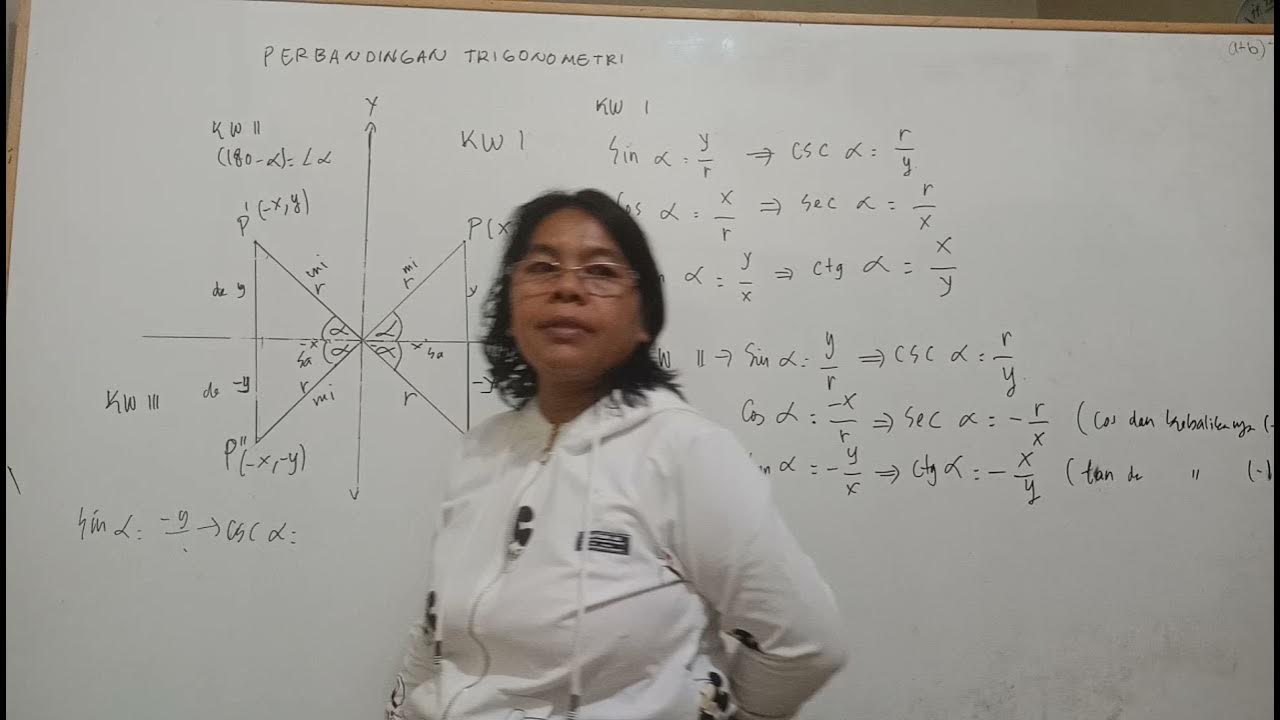
Perbandingan Trigonometri

RRB JE 2019 CLASSES/RRB NTPC 2019 /SSC CGL/SSC CHSL -MATHEMATICS CLASSES- 7-TRIGONOMETRY 3
APLIKASI TURUNAN TRIGONOMETRI | APLIKASI TURUNAN TRIGONOMETRI KELAS XII IPA
Pembahasan Soal Latihan Mandiri Trigonometri Dasar Matematika Wajib Kelas X
5.0 / 5 (0 votes)
