Hershey Chase DNA genetic Material Bill Nye
Summary
TLDRIn 1952, biologists Alfred Hershey and Martha Chase conducted groundbreaking experiments at Cold Spring Harbor Laboratory, revealing that DNA, not protein, carries genetic information. By using radioactive labeling, they discovered that only the DNA from a virus was able to direct bacterial cells to produce new viruses, fundamentally changing our understanding of genetics. Their innovative work, which included using a kitchen blender to separate bacterial cells from virus shells, earned Hershey the Nobel Prize in 1969 and sparked a new era of genetic research.
Takeaways
- 😀 In 1952, Alfred Hershey and Martha Chase conducted groundbreaking experiments at Cold Spring Harbor Laboratory.
- 😀 Their research focused on bacteriophages, viruses that infect bacteria through a process known as transformation.
- 😀 Bacteriophages consist of a protein shell and an inner substance, DNA (deoxyribonucleic acid).
- 😀 Hershey and Chase wanted to determine if the protein or DNA in the virus carried genetic information.
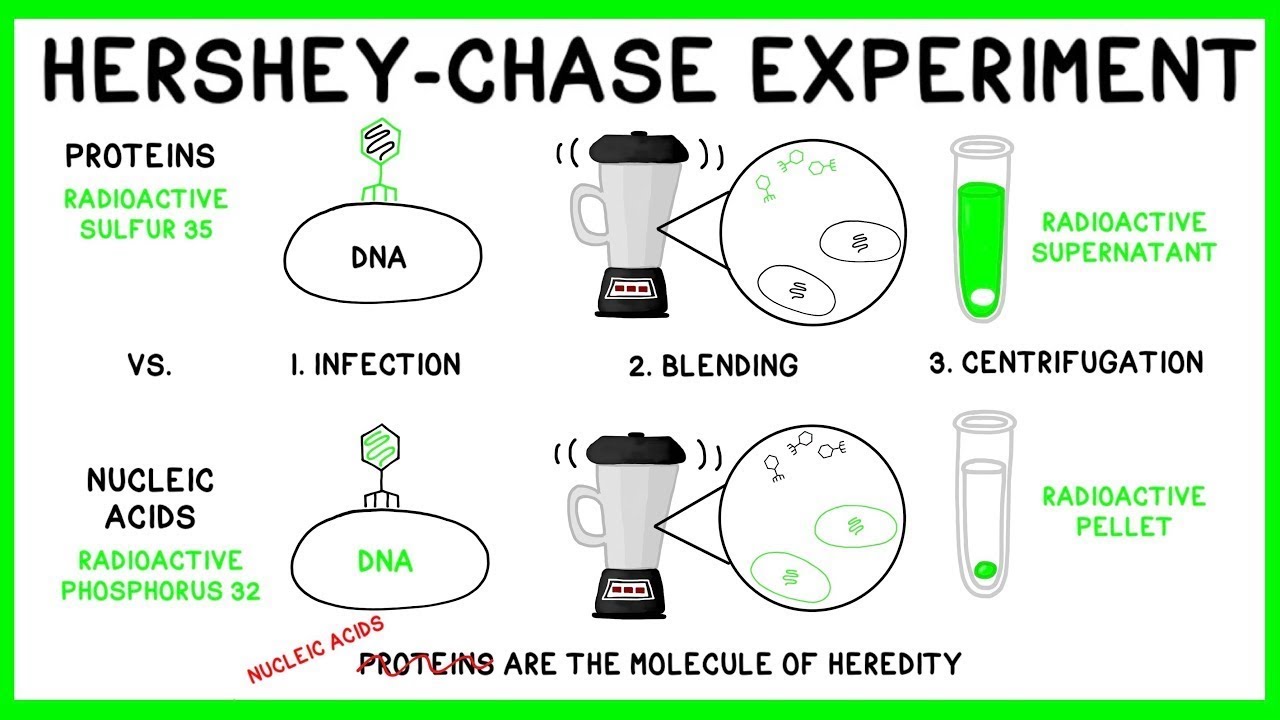
- 😀 They labeled the protein and DNA of bacteriophages with two different radioactive chemicals.
- 😀 E. coli bacteria were exposed to these labeled viruses to study the infection process.
- 😀 After using a kitchen blender to separate the bacteria from the viral shells, they discovered that the protein did not enter the bacteria.
- 😀 However, the DNA from the virus entered the bacterium and directed the host to produce new viruses.
- 😀 This experiment proved that DNA, not protein, is the carrier of genetic information.
- 😀 Hershey's work, along with the contributions of others, was instrumental in understanding DNA as the blueprint of life.
- 😀 Hershey was awarded the Nobel Prize in 1969 for his contributions to the discovery of DNA's role in genetics.
Q & A
What was the main research focus of Alfred Hershey and Martha Chase at Cold Spring Harbor Laboratory?
-Alfred Hershey and Martha Chase were focused on studying bacteriophage, a virus that infects bacteria through a process called transformation.
What are the two main components of a bacteriophage?
-A bacteriophage consists of two main components: a protein shell and DNA (deoxyribonucleic acid).
What was the objective of Hershey and Chase's experiment with bacteriophages?
-Hershey and Chase wanted to determine whether it was the protein or the DNA in the bacteriophage that carried the genetic information.
How did Hershey and Chase label the two components of the bacteriophage in their experiment?
-Hershey and Chase used two radioactive chemicals to label the protein in one set of bacteriophages and the DNA in another set.
What method did Hershey and Chase use to separate the bacteria from the viral protein shells?
-They used a kitchen blender to separate the bacteria from the empty viral protein shells.
What did Hershey and Chase discover about the behavior of the protein and DNA in their experiment?
-They discovered that the radioactive protein did not penetrate the bacterial wall, but the radioactive DNA did, indicating that the DNA carried the genetic information.
What was the significance of the discovery made by Hershey and Chase?
-The discovery showed that DNA, not protein, is the material that carries genetic information, which was a groundbreaking finding in genetics.
Why is the experiment conducted by Hershey and Chase often referred to as a breakthrough?
-It was a breakthrough because it confirmed that DNA is the genetic material, providing clarity on how genetic information is passed on and revolutionizing the field of genetics.
What role did the blender play in Hershey and Chase's experiment?
-The blender was used to separate the bacteria from the viral protein shells, allowing them to analyze the components inside the bacteria.
What recognition did Alfred Hershey receive for his work on this experiment?
-Alfred Hershey was awarded the Nobel Prize in 1969 for his groundbreaking work on the bacteriophage experiment with Martha Chase.
Outlines

This section is available to paid users only. Please upgrade to access this part.
Upgrade NowMindmap

This section is available to paid users only. Please upgrade to access this part.
Upgrade NowKeywords

This section is available to paid users only. Please upgrade to access this part.
Upgrade NowHighlights

This section is available to paid users only. Please upgrade to access this part.
Upgrade NowTranscripts

This section is available to paid users only. Please upgrade to access this part.
Upgrade Now

5.0 / 5 (0 votes)
