Review: Sampling Distribution of the Sample Proportion, Binomial Distribution, Probability (7.5)
Summary
TLDRThis video provides an in-depth review of probability concepts, focusing on the binomial distribution and sampling distribution of the sample proportion. Using practical examples like drawing marbles from a jar, it demonstrates how to calculate probabilities for various outcomes, including using the binomial formula for multiple trials. The video also explains how the central limit theorem applies to sampling distributions and illustrates the calculation of approximate probabilities for large sample sizes. It emphasizes the importance of understanding these foundational concepts in statistics for solving real-world problems.
Takeaways
- 😀 The video reviews concepts related to probability, binomial distribution, and the sampling distribution of the sample proportion.
- 😀 The probability of drawing a green marble from a jar with 200 green and 300 blue marbles is 0.4, while the probability of drawing a blue marble is 0.6.
- 😀 For a probability problem involving drawing 3 marbles with replacement, the sample space includes all possible combinations of drawing green and blue marbles.
- 😀 To calculate the probability of drawing at least two green marbles, sum the probabilities of drawing exactly two and exactly three green marbles.
- 😀 The final probability of drawing at least two green marbles when drawing 3 times is 0.352.
- 😀 When drawing 5 marbles with replacement, the binomial formula can be used to calculate the probability of getting exactly two, three, four, or five green marbles.
- 😀 The binomial formula is used to calculate probabilities for exact numbers of successes (e.g., drawing exactly two green marbles out of five).
- 😀 For a question involving 100 draws, using the binomial formula for all outcomes is not feasible, so the sampling distribution of the sample proportion can be used.
- 😀 The central limit theorem is applied to check if the sampling distribution of the sample proportion can be used. This is based on two conditions involving the sample size and probability of success.
- 😀 For a scenario with 100 marbles drawn, the probability of drawing at least 35 green marbles is approximately 84.61% using the standardization formula for proportions and the z-score table.
Q & A
What is the probability of drawing a green marble in a jar containing 200 green marbles and 300 blue marbles?
-The probability of drawing a green marble is calculated by dividing the number of green marbles by the total number of marbles. So, the probability is 200 / 500 = 0.4.
What does the term 'probability of success' mean in this context?
-'Probability of success' refers to the likelihood of drawing a green marble, which in this case is 0.4, as it represents the fraction of green marbles in the jar.
How do you calculate the probability of drawing at least two green marbles when drawing three times with replacement?
-To find the probability of drawing at least two green marbles, we calculate the probability of drawing exactly two green marbles and exactly three green marbles, then add them together. The result is 0.352.
How do you calculate the probability of drawing exactly two green marbles in three draws?
-The probability of drawing exactly two green marbles is the sum of the probabilities for all possible sequences where two marbles are green and one is blue. For example, GGB, GBG, and BGG all have a probability of 0.096, which gives a total of 0.288.
What does the binomial formula calculate?
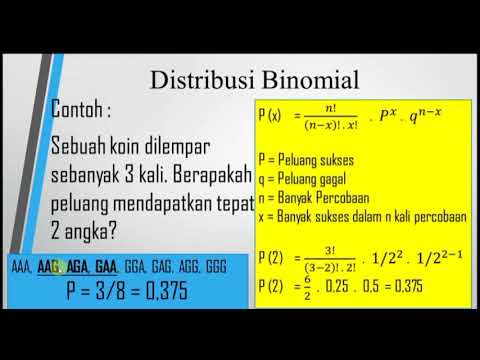
-The binomial formula calculates the probability of obtaining a specific number of successes (k) in a fixed number of trials (n), with a known probability of success (p).
How is the binomial formula applied when drawing five marbles with replacement?
-The binomial formula is applied by calculating the probability of drawing exactly 2, 3, 4, and 5 green marbles in 5 draws. The individual probabilities are then added to get the final result, which in this case is 0.6634.
What is the central limit theorem, and how is it applied in probability calculations?
-The central limit theorem states that, for large enough sample sizes, the distribution of sample proportions will be approximately normal, regardless of the original distribution. It is used to approximate probabilities when calculating large sample proportions, as in the case of drawing 100 marbles.
What are the two conditions for applying the central limit theorem?
-The two conditions are: (1) n * P should be greater than or equal to 10, and (2) n * (1 - P) should also be greater than or equal to 10. These conditions ensure that the sampling distribution is approximately normal.
How is the standardization formula used to calculate the probability of drawing at least 35 green marbles in 100 draws?
-The standardization formula is used to calculate the z-score, which is then looked up in a z-table to find the probability. For this problem, the z-score is -1.02, which corresponds to an area of 0.1539 to the left, so the area to the right (or the probability) is 0.8461.
Why is the result from using the central limit theorem considered an approximation?
-The central limit theorem provides an approximate probability, not an exact one, because it assumes that the sampling distribution is normal, which is an approximation for large sample sizes. The exact probability would require more precise methods like extending the sample space or using the binomial formula.
Outlines

This section is available to paid users only. Please upgrade to access this part.
Upgrade NowMindmap

This section is available to paid users only. Please upgrade to access this part.
Upgrade NowKeywords

This section is available to paid users only. Please upgrade to access this part.
Upgrade NowHighlights

This section is available to paid users only. Please upgrade to access this part.
Upgrade NowTranscripts

This section is available to paid users only. Please upgrade to access this part.
Upgrade NowBrowse More Related Video
Binomial distribution # Explanation with notes# Properties of binomial distribution.

Probabilitas dan Statistik: 8.6 Central Limit Theorem
Sesi 5 4 Distribusi Probabilitas Bagian 4
Distribusi Binomial • Part 6: Contoh Soal Distribusi Peluang Variabel Acak Diskrit (3)
Types Of Distribution In Statistics | Probability Distribution Explained | Statistics | Simplilearn
Distribusi Probabilitas Diskrit - Sesi 7 & 8 Statistik Bisnis
5.0 / 5 (0 votes)
