Kelarutan dan Hasil Kali Kelarutan (part 1)
Summary
TLDRIn this engaging chemistry lesson, Udin from Kim UD explains the concepts of solubility and the solubility product (KSP) in a clear, step-by-step manner. The video covers definitions, units, and formulas for molarity and solubility, then demonstrates how to calculate KSP for various compounds like AgCl, Mg(OH)₂, Al(OH)₃, and BaF₂. Udin provides practical tips for simplifying calculations, shows worked examples, and encourages viewers to practice with additional problems. The lesson combines detailed explanations with a conversational style, making it easy for students to understand the relationships between ion concentrations, stoichiometry, and solubility in saturated solutions.
Takeaways
- 😀 The video introduces solubility (kelarutan) and solubility product (Ksp) as key chemistry concepts.
- 😀 Solubility (S) represents the maximum concentration of a solute that can dissolve in a solvent, measured in molarity (M).
- 😀 High solubility means a substance dissolves easily, while low solubility indicates it tends to precipitate.
- 😀 Molarity (M) can be calculated using the formula: M = moles of solute / volume of solution (L).
- 😀 Alternate formulas for molarity include M = mass of solute / (molar mass × volume) or incorporating percentage concentration and density.
- 😀 The solubility product constant (Ksp) is defined as the product of ion concentrations raised to the power of their coefficients in the balanced equation.
- 😀 Ksp formulas can be derived using ionization equations and a shortcut formula: Ksp = x^x * y^y * S^(x+y) for compounds with coefficients x and y.
- 😀 Examples covered include Mg(OH)2, Al(OH)3, AgCl, and BaF2, illustrating how to calculate Ksp from solubility values.
- 😀 The step-by-step approach involves converting grams to moles, determining solubility, and then calculating Ksp using the appropriate formula.
- 😀 Practice exercises are suggested with compounds like Al(OH)3 and Ca3(PO4)2 to reinforce understanding of Ksp and solubility concepts.
Q & A
What is solubility and how is it represented in chemistry?
-Solubility is the maximum concentration of a solute that can dissolve in a solvent at a given temperature. It is represented by the symbol 'S', derived from the English word 'solubility'.
What does a higher solubility value indicate about a substance?
-A higher solubility value indicates that the substance dissolves more easily in a solvent, meaning it is more 'soluble' and less likely to precipitate.
What is the relationship between solubility and precipitation?
-The smaller the solubility, the more difficult it is for the substance to dissolve, meaning it is more likely to precipitate. Conversely, high solubility means the substance is less likely to form a precipitate.
How is molarity (M) calculated?
-Molarity is calculated as the number of moles of solute divided by the volume of solution in liters (M = moles/volume). Moles can be found using the formula moles = mass (g) / molar mass (Mr).
What is the solubility product constant (Ksp)?
-The solubility product constant (Ksp) is an equilibrium constant that represents the product of the molar concentrations of the ions in a saturated solution, each raised to the power of their coefficients in the balanced chemical equation.
How do you determine the Ksp for Mg(OH)2?
-For Mg(OH)2, which dissociates as Mg(OH)2 ⇌ Mg²⁺ + 2OH⁻, the Ksp formula is Ksp = [Mg²⁺][OH⁻]². If the solubility is S, then [Mg²⁺] = S and [OH⁻] = 2S, so Ksp = S*(2S)² = 4S³.
What is the general formula to calculate Ksp for any ionic compound?
-For a general compound AmBn, the Ksp can be calculated using Ksp = [A^n+]^m [B^m-]^n. Alternatively, a simplified formula is x^x * y^y * S^(x+y), where x and y are the stoichiometric coefficients and S is the solubility.
How is the solubility of AgCl used to calculate its Ksp?
-AgCl dissociates as AgCl ⇌ Ag⁺ + Cl⁻. If its solubility is 2 × 10⁻⁸ M, then Ksp = [Ag⁺][Cl⁻] = (2 × 10⁻⁸)² = 4 × 10⁻¹⁶.
How can you calculate Ksp from a given mass of a compound like BaF2?
-First, convert the mass to moles using molar mass and volume to find solubility S. For BaF2 (BaF2 ⇌ Ba²⁺ + 2F⁻), Ksp = [Ba²⁺][F⁻]² = S*(2S)² = 4S³. Plug in the calculated S to determine Ksp.
Why is the simplified Ksp formula helpful when the ions cannot be easily ionized mentally?
-The simplified formula (x^x * y^y * S^(x+y)) allows students to calculate Ksp directly from solubility without fully writing out the ionic dissociation, reducing potential errors and saving time.
What are some practice exercises suggested to reinforce understanding of Ksp?
-The transcript suggests calculating Ksp for compounds such as Al(OH)3 and Ca3(PO4)2 to apply the formula, understand stoichiometry, and strengthen skills in connecting solubility to Ksp.
Outlines

Этот раздел доступен только подписчикам платных тарифов. Пожалуйста, перейдите на платный тариф для доступа.
Перейти на платный тарифMindmap

Этот раздел доступен только подписчикам платных тарифов. Пожалуйста, перейдите на платный тариф для доступа.
Перейти на платный тарифKeywords

Этот раздел доступен только подписчикам платных тарифов. Пожалуйста, перейдите на платный тариф для доступа.
Перейти на платный тарифHighlights

Этот раздел доступен только подписчикам платных тарифов. Пожалуйста, перейдите на платный тариф для доступа.
Перейти на платный тарифTranscripts

Этот раздел доступен только подписчикам платных тарифов. Пожалуйста, перейдите на платный тариф для доступа.
Перейти на платный тарифПосмотреть больше похожих видео

kelarutan Dan Hasil Kali kelarutan (2) | Pengaruh Ion Sejenis atau Senama | Kimia kelas 11

Kelarutan dan Hasil Kali Kelarutan (1) | Hubungan S dgn Ksp | Kimia Kelas 11

Kelarutan dan KSP | Kimia SMA | Tetty Afianti

Kelarutan dan Hasil Kali Kelarutan (Ksp) Kimia Kelas 11 • Part 1: Konsep, Hubungan Kelarutan dan Ksp

PEKI4205 Kimia Analitik I - Analisis Gravimetri
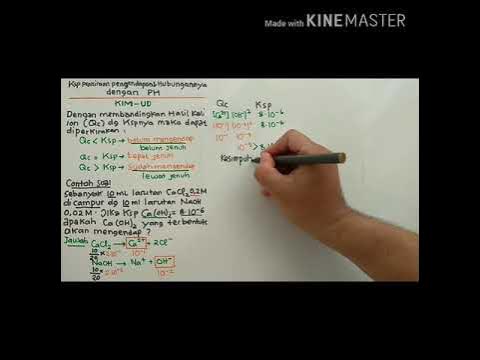
Ksp, Prakiraan Pengendapan dan Hubungan Ksp dg pH
5.0 / 5 (0 votes)

