Material Properties 101
Summary
TLDRThis video introduces six key material properties: stiff, strong, ductile, brittle, tough, and hard, helping viewers understand how materials behave under stress and why they're used in different applications. The video explains the tensile test, stress-strain curves, and important properties like Young’s Modulus, yield strength, and ultimate tensile strength. It covers the difference between ductile and brittle materials, illustrating how some can change characteristics with temperature. The hardness of materials is also discussed, with practical applications like sword making and steel heat treatment. The video ends with a sponsor message about affordable college programs through Lumerit.
Takeaways
- 😀 Understanding material properties is essential for explaining why certain materials are used in different applications.
- 😀 The six key material properties to know are: stiff, strong, ductile, brittle, tough, and hard.
- 😀 A tensile test measures a material's response to stress and strain by pulling it apart until failure.
- 😀 Stress in a tensile test is calculated by force divided by the material's cross-sectional area, measured in Pascals.
- 😀 Strain is the deformation of a material, found by dividing the change in length by the original length.
- 😀 The stress-strain graph shows elastic (reversible) and plastic (permanent) deformation, with a yield point marking the transition between the two.
- 😀 Young's Modulus (elastic modulus) describes the stiffness of a material and is derived from the slope of the elastic deformation portion of the stress-strain curve.
- 😀 Yield strength and ultimate tensile strength are critical in determining a material's maximum stress limits for design purposes.
- 😀 Toughness refers to a material's ability to absorb energy without breaking, while ductility refers to a material's ability to deform under stress.
- 😀 Hardness is related to stiffness and yield strength, and is measured using tests like the Rockwell hardness test, which determines a material's resistance to denting and scratching.
Q & A
What are the six key material properties discussed in the video?
-The six key material properties discussed are: stiff, strong, ductile, brittle, tough, and hard.
What is a tensile test and what information does it provide?
-A tensile test is a fundamental material mechanics test that involves pulling a sample of material apart until it fails while measuring force and displacement. It provides a stress/strain curve, which helps determine properties like Young's Modulus, yield strength, and ultimate tensile strength.
What does the stress/strain curve represent?
-The stress/strain curve represents the relationship between the force applied to a material and the deformation it undergoes. Stress is plotted on the Y-axis, and strain is plotted on the X-axis.
What is Young's Modulus, and what does it tell us about a material?
-Young's Modulus, also known as the elastic modulus, is a measure of a material's stiffness. A higher Young's Modulus indicates a stiffer material, while a lower value indicates a more flexible material.
What is the difference between yield strength and ultimate tensile strength?
-Yield strength is the amount of stress a material can withstand before permanent deformation begins, while ultimate tensile strength is the maximum stress a material can handle before it fractures.
How do engineers use yield and ultimate tensile strength in design?
-Engineers divide the yield or ultimate tensile strength by a safety factor to determine the maximum allowable stress for a material, influencing product design to ensure it can handle expected loads without failure.
What is the meaning of 'toughness' in materials?
-Toughness refers to a material's ability to absorb energy without breaking. It is represented by the area under the stress/strain curve, indicating how much energy the material can absorb before failure.
What does 'ductility' mean in terms of material behavior?
-Ductility describes a material's ability to deform under stress without breaking. Ductile materials can be stretched or bent significantly before failure.
How can you differentiate between a ductile and brittle material based on fracture surfaces?
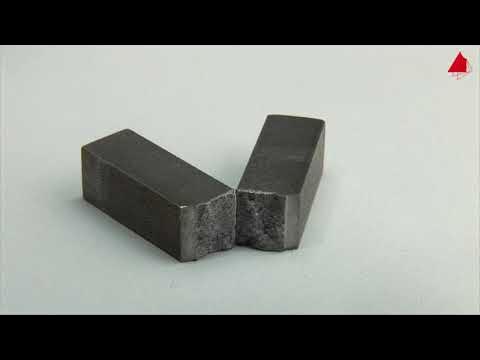
-A ductile material typically shows a cup-and-cone fracture surface, whereas a brittle material will exhibit a granular, flat fracture surface.
What is the significance of hardness in materials, and how is it measured?
-Hardness describes how resistant a material is to denting, scratching, and abrasion. It is measured using tests like the Rockwell hardness test, which involves applying a load to an indenter and measuring the resulting indentation depth.
Outlines

Этот раздел доступен только подписчикам платных тарифов. Пожалуйста, перейдите на платный тариф для доступа.
Перейти на платный тарифMindmap

Этот раздел доступен только подписчикам платных тарифов. Пожалуйста, перейдите на платный тариф для доступа.
Перейти на платный тарифKeywords

Этот раздел доступен только подписчикам платных тарифов. Пожалуйста, перейдите на платный тариф для доступа.
Перейти на платный тарифHighlights

Этот раздел доступен только подписчикам платных тарифов. Пожалуйста, перейдите на платный тариф для доступа.
Перейти на платный тарифTranscripts

Этот раздел доступен только подписчикам платных тарифов. Пожалуйста, перейдите на платный тариф для доступа.
Перейти на платный тариф




5.0 / 5 (0 votes)

