Pola Bilangan (2) | Barisan dan Deret Aritmatika | Matematika Kelas 8
Summary
TLDRThis educational video explores arithmetic sequences and series for 8th-grade mathematics. It explains arithmetic sequences as patterns where the difference between consecutive terms is constant, distinguishing between increasing and decreasing sequences. The video demonstrates how to identify sequences, calculate specific terms using the formula Uₙ = a + (n-1)b, and find the sum of terms with Sₙ = n/2 × (a + Uₙ). Through clear examples, viewers learn to determine sequence terms and sums efficiently without listing all elements. The content combines definitions, formulas, and step-by-step problem-solving, making it an accessible guide for mastering arithmetic sequences and series.
Takeaways
- 😀 Arithmetic sequences are number patterns where the difference between consecutive terms is constant.
- 😀 The difference between terms in an arithmetic sequence is called the common difference, denoted as 'b'.
- 😀 To check if a sequence is arithmetic, subtract each term from the previous one and see if the result is constant.
- 😀 Positive common difference indicates an increasing arithmetic sequence, while a negative difference indicates a decreasing sequence.
- 😀 The nth term of an arithmetic sequence can be calculated using the formula: U_n = a + (n-1) * b, where 'a' is the first term.
- 😀 You do not need to list all terms to find a specific term; the formula allows direct computation.
- 😀 Example: For the sequence 1, 5, 9, 13..., the 21st term is 81.
- 😀 Arithmetic series is the sum of terms in an arithmetic sequence, denoted as S_n.
- 😀 The sum of the first n terms of an arithmetic series can be calculated using S_n = n/2 * (2a + (n-1)b) or S_n = n/2 * (a + U_n).
- 😀 Example: The sum of the first 20 terms of the sequence 1, 5, 9, 13... is 780.
- 😀 The formulas for nth term and sum of n terms simplify solving problems without listing each term individually.
- 😀 Understanding arithmetic sequences and series helps solve real-life problems and more complex mathematical tasks efficiently.
Q & A
What is an arithmetic sequence?
-An arithmetic sequence is a sequence of numbers in which the difference between consecutive terms is constant. This constant difference is called the 'common difference'.
How can you determine if a sequence is arithmetic?
-To determine if a sequence is arithmetic, subtract each term from the next one. If the difference is constant, the sequence is arithmetic.
What does the symbol Un represent in an arithmetic sequence?
-Un represents the nth term of an arithmetic sequence, where 'n' is the position of the term in the sequence.
What is the formula to calculate the nth term (Un) of an arithmetic sequence?
-The formula for the nth term (Un) of an arithmetic sequence is Un = a + (n - 1) * b, where 'a' is the first term and 'b' is the common difference.
What is the difference between an arithmetic sequence and an arithmetic series?
-An arithmetic sequence is a list of numbers in a specific order with a constant difference between consecutive terms. An arithmetic series, on the other hand, is the sum of the terms in an arithmetic sequence.
How can you find the sum of the first 'n' terms of an arithmetic series?
-The sum of the first 'n' terms of an arithmetic series can be found using the formula Sn = (n / 2) * (2a + (n - 1) * b), where 'a' is the first term, 'b' is the common difference, and 'n' is the number of terms.
What does it mean when an arithmetic sequence is described as 'increasing' or 'decreasing'?
-An arithmetic sequence is described as 'increasing' when the common difference is positive, meaning the terms get larger. It is 'decreasing' when the common difference is negative, meaning the terms get smaller.
How can you find the 21st term of the sequence 1, 5, 9, 13, ...?
-To find the 21st term, use the formula Un = a + (n - 1) * b. Here, a = 1, b = 4, and n = 21. Thus, U21 = 1 + (21 - 1) * 4 = 1 + 80 = 81.
How do you calculate the sum of the first 20 terms of the sequence 1, 5, 9, 13, ...?
-To find the sum of the first 20 terms, use the sum formula Sn = (n / 2) * (2a + (n - 1) * b). With a = 1, b = 4, and n = 20, S20 = (20 / 2) * (2 * 1 + (20 - 1) * 4) = 10 * (2 + 76) = 10 * 78 = 780.
What is the sum of the first 50 terms of the sequence 20, 18, 16, 14, ...?
-To find the sum of the first 50 terms, use the sum formula Sn = (n / 2) * (2a + (n - 1) * b). Here, a = 20, b = -2, and n = 50. Thus, S50 = (50 / 2) * (2 * 20 + (50 - 1) * -2) = 25 * (40 - 98) = 25 * (-58) = -1450.
Outlines

このセクションは有料ユーザー限定です。 アクセスするには、アップグレードをお願いします。
今すぐアップグレードMindmap

このセクションは有料ユーザー限定です。 アクセスするには、アップグレードをお願いします。
今すぐアップグレードKeywords

このセクションは有料ユーザー限定です。 アクセスするには、アップグレードをお願いします。
今すぐアップグレードHighlights

このセクションは有料ユーザー限定です。 アクセスするには、アップグレードをお願いします。
今すぐアップグレードTranscripts

このセクションは有料ユーザー限定です。 アクセスするには、アップグレードをお願いします。
今すぐアップグレード関連動画をさらに表示
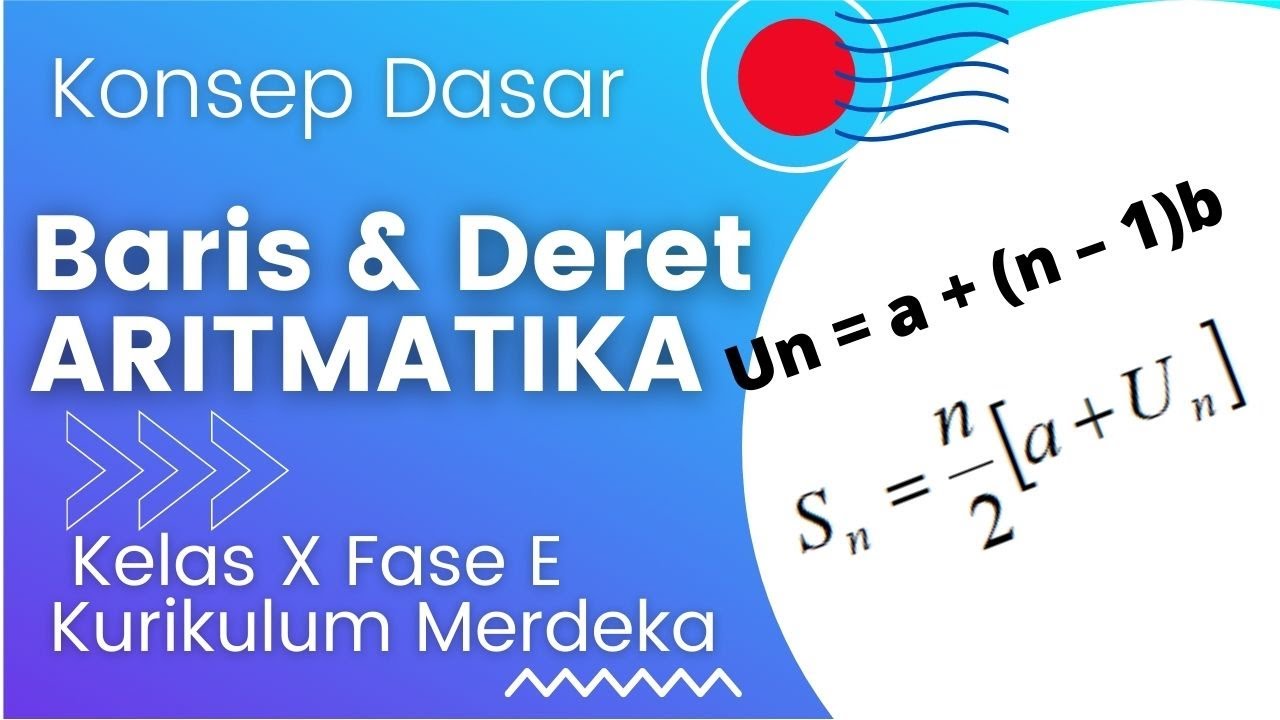
Konsep Dasar Baris dan Deret Aritmatika | Matematika Kelas X Fase E Kurikulum Merdeka

Pembahasan BARISAN DAN DERET (Aritmetika & Geometri) KELAS 11 | #MatematikAsik
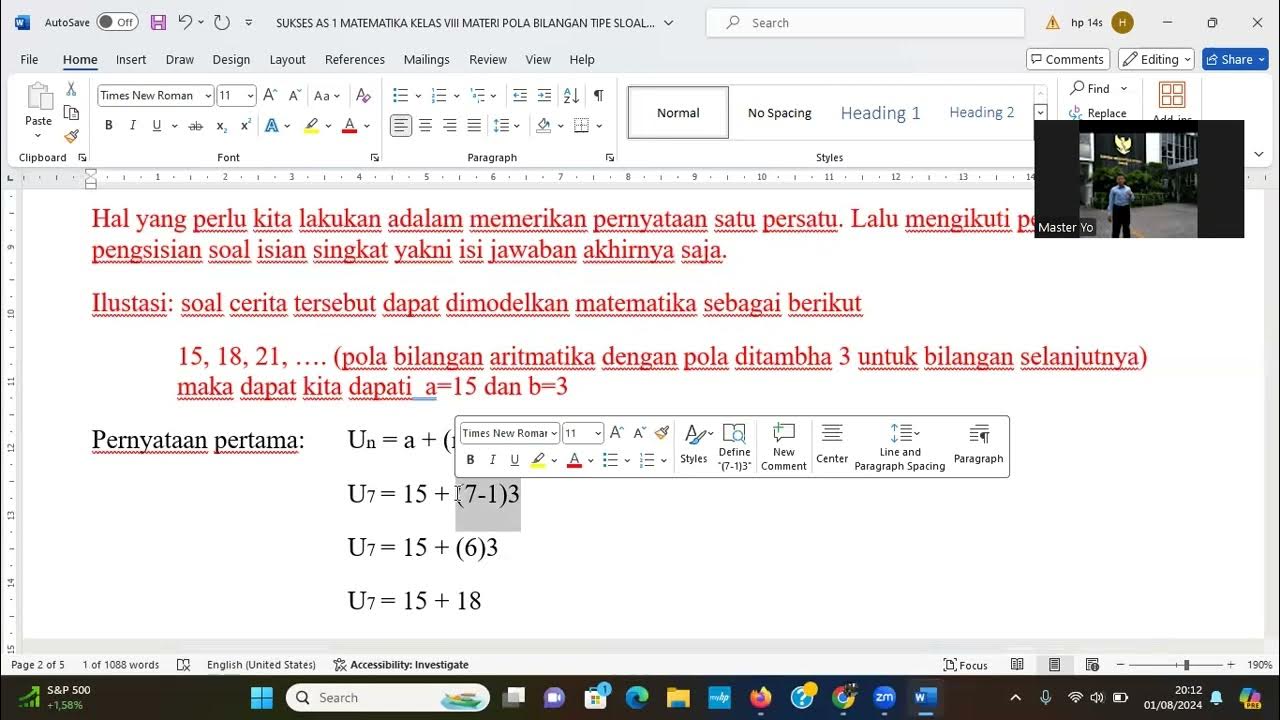
Latihan Soal Pola Bilangan
Pola Bilangan (5) | Barisan dan Deret Geometri
Pola Bilangan [Part 1] - Mengenal Pola Bilangan

pola bilangan kelas 8 part 1 (mudah)
5.0 / 5 (0 votes)

