penentuan pH asam dan basa
Summary
TLDRThis video lesson provides a detailed guide on calculating the pH of acids and bases. It covers identifying strong and weak acids and bases, memorization tips for common substances, and the process of ionization. The instructor explains step-by-step calculations for H⁺ and OH⁻ concentrations, using valence and molarity, and demonstrates converting these values to pH or pOH. Examples include strong acids like HCl, weak acids like CH₃COOH, strong bases like NaOH, and bases with multiple valences. The lesson emphasizes understanding the differences in approach for strong versus weak substances and offers practical strategies for mastering pH calculations effectively.
Takeaways
- 😀 A good understanding of strong and weak acids and bases is essential for calculating pH.
- 😀 For strong acids like HCl, the ionization is straightforward, and the concentration of H+ equals the molarity of the solution.
- 😀 Weak acids, such as CH3COOH, require the use of the ionization constant (Ka) for calculating the concentration of H+.
- 😀 The pH of a solution is calculated using the formula: pH = -log[H+].
- 😀 The process of ionization separates a solution into cations and anions, which is crucial for understanding pH calculations.
- 😀 For bases, the first step is to calculate the OH- concentration, and then the pH can be derived from pOH using the equation: pH = 14 - pOH.
- 😀 For strong bases like NaOH, the concentration of OH- equals the molarity of the solution, similar to strong acids.
- 😀 Weak bases like NH3 require the use of their ionization constant (Kb) for calculating the OH- concentration.
- 😀 Remember that for weak acids and bases, the ionization process is in equilibrium, and you must account for this in your calculations.
- 😀 The valency of acids and bases impacts their ionization, with polyprotic acids and bases releasing more than one ion per molecule.
Q & A
What is the importance of understanding whether an acid or base is strong or weak in calculating pH?
-Knowing whether an acid or base is strong or weak is crucial because it determines the ionization behavior in solution. Strong acids and bases dissociate completely, while weak acids and bases only partially dissociate. This affects how we calculate their pH using different formulas.
What are some common strong acids and bases mentioned in the transcript?
-Some common strong acids mentioned are HCl, HNO3, and H2SO4, while common strong bases include NaOH, KOH, and Ca(OH)2.
What mnemonic is used to help remember the strong acids?
-The mnemonic 'celana kolor baru sobek itu neraka' is used to remember strong acids: HCl, HClO4, HNO3, and H2SO4.
How can we determine if an acid or base is strong or weak?
-We determine if an acid or base is strong or weak based on its ability to dissociate in water. Strong acids and bases dissociate completely, while weak acids and bases only partially dissociate.
What formula is used to calculate pH for a strong acid?
-For a strong acid, the pH is calculated using the formula pH = -log[H+], where [H+] is the concentration of hydrogen ions in the solution.
How is the pH of a weak acid calculated differently from a strong acid?
-For a weak acid, we use the formula pH = -log(√(Ka * [acid])), where Ka is the acid dissociation constant, and [acid] is the molarity of the acid. This is different from strong acids, where the pH is directly calculated from the concentration of H+ ions.
What is the role of the acid dissociation constant (Ka) in calculating pH for a weak acid?
-The acid dissociation constant (Ka) represents the extent to which a weak acid dissociates in water. A higher Ka means a stronger acid, and we use it to find the concentration of hydrogen ions in a weak acid solution, which is then used to calculate pH.
How do you calculate pH for a base like NaOH?
-For a strong base like NaOH, the pH is calculated in two steps: first, find the pOH by calculating -log[OH-], and then use the relationship pH = 14 - pOH to find the pH.
What is the significance of using valence when calculating pH for strong acids or bases?
-Valence refers to the number of hydrogen ions (H+) or hydroxide ions (OH-) produced by an acid or base when it dissociates. This affects the final concentration of H+ or OH- ions, which is essential for calculating pH.
How do you calculate pH for a weak base like NH3?
-For a weak base like NH3, the pH is calculated by first determining the concentration of OH- ions using the base dissociation constant (Kb). Then, find the pOH, and finally use the equation pH = 14 - pOH to calculate the pH.
Outlines

このセクションは有料ユーザー限定です。 アクセスするには、アップグレードをお願いします。
今すぐアップグレードMindmap

このセクションは有料ユーザー限定です。 アクセスするには、アップグレードをお願いします。
今すぐアップグレードKeywords

このセクションは有料ユーザー限定です。 アクセスするには、アップグレードをお願いします。
今すぐアップグレードHighlights

このセクションは有料ユーザー限定です。 アクセスするには、アップグレードをお願いします。
今すぐアップグレードTranscripts

このセクションは有料ユーザー限定です。 アクセスするには、アップグレードをお願いします。
今すぐアップグレード関連動画をさらに表示

Larutan Asam-Basa • Part 6: Reaksi Asam-Basa / Reaksi Penetralan
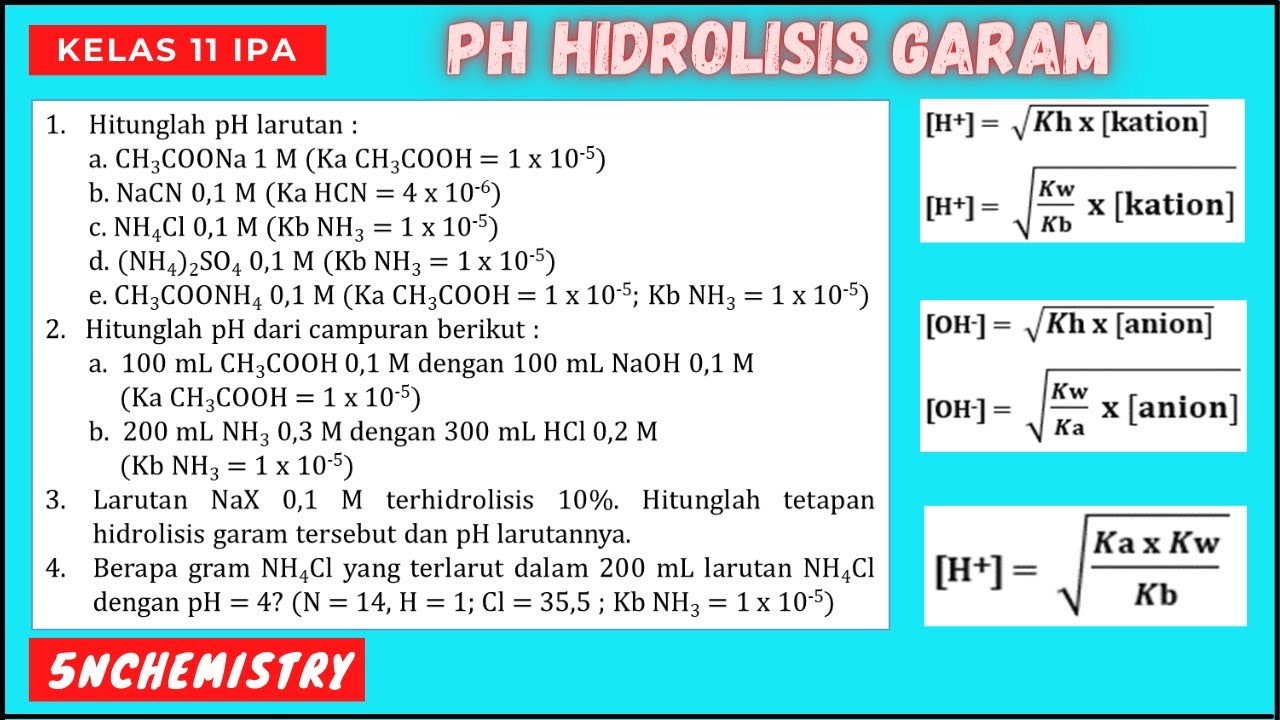
LENGKAP ‼️ CARA MENGHITUNG pH HIDROLISIS GARAM - KELAS 11

KESETIMBANGAN ION DALAM LARUTAN ASAM BASA

Menghitung pH larutan penyangga (materi Asam-Basa)

Larutan Asam Basa (5) | Pengenceran dan Pencampuran Asam atau Basa | Kimia kelas 11

Larutan Asam Basa (7) | Menentukan pH campuran Asam Basa | Kimia Kelas 11
5.0 / 5 (0 votes)

