Struktur Bahasa Inggris - Belajar Subordinating Conjunctions Beserta Contoh #belajarbahasainggris
Summary
TLDRIn this educational video, Rangga from Superpeaking teaches viewers about subordinating conjunctions in English. He explains how conjunctions connect clauses, focusing on subordinating conjunctions like 'because,' 'after,' 'before,' and 'when.' Rangga introduces phrases and clauses, emphasizing the difference between independent and dependent clauses. Through various examples, he demonstrates how subordinating conjunctions link these clauses, helping to form complete, cohesive sentences. The video is presented in a clear, friendly manner, with promises of further exploration into coordinating conjunctions in the next lesson.
Takeaways
- 😀 Conjunctions in English are linking words used to connect clauses or sentences, such as 'and', 'but', 'or', 'because'.
- 😀 The video introduces two types of conjunctions: Coordinating Conjunctions and Subordinating Conjunctions.
- 😀 Coordinating conjunctions are simpler and include words like 'and', 'but', 'or', and 'so'. These connect ideas of equal importance.
- 😀 Subordinating conjunctions, like 'because', 'after', 'before', 'when', and 'while', are used to connect a dependent clause to an independent clause.
- 😀 A dependent clause cannot stand alone as a complete sentence and needs to be connected to an independent clause.
- 😀 Independent clauses are complete sentences that can stand alone, while dependent clauses need additional information to form a full idea.
- 😀 Examples of dependent clauses include: 'because I lost my train ticket' and 'when the workers arrive'.
- 😀 The order of subordinating conjunctions can be flexible. For example, 'I could not arrive early because I lost my train ticket' can also be written as 'Because I lost my train ticket, I could not arrive early'.
- 😀 Subordinating conjunctions allow for smoother transitions in speech or writing by connecting dependent clauses to independent clauses.
- 😀 The video emphasizes the importance of distinguishing between independent and dependent clauses to construct clearer, more fluid sentences.
- 😀 The lesson also encourages viewers to practice using subordinating conjunctions and share their own examples in the comments section.
Q & A
What are conjunctions in English?
-Conjunctions are words used to connect clauses or phrases in a sentence. In English, they are often translated as 'kata sambung' in Indonesian.
What are the three types of conjunctions mentioned in the video?
-The three types of conjunctions are: coordinating conjunctions, subordinating conjunctions, and correlative conjunctions.
Which types of conjunctions are covered in this video?
-This video focuses on subordinating conjunctions and briefly touches on coordinating conjunctions.
Can you give examples of subordinating conjunctions?
-Some examples of subordinating conjunctions are 'because', 'after', 'before', 'when', 'while', 'though', 'that', and 'as'.
What does 'subordinating' mean in the context of subordinating conjunctions?
-'Subordinating' means that one clause depends on another clause to form a complete sentence. The subordinating conjunction connects the dependent clause to the independent clause.
What is the difference between a phrase and a clause?
-A phrase is a group of words that form a complete idea but lacks a subject or verb, like 'thank you' or 'goodbye'. A clause, however, contains both a subject and a verb, such as 'I work here'.
What is the difference between an independent and a dependent clause?
-An independent clause can stand alone as a complete sentence, while a dependent clause requires an independent clause to form a complete sentence.
What is an example of a sentence with a subordinating conjunction?
-An example is: 'I could not arrive early because I lost my train ticket.' Here, 'because' is the subordinating conjunction connecting the dependent clause to the independent clause.
Can you move the dependent clause to the beginning of the sentence?
-Yes, the dependent clause can be moved to the beginning of the sentence. For example: 'Because I lost my train ticket, I could not arrive early.'
What role do subordinating conjunctions play in writing or speaking?
-Subordinating conjunctions help to connect ideas smoothly, making sentences more coherent. They are especially useful when giving explanations or linking related ideas in both writing and speaking.
Outlines

このセクションは有料ユーザー限定です。 アクセスするには、アップグレードをお願いします。
今すぐアップグレードMindmap

このセクションは有料ユーザー限定です。 アクセスするには、アップグレードをお願いします。
今すぐアップグレードKeywords

このセクションは有料ユーザー限定です。 アクセスするには、アップグレードをお願いします。
今すぐアップグレードHighlights

このセクションは有料ユーザー限定です。 アクセスするには、アップグレードをお願いします。
今すぐアップグレードTranscripts

このセクションは有料ユーザー限定です。 アクセスするには、アップグレードをお願いします。
今すぐアップグレード関連動画をさらに表示
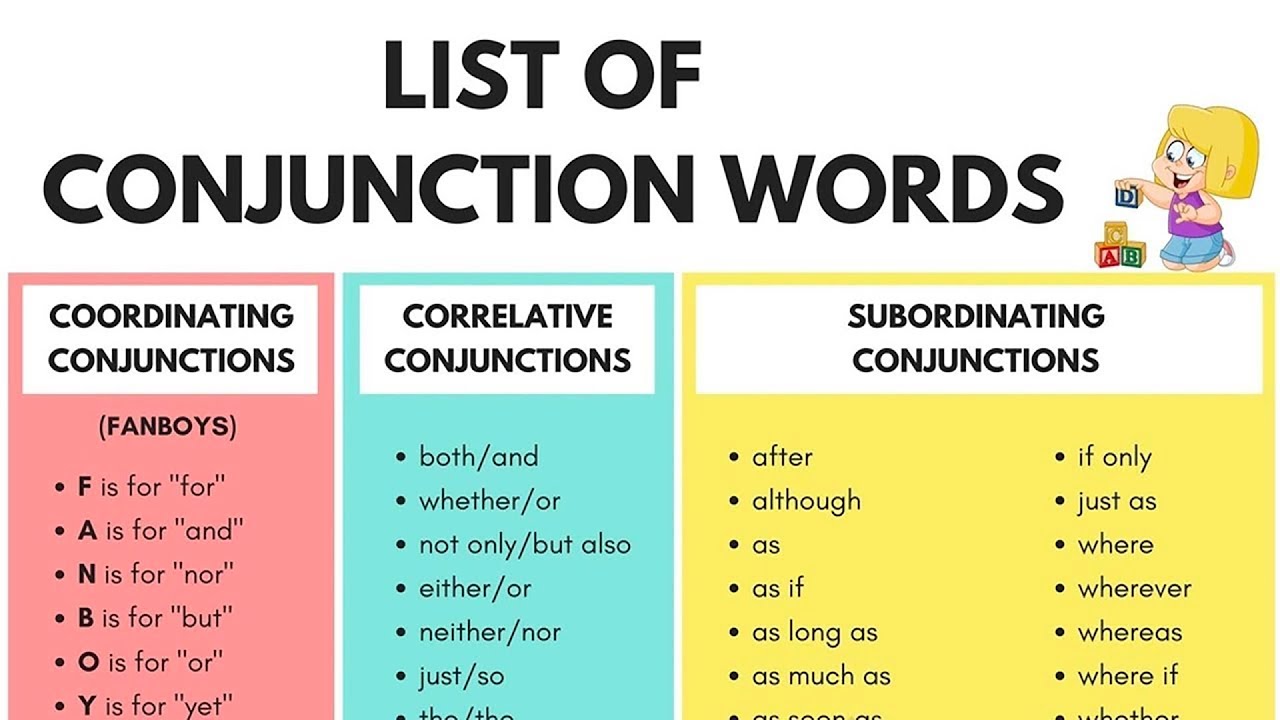
Conjunction Words: A Complete List of Conjunctions in English

Conjunctions materi
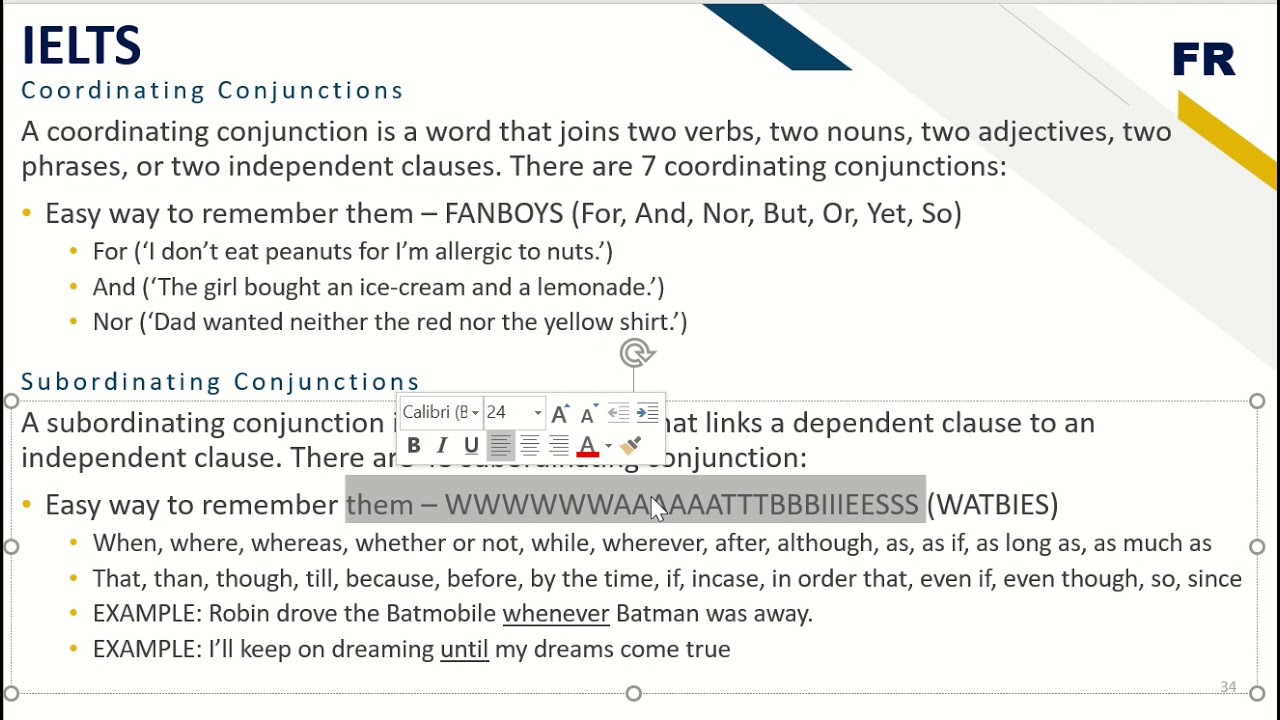
IELTS - Conjunctions | Learn conjunctions to form complex sentences | One trick to master IELTS.

Conjunction and it's types... Coordinating , Subordinating and Correlative Conjunctions.

Cause And Effect | Bahasa Inggris SMA Kelas 11

Conjunctions for Kids | Learn about coordinating, correlative, and subordinating conjunctions
5.0 / 5 (0 votes)

