Addition Rule of Probability - Explained
Summary
TLDRThis video explains the addition rule of probability, focusing on how to calculate the likelihood of either of two events happening. It covers examples like rolling a die (mutually exclusive events) and drawing cards (non-mutually exclusive events), illustrating how to apply the rule correctly. The video also applies this rule to a scenario involving students playing soccer and tennis, explaining how to calculate the probability of a student playing at least one sport. The summary provides an easy-to-follow guide on understanding the probability of 'or' events and highlights key concepts like overlapping probabilities and mutual exclusivity.
Takeaways
- 😀 The addition rule of probability helps calculate the likelihood of at least one of multiple events occurring.
- 😀 The rule is useful when you want to know the probability of event A or event B happening.
- 😀 The addition rule can be applied to mutually exclusive events, where events cannot happen simultaneously.
- 😀 For mutually exclusive events, the probability of either event occurring is the sum of their individual probabilities.
- 😀 Example: The probability of rolling a 2 or a 5 on a six-sided die is calculated as the sum of the probabilities for each event (1/6 + 1/6 = 2/6).
- 😀 When events are not mutually exclusive (e.g., drawing a heart or a face card from a deck), additional steps are needed.
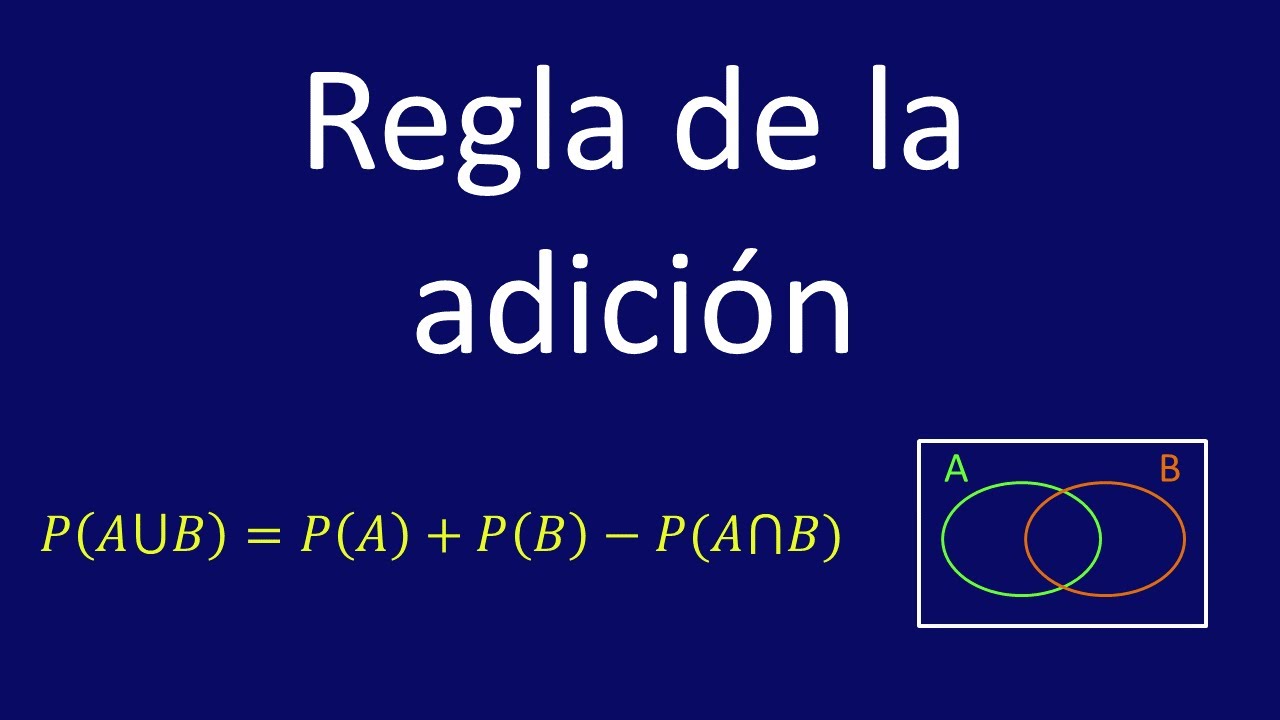
- 😀 For non-mutually exclusive events, subtract the probability of both events occurring to avoid double counting.
- 😀 Example: When drawing a heart or a face card, subtract the probability of drawing a heart that is also a face card (Jack, Queen, King of Hearts).
- 😀 The formula for the addition rule when events are not mutually exclusive is: P(A or B) = P(A) + P(B) - P(A and B).
- 😀 The addition rule can also be used for real-world problems, such as calculating the probability that a student plays at least one sport (soccer or tennis).
Q & A
What is the addition rule of probability?
-The addition rule of probability is used when we are interested in finding the probability of at least one of multiple criteria being true. It can be applied when calculating the probability of event A or event B occurring.
What does it mean for two events to be mutually exclusive?
-Two events are mutually exclusive if they cannot both occur at the same time. For example, rolling a 2 or a 5 on a single roll of a die is mutually exclusive because you can't roll both numbers in one throw.
How is the addition rule applied to mutually exclusive events?
-For mutually exclusive events, the probability of either event A or event B occurring is simply the sum of the probabilities of the individual events. For example, the probability of rolling a 2 or a 5 is the sum of the individual probabilities: 1/6 + 1/6 = 2/6.
What is the difference when events are not mutually exclusive?
-When events are not mutually exclusive, such as drawing a heart or a face card, we need to subtract the probability of the overlap (events that meet both criteria) to avoid double-counting. For instance, the queen of hearts is both a heart and a face card.
Why do we subtract the overlap in the case of non-mutually exclusive events?
-We subtract the overlap to ensure that events that meet both criteria are only counted once. For example, if you count all hearts and all face cards separately, the cards that are both (like the queen of hearts) would be counted twice.
What is an example of a situation where events are not mutually exclusive?
-An example is drawing a heart or a face card from a deck of cards. It's possible to draw a card that is both a heart and a face card, like the queen of hearts, which makes the events non-mutually exclusive.
How do you calculate the probability of drawing a heart or a face card?
-First, calculate the probability of drawing a heart (13 out of 52 cards) and the probability of drawing a face card (12 out of 52 cards). Then subtract the probability of drawing a card that is both a heart and a face card (3 out of 52) to avoid double-counting. The final probability is 22/52.
What is the probability that a student plays at least one of two sports, given that 50% play soccer, 20% play tennis, and 10% play both?
-The probability that a student plays at least one of the two sports is found by adding the probability of playing soccer (50%) and the probability of playing tennis (20%) and subtracting the probability of playing both sports (10%). The final probability is 60%.
What does 'at least one' mean in probability terms?
-'At least one' in probability means that we are interested in the event where one or more of the events happen. For example, in the case of the student playing soccer or tennis, we want to know the probability that the student plays at least one of the two sports, which includes those who play both.
Why is the addition rule also known as the 'or' rule in probability?
-The addition rule is often referred to as the 'or' rule because it helps to calculate the probability of either one event or another event occurring. It deals with the likelihood of one event or another event happening, rather than both.
Outlines

このセクションは有料ユーザー限定です。 アクセスするには、アップグレードをお願いします。
今すぐアップグレードMindmap

このセクションは有料ユーザー限定です。 アクセスするには、アップグレードをお願いします。
今すぐアップグレードKeywords

このセクションは有料ユーザー限定です。 アクセスするには、アップグレードをお願いします。
今すぐアップグレードHighlights

このセクションは有料ユーザー限定です。 アクセスするには、アップグレードをお願いします。
今すぐアップグレードTranscripts

このセクションは有料ユーザー限定です。 アクセスするには、アップグレードをお願いします。
今すぐアップグレード関連動画をさらに表示
Regla de la adición

Probability, Sample Spaces, and the Complement Rule (6.1)

Kaidah Pencacahan (Bab Peluang) Matematika SMK Kelas X
Tree Diagrams - Corbettmaths

(Part 1) PELUANG MATEMATIKA SMA KELAS 10 #kurikulummerdeka #matematikasma #bukupaket

Ruang Sampel dan Peluang Suatu Kejadian (Materi dan Contoh Soal diserta Pembahasan)
5.0 / 5 (0 votes)

