Kesetimbangan Kimia | Hubungan Kp dan Kc | Kimia kelas 11
Summary
TLDRIn this educational video, the presenter explains the relationship between equilibrium constants (Kc and Kp) in chemistry, specifically focusing on their connection to gas laws. Using the ideal gas law (PV = nRT), the presenter illustrates how to calculate Kc and Kp for chemical reactions involving gases. Through detailed examples, including a reaction involving CCl4 decomposition, the video covers how to apply formulas to calculate concentration and pressure-based equilibrium constants, alongside an explanation of how temperature and volume affect these values. The video is tailored for high school chemistry students, offering practical insights into chemical equilibrium calculations.
Takeaways
- 😀 The video explains the relationship between equilibrium constants based on concentration (Kc) and pressure (Kp) for chemical reactions.
- 😀 The ideal gas law, PV = nRT, is used to relate gas concentration and pressure in equilibrium calculations.
- 😀 Pressure (P) can be calculated using the formula P = concentration × R × T, where R is the gas constant and T is temperature in Kelvin.
- 😀 The equilibrium constant based on concentration (Kc) is calculated using the ratio of product concentrations to reactant concentrations, each raised to their respective stoichiometric coefficients.
- 😀 The equilibrium constant based on pressure (Kp) follows a similar formula as Kc, but uses partial pressures instead of concentrations.
- 😀 The relationship between Kp and Kc is given by Kp = Kc × (RT)^Δn, where Δn is the difference in the sum of gas coefficients between products and reactants.
- 😀 Δn is calculated as the total stoichiometric coefficients of gaseous products minus those of gaseous reactants.
- 😀 Example 1 demonstrates calculating Kc and Kp for the decomposition of CCl4, considering a 60% reaction and volume of 1 liter.
- 😀 Example 2 shows that when Δn = 0 (number of gas moles unchanged), Kc equals Kp, as in the reaction H2 + I2 ⇌ 2HI.
- 😀 The video emphasizes the importance of converting temperatures to Kelvin and using the correct gas constant when calculating equilibrium constants.
Q & A
What is the relationship between Kc and Kp?
-Kc (concentration-based equilibrium constant) and Kp (pressure-based equilibrium constant) are related by the equation: Kp = Kc × (RT)^(Δn), where R is the gas constant, T is the temperature in Kelvin, and Δn is the change in the number of moles of gas between products and reactants.
How do you calculate Kc for a chemical reaction?
-To calculate Kc, use the formula: Kc = [Products]^coefficients / [Reactants]^coefficients, where the concentrations of products and reactants are raised to the power of their respective coefficients in the balanced equation.
What is the significance of Δn in the Kp-Kc relationship?
-Δn represents the difference in the number of moles of gas between the products and reactants. It is used in the formula for calculating Kp from Kc. If Δn is 0, then Kp equals Kc.
How does the ideal gas law relate to Kp?
-The ideal gas law (PV = nRT) is used to relate pressure (P) to concentration in the context of Kp. Since pressure is proportional to concentration, Kp can be expressed using pressure in place of concentration, with the ideal gas law helping to convert between the two.
In the equation for Kp, why is RT raised to the power of Δn?
-RT is raised to the power of Δn to account for the change in the number of moles of gas during the reaction. This ensures that the units on both sides of the equation remain consistent and properly reflect the gas behavior under equilibrium conditions.
What happens when Δn is equal to 0 in the Kp-Kc equation?
-When Δn = 0, meaning the number of moles of gas is the same on both sides of the reaction, Kp equals Kc. In this case, the RT term in the equation does not affect the value, and both constants are numerically equal.
How do you calculate the equilibrium concentrations from the moles of gas given in a problem?
-To calculate equilibrium concentrations, divide the moles of each substance by the volume of the container. This gives you the concentration in mol/L, which can then be used in the Kc formula to determine the equilibrium constant.
In the example with CCl4 dissociation, why is the solid carbon not included in the Kc expression?
-Solid carbon is not included in the Kc expression because, in the equilibrium constant formula, the concentration of pure solids is considered constant and is therefore omitted from the equation.
What is the significance of the gas constant (R) in the Kp calculation?
-The gas constant (R) is used to convert between pressure and concentration. In the Kp formula, it helps account for the temperature and the behavior of gases, ensuring the units are correct and consistent when calculating the equilibrium constant in terms of pressure.
Why do we convert temperature to Kelvin when using Kp and Kc formulas?
-Temperature must be in Kelvin because the gas constant R is defined for Kelvin. Using Kelvin ensures that the units of temperature match those in the gas law and equilibrium constant equations.
Outlines

Cette section est réservée aux utilisateurs payants. Améliorez votre compte pour accéder à cette section.
Améliorer maintenantMindmap

Cette section est réservée aux utilisateurs payants. Améliorez votre compte pour accéder à cette section.
Améliorer maintenantKeywords

Cette section est réservée aux utilisateurs payants. Améliorez votre compte pour accéder à cette section.
Améliorer maintenantHighlights

Cette section est réservée aux utilisateurs payants. Améliorez votre compte pour accéder à cette section.
Améliorer maintenantTranscripts

Cette section est réservée aux utilisateurs payants. Améliorez votre compte pour accéder à cette section.
Améliorer maintenantVoir Plus de Vidéos Connexes

Constante de Equilíbrio: Kp e Kc
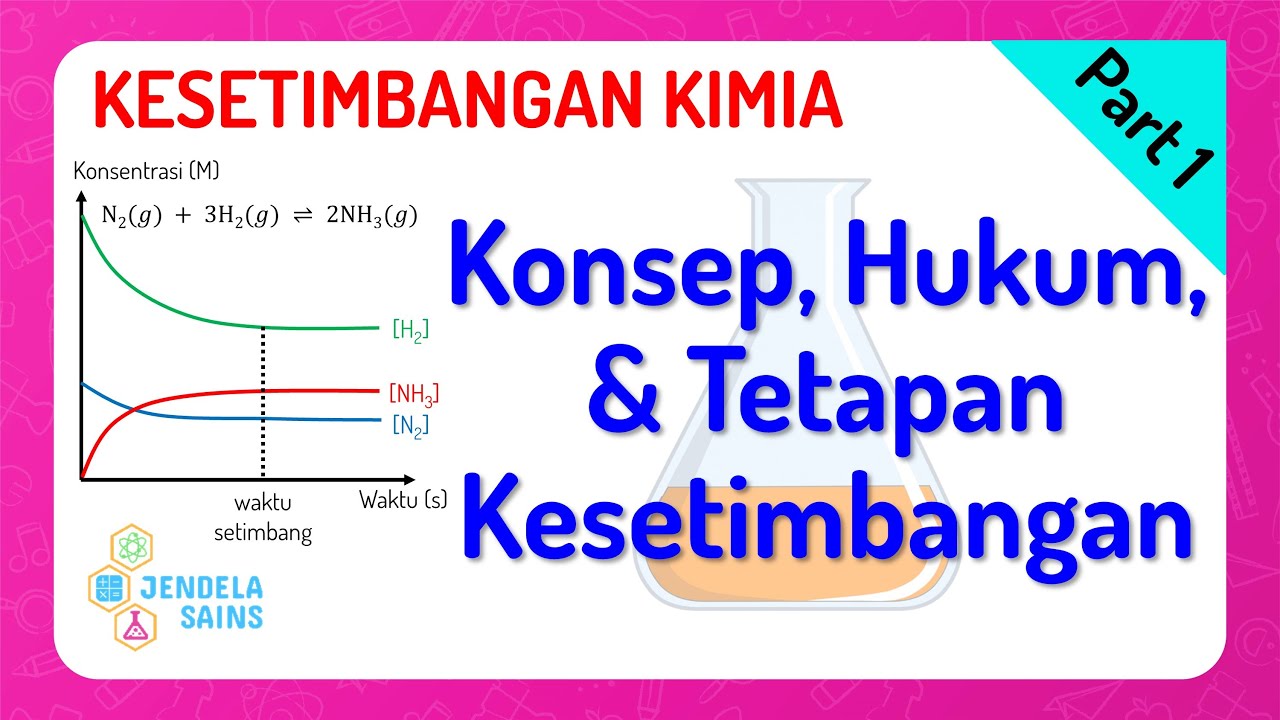
Kesetimbangan Kimia • Part 1: Konsep, Hukum, Tetapan Kesetimbangan Kc dan Kp

Kesetimbangan Kimia : Tetapan Kesetimbangan Berdasarkan Tekanan Parsial (Kp) dan Hubungan Kp & Kc

Kesetimbangan Kimia| Kimia SMA | Tetty Afianti

Equilibrium Quick Revision | CBSE Class 11 Chemistry | Full Chapter in 1️⃣5️⃣ Mins | Rapid Revision

Kesetimbangan Kimia • Part 3: Tetapan Kesetimbangan Pada Reaksi Berkaitan / Hukum Hess
5.0 / 5 (0 votes)

