Secant slope, tangent slope, and instantaneous rates of change
Summary
TLDRThis video introduces the foundational ideas of differential calculus, focusing on the concepts of average and instantaneous rates of change. It explains how the average rate of change corresponds to the slope of a secant line and demonstrates this with examples, including motion along a line. The video then explores tangent lines, emphasizing their subtlety compared to secant lines and how they represent instantaneous change. Using the function f(x) = x², it shows how secant slopes approaching a point via a limiting process reveal the tangent slope, bridging the gap from average to instantaneous rates of change and laying the groundwork for understanding limits in calculus.
Takeaways
- 📈 The average rate of change of a function over an interval is calculated by dividing the change in function values by the change in the input values.
- 🚗 In motion contexts, the average rate of change corresponds to average velocity, with units reflecting distance over time.
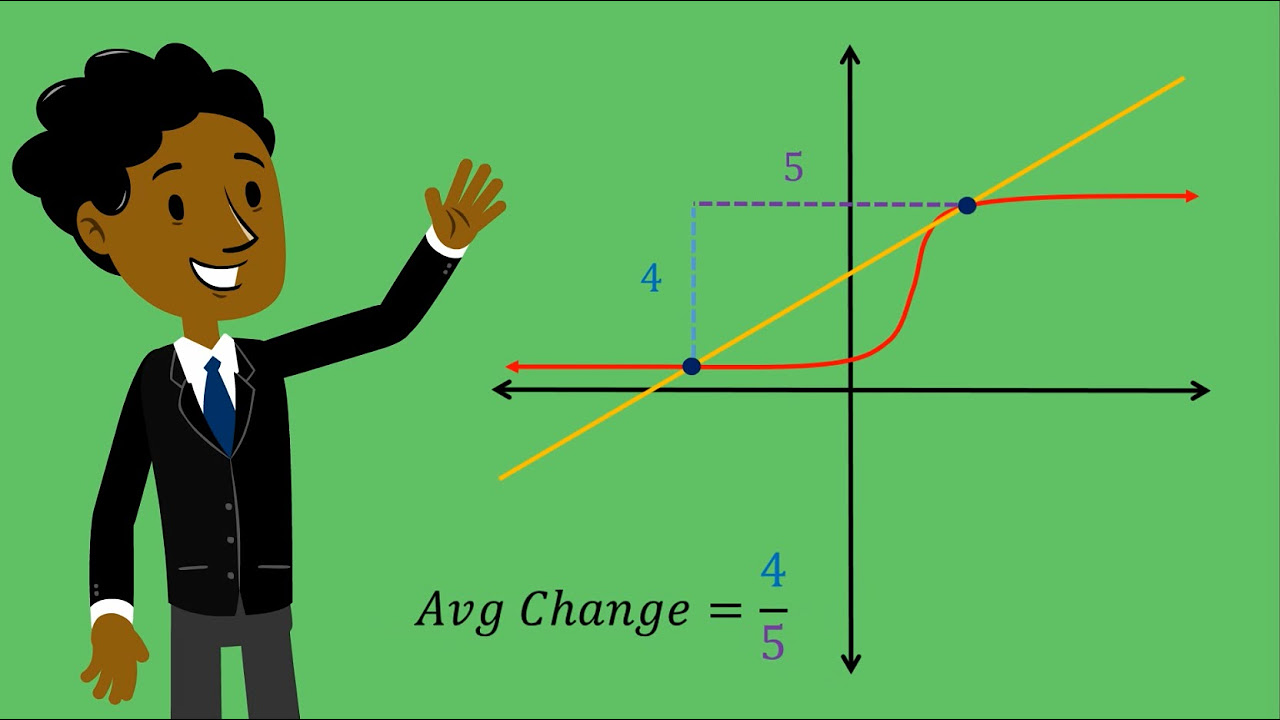
- 🧮 Secant lines connect two points on a function's graph and represent the average rate of change over that interval.
- ✏️ Tangent lines touch a curve at a single point locally, representing the instantaneous rate of change at that point.
- ❌ Defining a tangent line as intersecting a curve only once is insufficient; it must reflect local behavior.
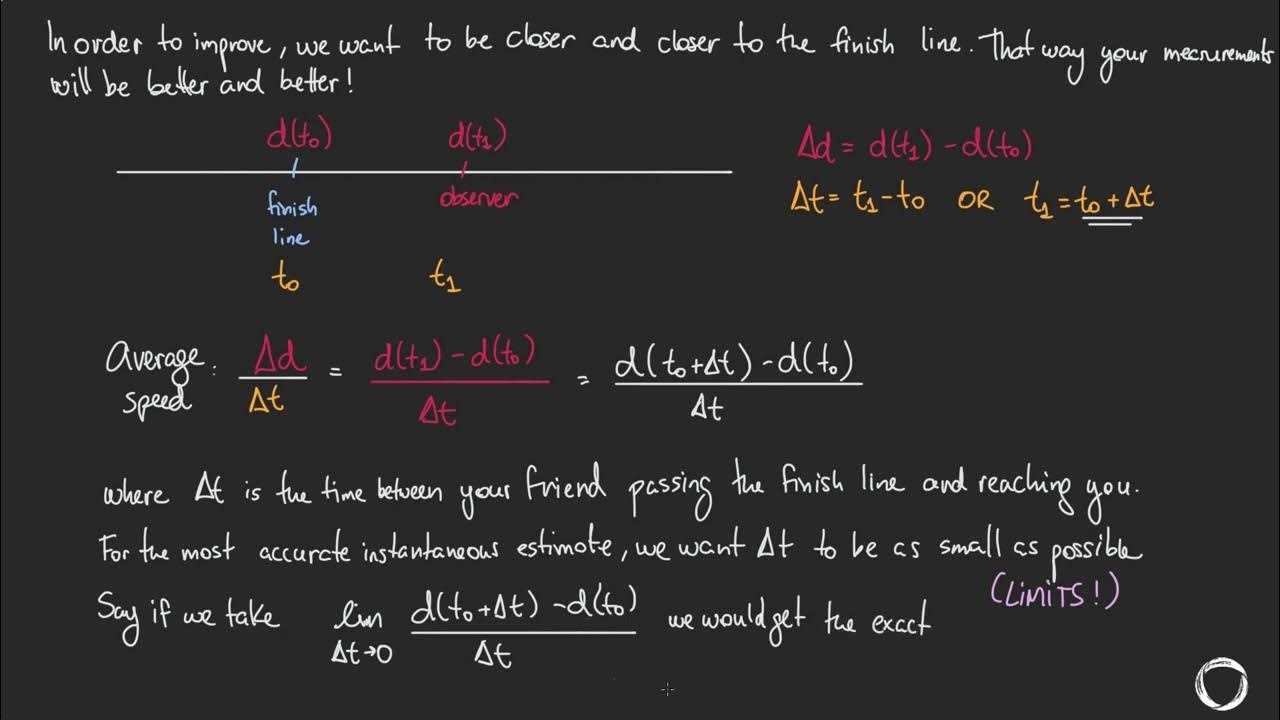
- 🔍 To find a tangent slope at a point, compute the secant slope from the point to a nearby point and observe as the nearby point approaches the target.
- ⚠️ Directly evaluating the slope at the same point leads to division by zero, which is why a limit is required.
- 🔢 Using small increments (h) in calculations allows numerical estimation of the tangent slope.
- 📊 Approaching the target from either direction (left or right) helps confirm the tangent slope converges to the same value.
- 🧩 The tangent slope represents the instantaneous rate of change, a foundational concept in differential calculus.
- 🎯 The process of taking limits of secant slopes underpins the definition of derivative and connects average and instantaneous rates of change.
- 📚 Visual and numerical tools, such as graphs and calculators, are useful for intuitively understanding limits and tangent slopes.
Q & A
What is the fundamental idea behind differential calculus introduced in the video?
-The video introduces differential calculus by explaining how the rate of change of a function can be calculated using the average rate of change over an interval. This involves calculating the quotient of the change in function value over the change in argument and understanding the relationship between secant and tangent lines.
What does the term 'average rate of change' refer to in the context of motion along a straight road?
-In the context of motion, the average rate of change refers to the average velocity of an object moving along a straight road. This is calculated as the change in position divided by the change in time, typically measured in units like kilometers per hour.
How is the average velocity calculated in the example involving a bead on a rod?
-In the example, the bead moves over specific intervals, and the average velocity is calculated by dividing the change in position by the change in time. For example, from 0 to 3 seconds, the position changes by 6 centimeters, and the average velocity is 2 centimeters per second.
What is the key challenge when finding the tangent line to a graph?
-The key challenge in finding the tangent line to a graph is determining its slope. The slope of the tangent line is not immediately obvious, so the video suggests using secant lines and then taking the limit as the points approach the point of interest to estimate the tangent slope.
What is a secant line, and how is it related to the average rate of change?
-A secant line is a line that intersects a curve at two points. The slope of the secant line is equivalent to the average rate of change of the function over the interval between those two points. This concept is key to understanding how rates of change are calculated.
Why is the definition of a tangent line not simply a line that intersects the graph once?
-The definition of a tangent line is more subtle. A line that intersects a graph once may not behave like the tangent line we expect, as seen in the examples. The true tangent line only touches the graph at one point and has a specific limiting behavior, which requires a more precise definition involving limits.
How does the limit process help in finding the tangent slope at a point?
-The limit process helps in finding the tangent slope by considering secant slopes from points approaching the target point. As the points get closer, the secant slopes approach the tangent slope, but we cannot directly evaluate at the point itself due to division by zero. Instead, we calculate the limit of the secant slopes as the distance between the points approaches zero.
What is the significance of using '1 + h' for the argument in the function?
-Using '1 + h' for the argument allows us to measure how far away we are from the target point (in this case, x = 1). The value of h represents the difference between the point we are evaluating and the target, and as h approaches zero, we get closer to calculating the true tangent slope.
Why can't we directly substitute h = 0 when calculating the tangent slope?
-Substituting h = 0 would result in a zero denominator in the secant slope formula, which is undefined. Therefore, we approach h = 0 using limits, considering values of h that are infinitesimally close to zero rather than exactly zero.
What does the term 'instantaneous rate of change' refer to in the context of the video?
-The instantaneous rate of change refers to the rate of change of the function at a specific point. It is obtained by taking the limit of the average rate of change as the interval shrinks to zero, and it corresponds to the slope of the tangent line at that point.
Outlines

Cette section est réservée aux utilisateurs payants. Améliorez votre compte pour accéder à cette section.
Améliorer maintenantMindmap

Cette section est réservée aux utilisateurs payants. Améliorez votre compte pour accéder à cette section.
Améliorer maintenantKeywords

Cette section est réservée aux utilisateurs payants. Améliorez votre compte pour accéder à cette section.
Améliorer maintenantHighlights

Cette section est réservée aux utilisateurs payants. Améliorez votre compte pour accéder à cette section.
Améliorer maintenantTranscripts

Cette section est réservée aux utilisateurs payants. Améliorez votre compte pour accéder à cette section.
Améliorer maintenantVoir Plus de Vidéos Connexes




5.0 / 5 (0 votes)

