2.4 Linked List Implementation in C/C++ | Creation and Display | DSA Tutorials
Summary
TLDRThis video tutorial covers the basics of implementing a singly linked list in C, focusing on memory management, node creation, and pointer operations. The instructor explains how a linked list is logically represented with nodes containing data and pointers to the next node, and how to allocate memory dynamically using `malloc`. The program allows the user to continuously create new nodes and traverse the list to display their values. The video also explains how to count nodes and handle user interaction to control node creation. Future lessons will explore advanced insertions at different positions within the list.
Takeaways
- 😀 Understand the basics of a singly linked list: nodes with data and address (pointer to the next node).
- 😀 Familiarize yourself with the concepts of dynamic memory allocation and how to use the `malloc` function in C.
- 😀 Learn how to define a custom data type for linked list nodes using `struct` in C.
- 😀 Know how to declare a head pointer to store the address of the first node in a linked list.
- 😀 Understand how to dynamically allocate memory for new nodes using the `malloc` function.
- 😀 Use pointers to access and manipulate the structure members (data and next) of linked list nodes.
- 😀 Understand how to traverse a linked list by moving through nodes using the `next` pointers.
- 😀 Learn how to handle user input to dynamically create nodes in the list based on the user's choice (continue or stop).
- 😀 Implement a loop to traverse the linked list and print out the data from each node.
- 😀 Use a counter to count the number of nodes in the list and display it after traversal.
- 😀 Understand the importance of an additional pointer (like `temp`) to traverse the list without modifying the `head` pointer.
- 😀 Learn how to modify the program to handle different insertion points for nodes: beginning, middle, and end.
Q & A
What is a singly linked list, and how is it represented in memory?
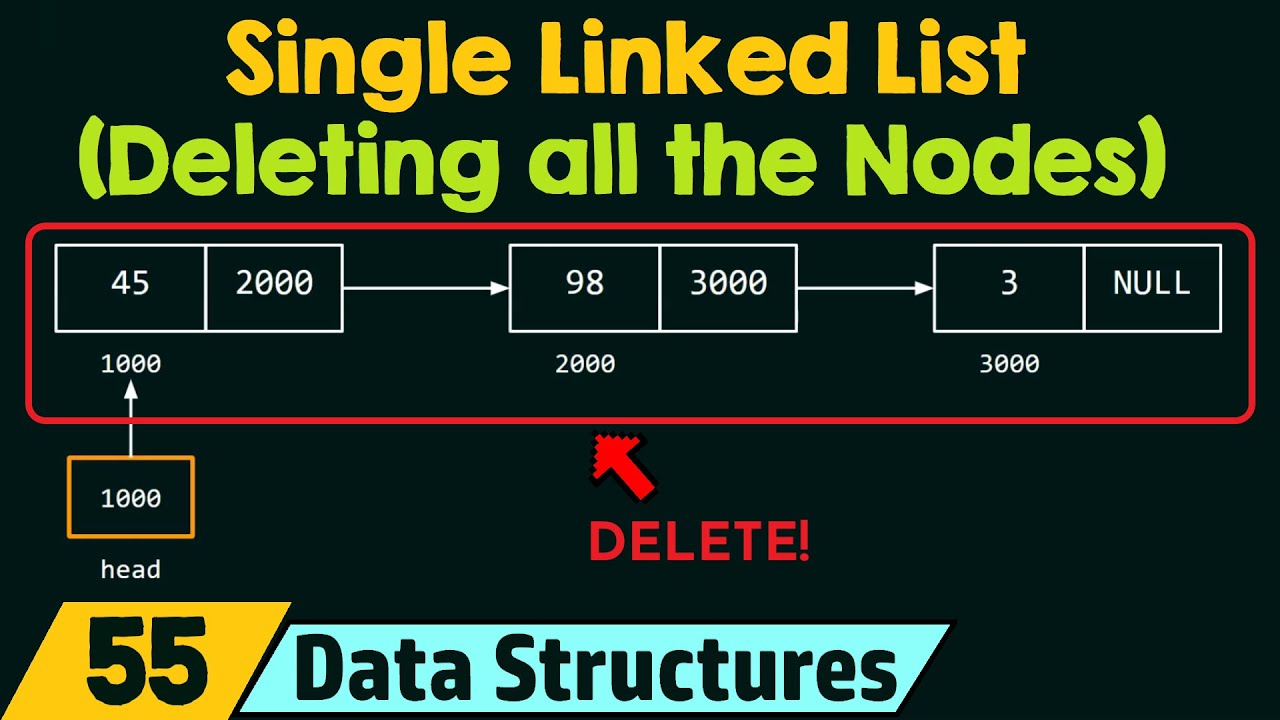
-A singly linked list is a linear data structure where each node contains two parts: a data element and a pointer to the next node in the list. In memory, it is represented by nodes connected sequentially, where each node points to the next. The last node has a null pointer indicating the end of the list.
Why is dynamic memory allocation used in implementing a linked list in C?
-Dynamic memory allocation is used in linked lists to allocate memory for each node as needed during runtime. This allows flexibility in memory usage, as memory is only allocated when a node is created, rather than pre-allocating a fixed amount of space, which would be inefficient for variable-sized lists.
What role does the 'head' pointer play in a singly linked list?
-The 'head' pointer is crucial in a singly linked list because it holds the memory address of the first node. It serves as the entry point to the list, allowing traversal from the first node to the last node. Without the 'head' pointer, the linked list would be unreachable.
What is the purpose of the 'malloc' function in C for creating nodes in a linked list?
-The 'malloc' function in C is used to dynamically allocate memory for a new node. It returns a pointer to the allocated memory block, which is then used to store the node's data and the pointer to the next node. The memory allocated is based on the size of the node structure.
How is the data of a node accessed in a linked list when using pointers?
-In a linked list, the data of a node is accessed using a pointer to the node. The arrow operator (`->`) is used to dereference the pointer and access the structure members, such as the data and next pointer. For example, `newNode->data` accesses the data of the node pointed to by `newNode`.
What happens when a new node is inserted into a non-empty linked list?
-When a new node is inserted into a non-empty linked list, the pointer of the last node (which points to null) is updated to point to the newly created node. This ensures that the new node becomes part of the list without losing the link to the previous nodes.
Why is a temporary pointer (temp) needed when traversing a linked list?
-A temporary pointer (`temp`) is used to traverse a linked list without altering the `head` pointer. The `head` pointer must always point to the first node of the list, so using `temp` allows the program to move through the list node by node while preserving the reference to the start of the list.
How is user input handled to create multiple nodes in the linked list?
-User input is handled through a `scanf` function that prompts the user to either continue adding nodes (by entering 1) or stop (by entering 0). The program uses a `while` loop to repeatedly create nodes as long as the user chooses to continue, dynamically allocating memory for each new node.
What is the significance of checking if the 'head' pointer is null before creating a new node?
-Checking if the 'head' pointer is null helps determine if the list is empty. If it is null, the new node becomes the first node, and the 'head' pointer is updated to point to this node. If the list is not empty, the program appends the new node to the end of the list.
How does the program ensure that newly created nodes are linked correctly in the list?
-The program ensures correct linking by updating the 'next' pointer of the last node to point to the newly created node. It uses a temporary pointer to traverse the list and find the correct position for inserting the new node, thereby maintaining the order of nodes in the list.
Outlines

Esta sección está disponible solo para usuarios con suscripción. Por favor, mejora tu plan para acceder a esta parte.
Mejorar ahoraMindmap

Esta sección está disponible solo para usuarios con suscripción. Por favor, mejora tu plan para acceder a esta parte.
Mejorar ahoraKeywords

Esta sección está disponible solo para usuarios con suscripción. Por favor, mejora tu plan para acceder a esta parte.
Mejorar ahoraHighlights

Esta sección está disponible solo para usuarios con suscripción. Por favor, mejora tu plan para acceder a esta parte.
Mejorar ahoraTranscripts

Esta sección está disponible solo para usuarios con suscripción. Por favor, mejora tu plan para acceder a esta parte.
Mejorar ahoraVer Más Videos Relacionados

Curso de Programação C | Como inserir no início de uma Lista Simplesmente Encadeada? | aula 243

ENTENDA LISTAS ENCADEADAS EM C EM POUCOS MINUTOS!

Data Structures in Python: Doubly Linked Lists -- Append and Prepend
Deleting the Entire Single Linked List

doubly linked list: #1 Konsep dan Deklarasi Node

1. How to Represent a Singly Linked List in Java | Data Structure using JAVA|APIPOTHI| DATASTRATURES
5.0 / 5 (0 votes)

