Membincang Uji Normalitas 2
Summary
TLDRThe video explains the concept of normality in statistical analysis, emphasizing its importance in dependent variables and residuals rather than independent variables in regression tests. It discusses how normality assumptions differ across tests, including independent sample tests, paired t-tests, and correlation analyses. Various methods to assess normality are covered, such as visual inspection, skewness and kurtosis, and statistical tests like Anderson-Darling, Kolmogorov-Smirnov, and Shapiro-Wilk. The speaker highlights that normality should be viewed as a continuum, not a strict dichotomy, and stresses analyzing residuals for accurate and reliable model predictions. Practical tips for using SPSS for normality tests are also provided.
Takeaways
- 📊 Normality in statistics primarily concerns dependent variables rather than independent variables, especially in regression analysis.
- 🔗 In bivariate correlation tests, both variables are assumed to be normally distributed.
- 👥 For independent sample tests or factorial ANOVA, normality must be checked for each group within the dependent variable.
- 📏 In paired sample tests, normality is assessed based on the differences between paired observations (e.g., pretest vs. posttest).
- 📈 Cross-sample normality refers to the distribution of the mean at each measurement point in a variable.
- 🧩 Residuals represent the portion of data not explained by the model; normally distributed residuals indicate an optimal model.
- ⚖️ Normality affects the quality, consistency, and reliability of statistical results.
- 👀 Methods to check normality include statistical inspection (skewness, kurtosis, mean vs. median), visual inspection (histograms, Q-Q plots), and formal tests (Shapiro-Wilk, Anderson-Darling, Kolmogorov-Smirnov).
- 📉 Normality is a continuum rather than a strict yes/no condition; slight deviations usually do not invalidate statistical analysis.
- 🖥️ Software like SPSS provides built-in normality tests with corrections (e.g., Lilliefors), but results should be interpreted flexibly, not rigidly.
- 📝 The main practical focus should be on analyzing residuals rather than solely testing variables for normality.
Q & A
What is the primary focus of normality in statistical analysis according to the transcript?
-Normality primarily focuses on the dependent variable and the residuals in a model, rather than the independent variables.
How is normality treated differently in correlation tests versus regression tests?
-In correlation tests, both variables are assumed to be normally distributed. In regression tests, normality is mainly considered for the residuals of the dependent variable rather than for independent variables.
Why is normality of residuals important in regression analysis?
-Normality of residuals indicates that the model's predictions are optimal. Any leftover variation should be random, and if residuals are normal, it ensures the model has captured the systematic patterns effectively.
How is normality assessed in paired sample t-tests?
-For paired sample t-tests, normality is checked on the difference between the two observations (e.g., pretest vs posttest) rather than the individual measurements.
What are the main methods to test for normality mentioned in the transcript?
-Normality can be tested using statistical measures (skewness, kurtosis, mean vs median), visual inspection (histograms, Q-Q plots, stem-and-leaf plots), and formal statistical tests (Anderson-Darling, Kolmogorov-Smirnov, Shapiro-Wilk).
What is the recommended p-value threshold in formal normality tests, and what does it indicate?
-A p-value below 0.05 indicates that the data significantly deviates from normality. However, researchers should interpret this cautiously, especially with large sample sizes, because even small deviations can appear significant.
What caution is given regarding strict adherence to normality assumptions?
-The transcript advises that normality should not be treated as a strict binary condition. Data that slightly deviates from normality can still produce valid statistical results.
Why is visual inspection of normality sometimes insufficient?
-Visual methods like histograms provide a general overview but may miss subtle deviations, making them less precise than formal statistical tests.
What is the role of normality in the quality of statistical information?
-Normality affects the quality of statistical results, including consistency and accuracy. Ensuring approximate normality helps maintain the reliability of the analysis.
Which formal normality test is mentioned as effective, and what limitation does it have?
-The Anderson-Darling test is mentioned as effective, but it can sometimes be too strict, flagging minor deviations from normality as significant.
How should researchers handle data that appears non-normal according to statistical tests?
-Researchers should consider the overall distribution visually and the context of the data. Minor deviations may not compromise the validity of statistical analysis, and nonparametric methods can be used if necessary.
Outlines

Esta sección está disponible solo para usuarios con suscripción. Por favor, mejora tu plan para acceder a esta parte.
Mejorar ahoraMindmap

Esta sección está disponible solo para usuarios con suscripción. Por favor, mejora tu plan para acceder a esta parte.
Mejorar ahoraKeywords

Esta sección está disponible solo para usuarios con suscripción. Por favor, mejora tu plan para acceder a esta parte.
Mejorar ahoraHighlights

Esta sección está disponible solo para usuarios con suscripción. Por favor, mejora tu plan para acceder a esta parte.
Mejorar ahoraTranscripts

Esta sección está disponible solo para usuarios con suscripción. Por favor, mejora tu plan para acceder a esta parte.
Mejorar ahoraVer Más Videos Relacionados
Modul 12 (StatSos2) - Konsep Dasar Regresi Linear Sederhana

Regresi Linear Sederhana dengan Ordinary Least Square
STATISTIKA - Regresi Linier Sederhana Cara Manual + Contoh Soal

SPSS : Uji t, Uji F dan Koefisien Determinasi dalam Analisis Regresi Berganda
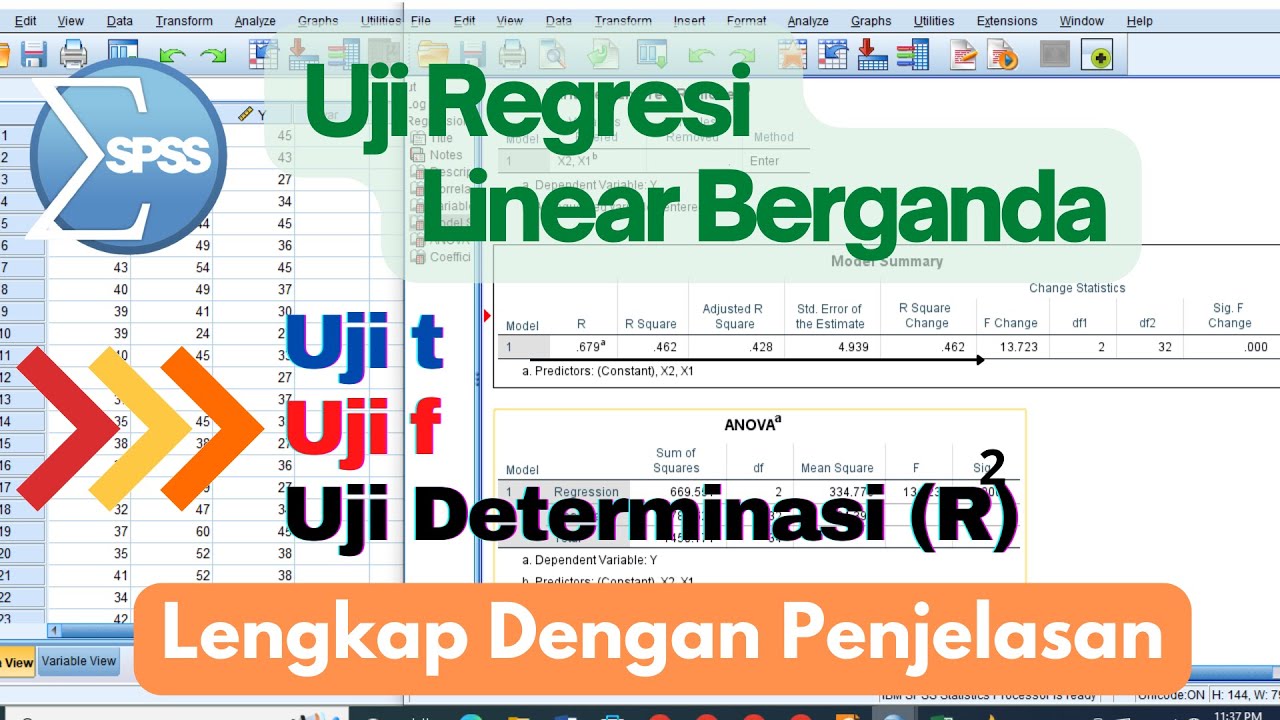
Cara Uji Regresi Linear Berganda ( Uji t, Uji f dan Uji Determinasi) menggunakan aplikasi SPSS

Analisis Jalur (Kelompok 2 PD)
5.0 / 5 (0 votes)

