SIMPLE PAST: aprenda a falar sobre o PASSADO em inglês (DID) | Aula 06 - English in Brazil
Summary
TLDRThis video class delves into the past tense in English, focusing on both regular and irregular verbs. The teacher explains how regular verbs take the '-ed' suffix to form their past tense, while irregular verbs deviate from this pattern. Examples from the '80s and '90s illustrate how these verbs are used in sentences. The class also covers affirmative, negative, and interrogative forms of past tense sentences, encouraging students to practice and consult a list of irregular verbs. With a fun and engaging approach, the teacher invites viewers to test their knowledge and join the next lesson.
Takeaways
- 😀 The lesson focuses on teaching the past tense in English, particularly regular and irregular verbs.
- 😀 Regular verbs in the past tense typically end with the suffix 'ed'. For example, 'imagine' becomes 'imagined'.
- 😀 Irregular verbs do not follow the 'ed' pattern and must be memorized. For instance, 'come' becomes 'came' in the past tense.
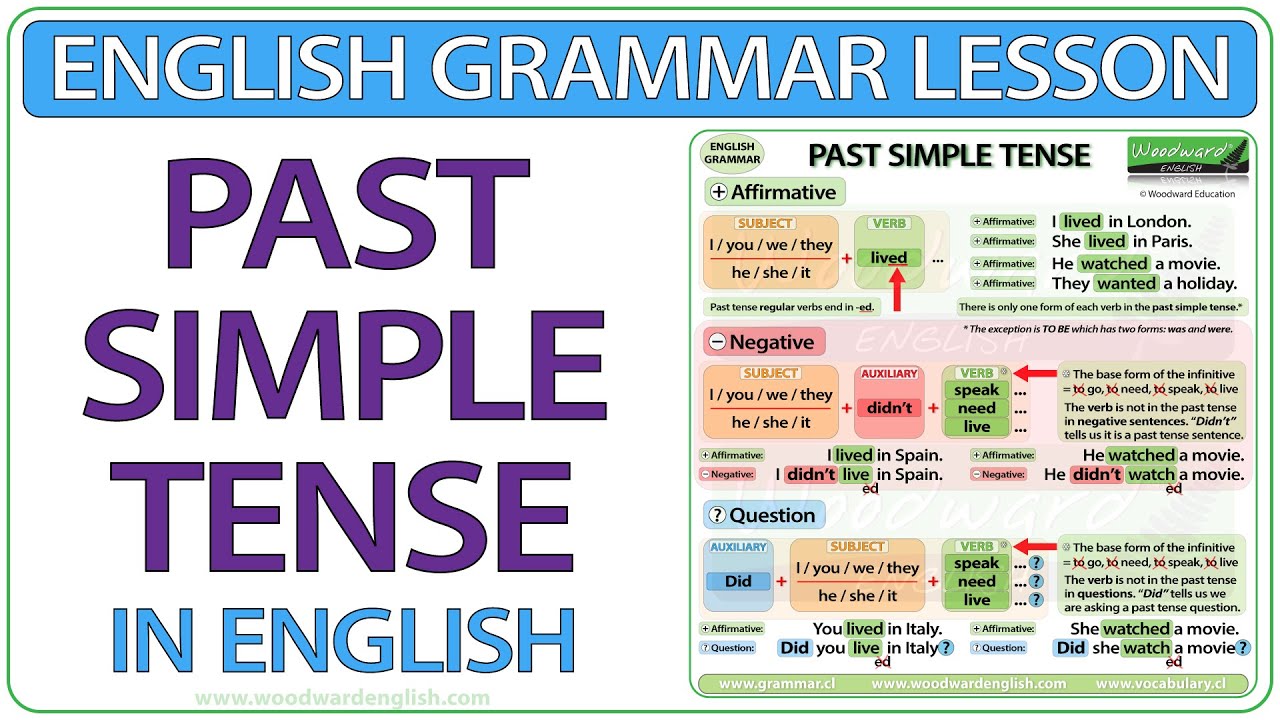
- 😀 To form negative sentences in the past tense, the auxiliary verb 'did' is used, followed by the base form of the main verb (e.g., 'I did not go').
- 😀 In questions, the auxiliary verb 'did' also comes at the beginning of the sentence, followed by the base form of the verb (e.g., 'Did you go?').
- 😀 It’s important to memorize irregular verbs over time rather than trying to memorize them all at once.
- 😀 A list of irregular verbs is provided for reference and can be used to check verb forms when constructing past tense sentences.
- 😀 There are specific spelling rules for regular verbs ending in 'y'. These rules are summarized in an e-book available for download.
- 😀 Regular verbs form their past tense by adding 'ed', but irregular verbs change forms entirely, and these changes do not follow a set pattern.
- 😀 Short answers in the past tense can be given without repeating the full question, using simple affirmatives like 'Yes, I did' or 'No, I didn’t'.
- 😀 The lesson includes a quiz to test understanding of the past tense, focusing on choosing the correct form of verbs in context.
Q & A
What is the main topic of the video lesson?
-The video lesson focuses on the past tense in English, covering both regular and irregular verbs, and how to use them in affirmative, negative, and interrogative sentences.
How are regular verbs conjugated in the past tense?
-Regular verbs are conjugated in the past tense by adding the suffix '-ed' to the base form of the verb. For example, 'study' becomes 'studied'.
What is an irregular verb, and how is it different from a regular verb?
-An irregular verb does not follow the standard '-ed' rule for past tense. Its past form is unique and must be memorized, such as 'go' becoming 'went' or 'know' becoming 'knew'.
How do you form negative sentences in the past tense?
-To form negative sentences in the past tense, you use the auxiliary verb 'did not' (or 'didn't') followed by the base form of the main verb. For example, 'I studied' becomes 'I did not study'.
How do you form questions in the past tense?
-Questions in the past tense are formed by placing 'did' at the beginning of the sentence, followed by the subject and the base form of the main verb. For example, 'You studied?' becomes 'Did you study?'.
What tip does the teacher give for learning irregular verbs?
-The teacher suggests using a list of irregular verbs as a reference rather than trying to memorize all of them at once. Over time, exposure and practice will help internalize them.
Can you give an example of a past tense regular verb in context from the video?
-Yes, the teacher used the example 'I studied English last week,' where 'studied' is the past tense of the regular verb 'study'.
Can you give an example of a past tense irregular verb in context from the video?
-Yes, the verb 'come' was used in the example 'I came from the future,' where 'came' is the past tense of the irregular verb 'come'.
What is the function of short answers in past tense conversations?
-Short answers make conversations more natural. For example, when asked 'Did you like the cake?' you can answer simply 'Yes, I did' or 'No, I didn’t' instead of repeating the full sentence.
Why is it important to pay attention to the base form of verbs in negative and interrogative sentences?
-In negative and interrogative sentences, the main verb always returns to its base form because 'did' already indicates the past tense. Using the past form here would be grammatically incorrect.
Outlines

Esta sección está disponible solo para usuarios con suscripción. Por favor, mejora tu plan para acceder a esta parte.
Mejorar ahoraMindmap

Esta sección está disponible solo para usuarios con suscripción. Por favor, mejora tu plan para acceder a esta parte.
Mejorar ahoraKeywords

Esta sección está disponible solo para usuarios con suscripción. Por favor, mejora tu plan para acceder a esta parte.
Mejorar ahoraHighlights

Esta sección está disponible solo para usuarios con suscripción. Por favor, mejora tu plan para acceder a esta parte.
Mejorar ahoraTranscripts

Esta sección está disponible solo para usuarios con suscripción. Por favor, mejora tu plan para acceder a esta parte.
Mejorar ahoraVer Más Videos Relacionados

TUDO QUE VOCÊ PRECISA SABER SOBRE O PASSADO EM INGLÊS - AULA 45 PARA INICIANTES - PROFESSOR KENNY
Past Simple Tense in English - Regular and Irregular Verbs Grammar lesson

Verbos Regulares e Irregulares em Inglês | Explicação simples e fácil

Past Simple | An Easy English Grammar Lesson

Simple Past Tense Verbal & Nominal | Regular & Irregular Verbs | English Pedia

COMO APRENDER SIMPLE PAST EM 6 MINUTOS | INGLÊS
5.0 / 5 (0 votes)

