A-Level Maths: R4-01 [Forces: Newton’s Third Law]
Summary
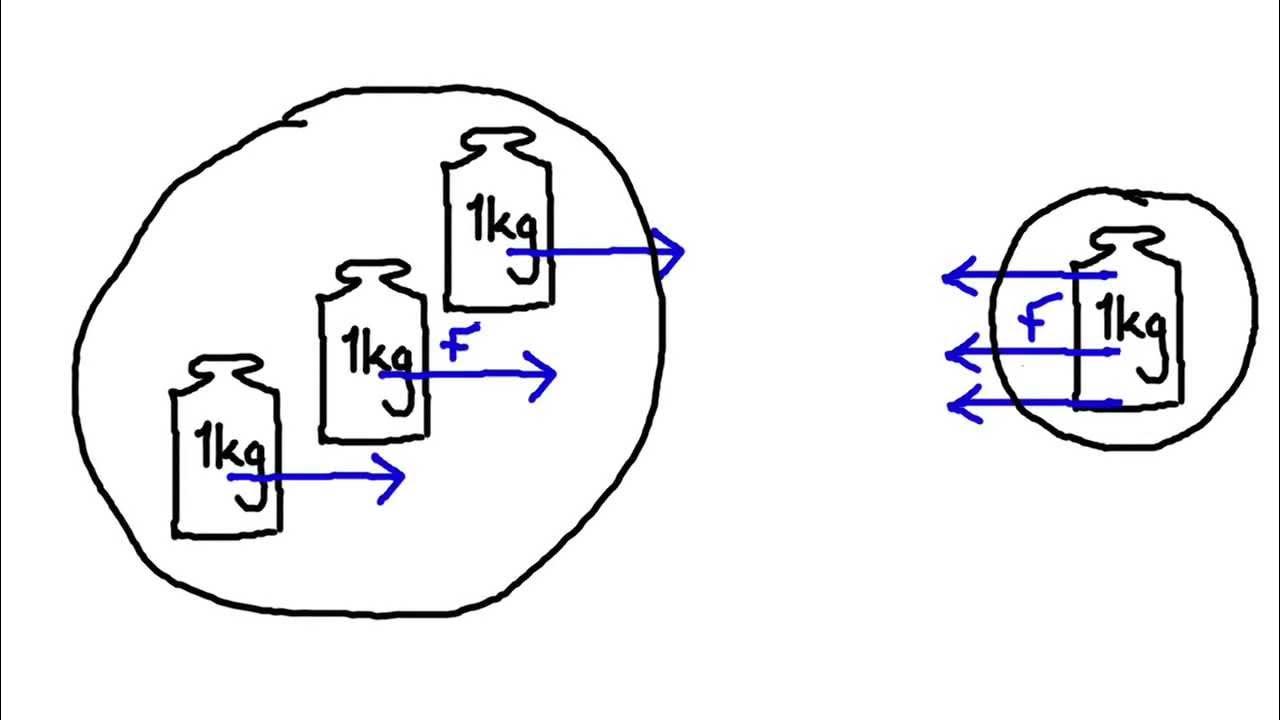
TLDRIn this video, the concept of Newton's Third Law is introduced, explaining how two bodies in contact exert equal and opposite forces on each other. The example of sitting on a chair illustrates this, where the force you apply downward is balanced by the normal reaction force pushing upward, preventing you from falling through. This principle extends to various scenarios like pressing against a wall or static objects on a surface. The video also touches on the next topics, including problems involving connected particles, tension, and thrust.
Takeaways
- 😀 Newton's third law states that for two bodies in contact, the force exerted by body A on body B is equal in magnitude but opposite in direction to the force exerted by body B on body A.
- 😀 The law demonstrates the principle that every action has an equal and opposite reaction.
- 😀 An example of Newton's third law is the normal reaction force when sitting in a chair: your weight presses down on the chair, and the chair pushes up with an equal force.
- 😀 If an object, like a box on a table, is static, the force of gravity pulling it down is counteracted by the normal reaction force pushing it upward.
- 😀 Newton's third law applies not just to stationary objects but also to objects in motion, such as when you press against a wall—the wall exerts an equal and opposite force on you.
- 😀 The concept of normal reaction forces, as seen in various examples (e.g., a box on a table or a person sitting in a chair), is a direct manifestation of Newton’s third law.
- 😀 When you apply a force to an object (like pressing against a wall), the object will exert an equal force back on you, resulting in no movement if the forces balance.
- 😀 Newton’s third law helps explain why objects don't fall through surfaces or move unexpectedly, as the forces exerted by and on the objects are in equilibrium.
- 😀 The next topics to be explored involve problems related to connected particles, tension, and thrust, expanding on the concepts of forces and reactions.
- 😀 Newton's third law is foundational for understanding many physical interactions, from everyday scenarios like sitting in a chair to more complex situations involving tension and thrust in connected systems.
Q & A
What does Newton's Third Law of Motion state?
-Newton's Third Law states that for every action, there is an equal and opposite reaction. In other words, the force exerted by one body on another is equal in magnitude and opposite in direction to the force exerted by the second body on the first.
How is Newton's Third Law demonstrated when sitting on a chair?
-When sitting on a chair, your weight presses down on the chair, and the chair pushes back up with an equal force. These equal and opposite forces illustrate Newton's Third Law.
What is the role of the normal reaction force in the context of Newton's Third Law?
-The normal reaction force is the upward force exerted by a surface to support an object resting on it. It balances the downward weight of the object, exemplifying the equal and opposite forces described in Newton's Third Law.
Why doesn't a box on a table fall through it?
-A box on a table doesn’t fall because the table exerts an upward normal reaction force equal in magnitude and opposite in direction to the downward force of the box’s weight, keeping the box in equilibrium.
How can pressing against a wall illustrate Newton's Third Law?
-When you press against a wall, you exert a force on it. The wall simultaneously exerts an equal and opposite force back on you, showing the action-reaction force pair in Newton's Third Law.
Are action and reaction forces acting on the same object?
-No, action and reaction forces always act on two different objects. For example, when you sit on a chair, your weight acts on the chair, and the chair's normal force acts on you.
What happens if the forces on an object are not equal and opposite?
-If forces on an object are not equal and opposite, the object will accelerate in the direction of the net force according to Newton's Second Law of Motion.
What practical scenarios can help understand Newton’s Third Law?
-Practical scenarios include sitting on a chair, a box resting on a table, pressing a wall, or interacting objects like connected particles experiencing tension or thrust.
How is the concept of connected particles related to Newton's Third Law?
-Connected particles, such as in a rope or chain, experience tension forces. Each particle exerts a force on its neighbor, and the neighbor exerts an equal and opposite force back, demonstrating Newton’s Third Law.
Why is it important to understand equal and opposite forces in physics problems?
-Understanding equal and opposite forces helps analyze static and dynamic situations, calculate tensions, reactions, and accelerations accurately, and predict how objects interact in various mechanical systems.
Can Newton’s Third Law apply to both static and moving objects?
-Yes, Newton’s Third Law applies to all interactions, whether the objects are stationary or moving. The law governs the forces between interacting bodies in every scenario.
What is the next topic mentioned for applying Newton's Third Law?
-The next topic involves applying Newton's Third Law to problems with connected particles, specifically focusing on tension and thrust in systems.
Outlines

Esta sección está disponible solo para usuarios con suscripción. Por favor, mejora tu plan para acceder a esta parte.
Mejorar ahoraMindmap

Esta sección está disponible solo para usuarios con suscripción. Por favor, mejora tu plan para acceder a esta parte.
Mejorar ahoraKeywords

Esta sección está disponible solo para usuarios con suscripción. Por favor, mejora tu plan para acceder a esta parte.
Mejorar ahoraHighlights

Esta sección está disponible solo para usuarios con suscripción. Por favor, mejora tu plan para acceder a esta parte.
Mejorar ahoraTranscripts

Esta sección está disponible solo para usuarios con suscripción. Por favor, mejora tu plan para acceder a esta parte.
Mejorar ahoraVer Más Videos Relacionados

3of6 newtons 3rd law

Newton's Third Law | Common Misunderstandings | Doc Physics

More on Newton's third law | Forces and Newton's laws of motion | Physics | Khan Academy
Best Film on Newton's Third Law. Ever.

Newton's Third Law | Forces & Motion | Physics | FuseSchool

Newton's third law of motion | Forces and Newton's laws of motion | Physics | Khan Academy
5.0 / 5 (0 votes)

