Fluid Mechanics Lesson 07A: Dimensional Analysis Introduction
Summary
TLDRLesson 7A introduces the fundamentals of dimensional analysis in fluid mechanics, focusing on the seven primary dimensions: mass, length, time, temperature, electric current, light, and amount of matter. The lesson explains dimensional homogeneity, showing that all terms in an equation must share the same dimensions, and demonstrates how to express primary dimensions for quantities like force, shear stress, and power. It also defines dimensionless parameters, using examples such as the Mach number and Reynolds number, and guides students through constructing a dimensionless parameter from given variables. Clear examples and step-by-step calculations make complex concepts accessible and engaging.
Takeaways
- 📏 There are seven primary dimensions: Mass (M), Length (L), Time (T), Temperature (Θ), Electric Current (I), Amount of Light (C), and Amount of Matter (N).
- ⚙️ Most fluid mechanics problems use only the first four primary dimensions: M, L, T, and Θ.
- 💪 Derived quantities like force, shear stress, and power can be expressed in terms of primary dimensions using algebraic combinations.
- 🔍 Force has dimensions [F] = M L T⁻², shear stress [τ] = M L⁻¹ T⁻², force per unit length [A] = M T⁻², and power [P] = M L² T⁻³.
- ✅ Dimensional homogeneity requires all additive terms in an equation to have the same dimensions, acting as a consistency check.
- 🍏 Dimensionless parameters, represented by capital Greek Pi (Π), have all primary dimension exponents equal to zero.
- 🚀 Mach number is an example of a dimensionless parameter, defined as speed divided by speed of sound.
- 🌊 Reynolds number (Re = ρ V L / μ) is a key dimensionless parameter in fluid mechanics for characterizing flow.
- 🧮 Constructing a π term involves assigning unknown exponents, combining dimensions, and solving for zero exponents to ensure the parameter is dimensionless.
- 🔄 Verification is essential: always check that the constructed π term indeed cancels out all dimensions to confirm it is dimensionless.
- ⚠️ Inconsistent exponents during π term construction indicate either an algebraic mistake or that a dimensionless parameter cannot be formed with the given variables.
Q & A
What are the seven primary dimensions in dimensional analysis?
-The seven primary dimensions are Mass (M), Length (L), Time (T), Temperature (T), Electric Current (I), Amount of Light (C), and Amount of Matter (N).
Why are these dimensions called 'primary dimensions'?
-They are called primary dimensions because all other physical quantities can be expressed as combinations of these seven fundamental dimensions.
How are the dimensions of force expressed in terms of primary dimensions?
-Force has dimensions of mass times acceleration. Since acceleration has dimensions L/T², the dimensions of force are M L/T².
What is the difference between mass (M) and amount of matter (N)?
-Mass (M) represents the quantity of matter in an object, while N (amount of matter) represents moles. For example, molecular weight is expressed as mass per mole.
How can shear stress be expressed in terms of primary dimensions?
-Shear stress (τ) has units of force per area. Since force is M L/T² and area is L², τ has primary dimensions of M/(L T²), or M¹ L⁻¹ T⁻².
Explain dimensional homogeneity and why it is important.
-Dimensional homogeneity means that all additive terms in an equation must have the same dimensions. It is important because it ensures the physical validity of equations and helps identify errors.
What is a dimensionless parameter and how is it represented?
-A dimensionless parameter has no units, meaning the exponent of all primary dimensions is zero (M⁰ L⁰ T⁰ …). It is represented by a capital Greek Pi (Π).
Why is the Mach number considered a dimensionless parameter?
-Mach number is the ratio of speed to the speed of sound. Since it is a speed divided by a speed, all dimensions cancel, making it dimensionless.
How is the Reynolds number defined and why is it important in fluid mechanics?
-Reynolds number (Re) is defined as ρ V L / μ, where ρ is fluid density, V is flow speed, L is characteristic length, and μ is viscosity. It is important because it characterizes flow regimes (laminar vs turbulent) in both internal and external flows.
How do you construct a dimensionless Pi using three variables a, b, and c?
-To construct a dimensionless Pi, assign an unknown exponent to one variable (e.g., a^x) and divide by the others (b and c). Then, equate the exponents of all primary dimensions to zero to solve for x, ensuring the resulting combination is dimensionless.
In the given example, how is the exponent x determined when forming Π = a^x / (b c)?
-Using the dimensions of a, b, and c, set up equations for each primary dimension (M, L, T) such that the sum of exponents equals zero. Solving these equations yields x = 2, giving Π = a² / (b c).
What is a simple way to verify if a constructed Pi is dimensionless?
-Substitute the primary dimensions of each variable into the Pi expression. Simplify to see if all exponents of M, L, T, etc., cancel to zero. If they do, the Pi is dimensionless.
Outlines

Dieser Bereich ist nur für Premium-Benutzer verfügbar. Bitte führen Sie ein Upgrade durch, um auf diesen Abschnitt zuzugreifen.
Upgrade durchführenMindmap

Dieser Bereich ist nur für Premium-Benutzer verfügbar. Bitte führen Sie ein Upgrade durch, um auf diesen Abschnitt zuzugreifen.
Upgrade durchführenKeywords

Dieser Bereich ist nur für Premium-Benutzer verfügbar. Bitte führen Sie ein Upgrade durch, um auf diesen Abschnitt zuzugreifen.
Upgrade durchführenHighlights

Dieser Bereich ist nur für Premium-Benutzer verfügbar. Bitte führen Sie ein Upgrade durch, um auf diesen Abschnitt zuzugreifen.
Upgrade durchführenTranscripts

Dieser Bereich ist nur für Premium-Benutzer verfügbar. Bitte führen Sie ein Upgrade durch, um auf diesen Abschnitt zuzugreifen.
Upgrade durchführenWeitere ähnliche Videos ansehen

BESARAN DAN SATUAN - MATERI FISIKA KELAS 10 | Edcent.id

IPA Kelas 7 : Besaran Pokok beserta Satuan dan Alat Ukurnya

Modul Fisika Dimensi Untuk SMA (Murid)
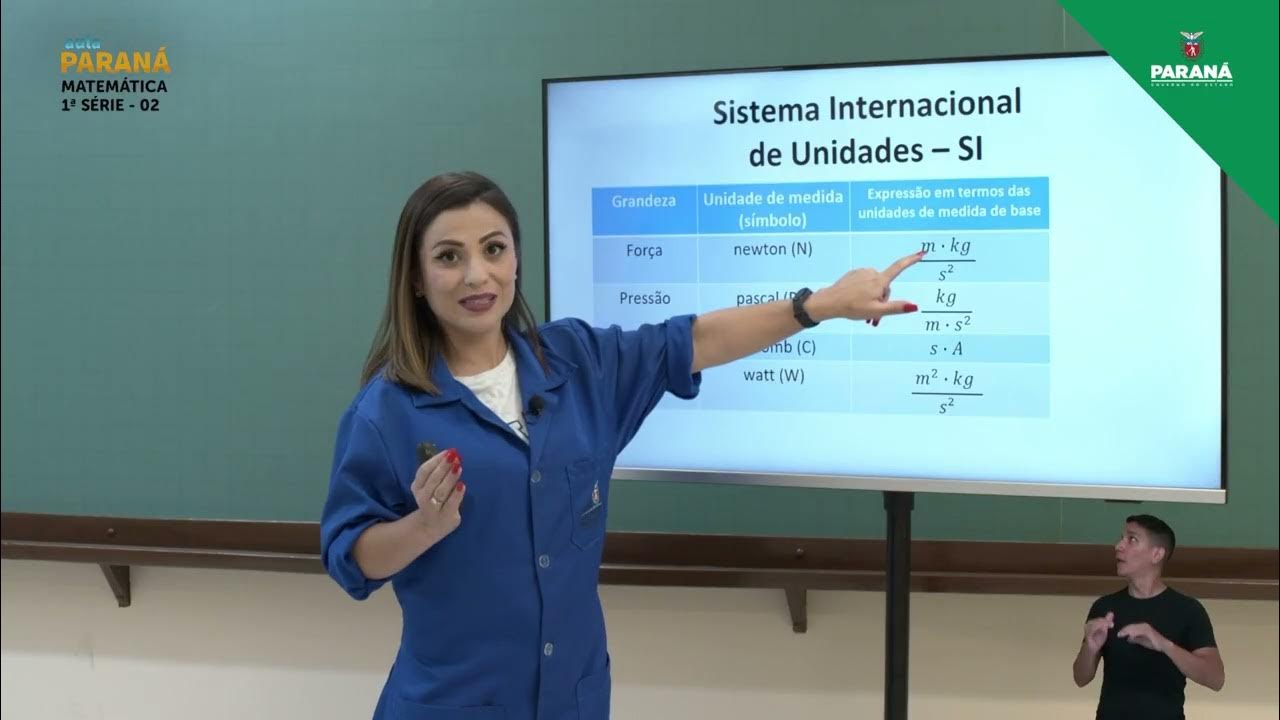
2022 | Resumo da Aula | 1ª Série | Matemática | Aula 2 - Sistema Internacional de Unidades (SI) II

Pengukuran dan Besaran Pokok

BESARAN POKOK | IPA KELAS 7
5.0 / 5 (0 votes)

