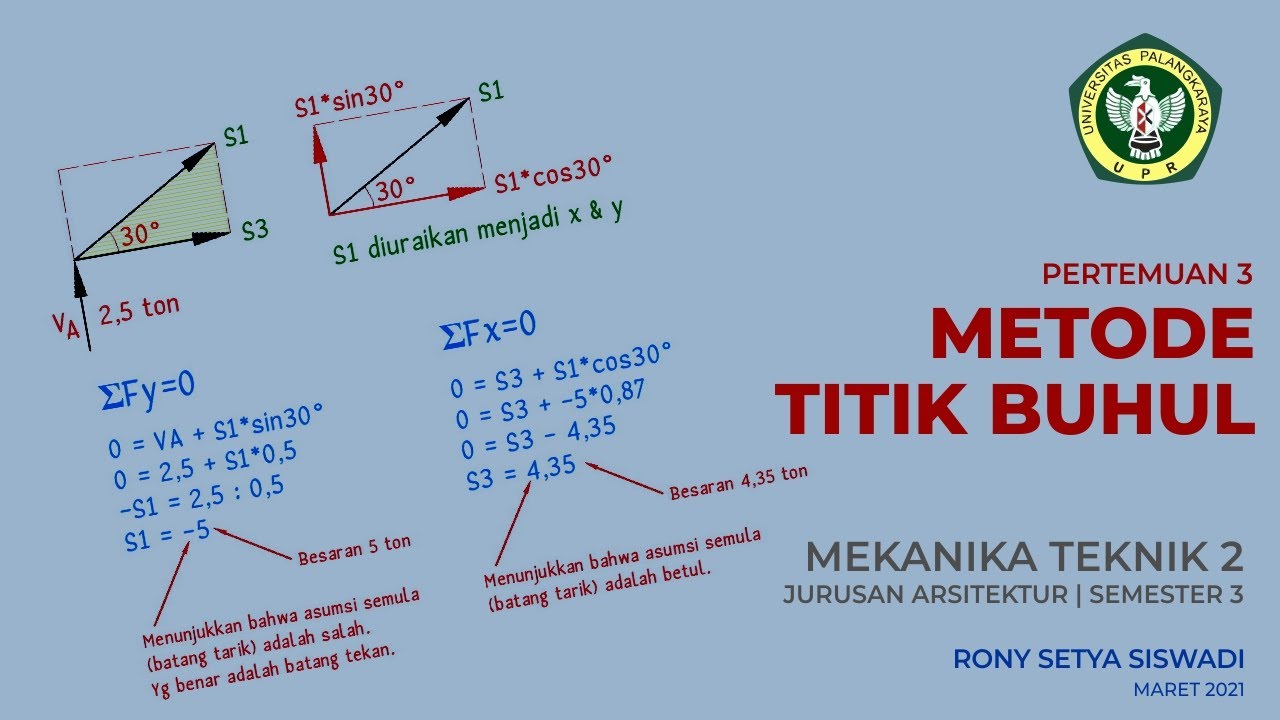
Sangat mudah contoh perhitungan rangka batang cara grafis- rangka jembatan
Summary
TLDRThis video script offers a detailed tutorial on using the Cremona method for solving forces in a truss bridge structure. It covers the process of determining reaction forces at the support points, analyzing the forces in various truss members, and identifying whether each member is in tension or compression. The method relies on graphical representations, using scales for both length and load, to visually depict the forces and equilibrium conditions at different nodes in the structure. The video also includes step-by-step guidance on drawing and calculating the forces in each member, providing a comprehensive and practical approach for structural analysis.
Takeaways
- 😀 The tutorial demonstrates calculating and drawing forces in a bridge truss using the Cremona method.
- 😀 Structural stability must first be verified using the static determinacy formula: 2 × (joints) = members + 2 × (reactions).
- 😀 The scales used are 1 cm = 1 m for length and 1 cm = 1 kN for force.
- 😀 Support reactions are calculated using moments and equilibrium equations at specific joints.
- 😀 Forces in truss members are drawn sequentially around each joint in a clockwise direction.
- 😀 Two main tools are needed for drawing forces: a pencil and a set square ruler.
- 😀 The direction of the force line indicates the type of member force: towards the joint means compression, away means tension.
- 😀 Each member’s force is determined by measuring the line length in the diagram and multiplying by the force scale.
- 😀 After all forces are drawn, a table is compiled summarizing each member's force magnitude and type (tension or compression).
- 😀 Example member forces: S1 (5.6 kN, compression), S2 (4 kN, compression), S4 (4 kN, tension), S5 (5 kN, tension), S6 (5 kN, tension), S8 (1.4 kN, compression), S9 (6 kN, tension).
- 😀 The method emphasizes careful sequential drawing, accurate measurement, and proper identification of tension or compression members for truss analysis.
Q & A
What is the first step in analyzing the truss structure using the Cremona method?
-The first step is to check the stability of the structure by verifying the statical determinacy using the formula 2j = s + r, where j is the number of joints, s is the number of members, and r is the number of support reactions.
How is the scale chosen for the graphical method in this example?
-The scale chosen is 1 cm to represent 1 meter for lengths and 1 cm to represent 1 kN for loads, allowing accurate graphical representation of forces.
What are the calculated support reactions at points A and B?
-The reaction at support A is 4 kN, and the reaction at support B is 5 kN, determined using moment equilibrium equations.
How does the direction of the force line in the Cremona diagram indicate the type of member force?
-If the force line points toward the joint, the member is in compression (negative), and if it points away from the joint, the member is in tension (positive).
What is the sequence for drawing member forces at each joint using the Cremona method?
-The member forces are drawn sequentially in a clockwise direction around each joint, ensuring that the diagram closes properly and accurately represents force equilibrium.
Which tools are recommended for drawing the Cremona diagram accurately?
-A pencil and a set square (two rulers forming a right angle) are recommended to draw the force lines precisely.
What are the forces and types for members S1 and S2 in the example?
-Member S1 has a force of 5.6 kN in compression, and member S2 has a force of 4 kN in compression, determined from the Cremona diagram.
How are unknown member forces calculated graphically in the Cremona method?
-Unknown member forces are measured as the lengths of lines in the Cremona diagram and converted to kN using the chosen scale for loads.
What is the force and type for member S6, and how is it determined?
-Member S6 has a force of 5 kN in tension, determined by drawing its line in the Cremona diagram pointing away from the joint, indicating a tensile force.
Why is it important to maintain consistent direction and scale when constructing the Cremona diagram?
-Consistent direction ensures correct identification of tension or compression, and consistent scale ensures accurate representation of the relative magnitude of forces.
What is the purpose of creating a force table after completing the Cremona diagram?
-The force table summarizes the magnitude and type (tension or compression) of each member, making it easy to interpret and verify the results of the analysis.
How does the Cremona method help in understanding the behavior of truss members under loads?
-The Cremona method provides a visual and quantitative way to determine whether each member is in tension or compression, and the magnitude of the forces, helping engineers understand the internal behavior of the truss structure.
Outlines

Dieser Bereich ist nur für Premium-Benutzer verfügbar. Bitte führen Sie ein Upgrade durch, um auf diesen Abschnitt zuzugreifen.
Upgrade durchführenMindmap

Dieser Bereich ist nur für Premium-Benutzer verfügbar. Bitte führen Sie ein Upgrade durch, um auf diesen Abschnitt zuzugreifen.
Upgrade durchführenKeywords

Dieser Bereich ist nur für Premium-Benutzer verfügbar. Bitte führen Sie ein Upgrade durch, um auf diesen Abschnitt zuzugreifen.
Upgrade durchführenHighlights

Dieser Bereich ist nur für Premium-Benutzer verfügbar. Bitte führen Sie ein Upgrade durch, um auf diesen Abschnitt zuzugreifen.
Upgrade durchführenTranscripts

Dieser Bereich ist nur für Premium-Benutzer verfügbar. Bitte führen Sie ein Upgrade durch, um auf diesen Abschnitt zuzugreifen.
Upgrade durchführenWeitere ähnliche Videos ansehen
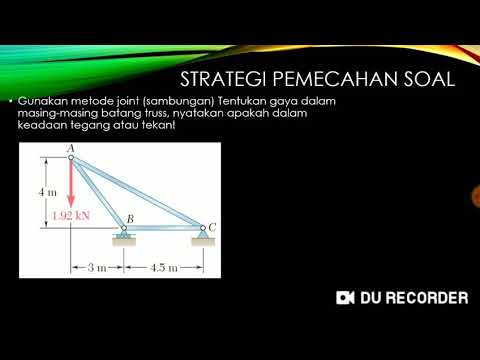
Pembahasan Soal Analisis Struktur Truss dengan metode joint/sambungan
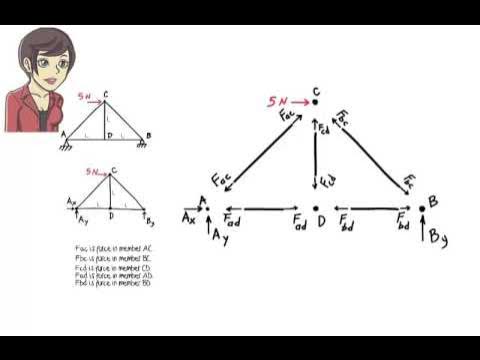
SA04: Truss Analysis: Method of Joints
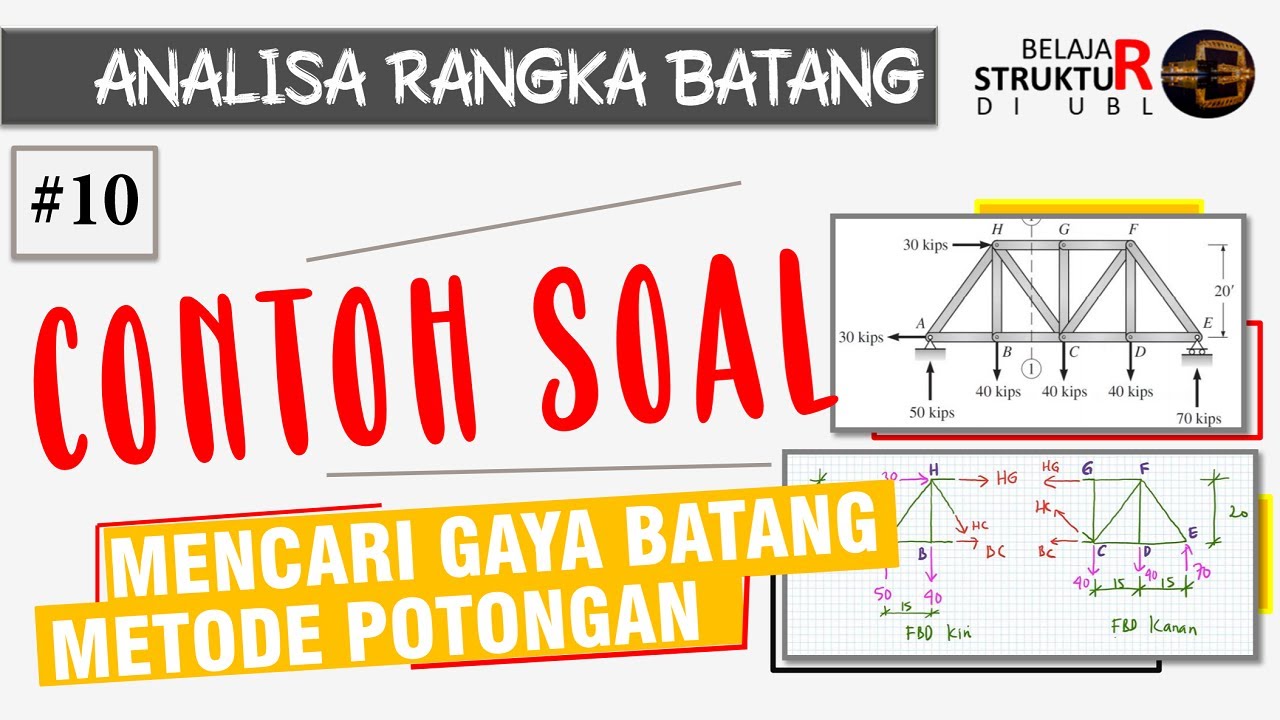
Contoh Perhitungan Rangka Batang dengan Metode Potongan | Analisa Struktur Rangka Batang

Metode Elemen Hingga #1 Analisa Rangka Batang Sederhana dengan SAP2000
V11.1 Statis Tak Tentu - Force Method untuk Truss System
Mekanika Teknik 2 Metode Titik Buhul
5.0 / 5 (0 votes)

