Mekanika Teknik 2 Metode Titik Buhul
Summary
TLDRThis video lesson explores the types of structural supports and the forces acting on trusses in engineering mechanics. It explains roll (wheel), hinge (pinned), and fixed (clamped) supports, highlighting their ability to resist vertical, horizontal, and moment forces. The lecture introduces tensile and compressive forces on truss members, detailing how to determine whether a member is in tension or compression. Using the joint method, the instructor demonstrates step-by-step calculations of support reactions and internal member forces, incorporating vector decomposition and trigonometry. The video emphasizes practical examples, clear assumptions, and careful verification of results, helping students understand force distribution and analysis in truss structures effectively.
Takeaways
- 😀 Rollers or wheels (support type) only resist vertical forces and allow horizontal movement, like the wheels on a car or motorcycle.
- 😀 Hinges or joints (support type) resist both vertical and horizontal forces and allow rotational movement, like a door hinge.
- 😀 Fixed supports or clamps resist vertical forces, horizontal forces, and moments, preventing any movement, as seen in flagpoles.
- 😀 Forces acting on structures can be either tension (pulling) or compression (pushing). Tension causes elongation, while compression leads to shortening.
- 😀 A bending force on a beam results in the top part shortening (compression) and the bottom part elongating (tension).
- 😀 To calculate the forces in a truss or structure, methods like the Method of Joints, Method of Sections, and the Rider Method are used.
- 😀 The first step in solving a truss problem is identifying and naming the joints and members for clarity in calculations.
- 😀 Reaction forces at supports (like A and B) can be determined by using equilibrium equations such as ΣM = 0 and ΣF = 0.
- 😀 The sign convention is crucial: vertical forces upward are positive, downward are negative; clockwise moments are positive, counterclockwise are negative.
- 😀 The assumption for analyzing forces is that all members are in tension. If the calculation yields a negative value, it indicates compression in that member.
- 😀 Trigonometry plays a vital role in resolving forces into components, particularly when forces are at angles like 30° or 60°.
Q & A
What are the three types of supports mentioned in the script?
-The three types of supports mentioned are: roll (or wheel), hinge (or joint), and fixed (or clamp). Each type has different characteristics in terms of the forces it can resist.
What is the primary characteristic of a 'roll' or 'wheel' support?
-A 'roll' or 'wheel' support primarily resists vertical forces. It can move horizontally and is typically used in vehicles like cars or motorcycles, where the force acts vertically but it cannot resist horizontal forces.
How does the 'hinge' or 'joint' support work?
-The 'hinge' or 'joint' support can resist both vertical and horizontal forces. An example is a door hinge, which allows the door to move while preventing it from falling due to vertical or horizontal forces.
What makes the 'fixed' or 'clamp' support unique?
-A 'fixed' or 'clamp' support resists vertical, horizontal, and moment forces. It is completely immovable and typically used in structures like flagpoles, where forces can act in multiple directions.
What are the two main types of forces discussed in relation to plant mechanics?
-The two main types of forces discussed are tension (pulling force) and compression (pressing force). Tension causes elongation, while compression leads to shortening of a structure.
What is the difference between tension and compression in structural mechanics?
-Tension causes a material to stretch and lengthen, while compression causes a material to shorten and become more compact.
What are the three methods used to calculate forces in a structure as mentioned in the script?
-The three methods used to calculate forces are the point method, the Krim method, and the Rider method. These methods involve calculating reaction forces and internal forces in structural members.
How is the moment method used to calculate reaction forces in structural analysis?
-The moment method involves summing the moments around a point (usually a support point) and setting the total equal to zero to solve for unknown reaction forces. This helps in determining how forces are distributed across the structure.
What does a positive result in force calculation indicate about the direction of the force?
-A positive result indicates that the assumed direction of the force (usually away from a point) is correct, meaning the force is acting in the expected direction, such as pulling or stretching.
What is the significance of using trigonometry in calculating forces in structures?
-Trigonometry is essential in breaking down forces into their horizontal and vertical components, allowing for accurate calculation of internal forces acting on the structure, especially in angled members.
Outlines

This section is available to paid users only. Please upgrade to access this part.
Upgrade NowMindmap

This section is available to paid users only. Please upgrade to access this part.
Upgrade NowKeywords

This section is available to paid users only. Please upgrade to access this part.
Upgrade NowHighlights

This section is available to paid users only. Please upgrade to access this part.
Upgrade NowTranscripts

This section is available to paid users only. Please upgrade to access this part.
Upgrade NowBrowse More Related Video
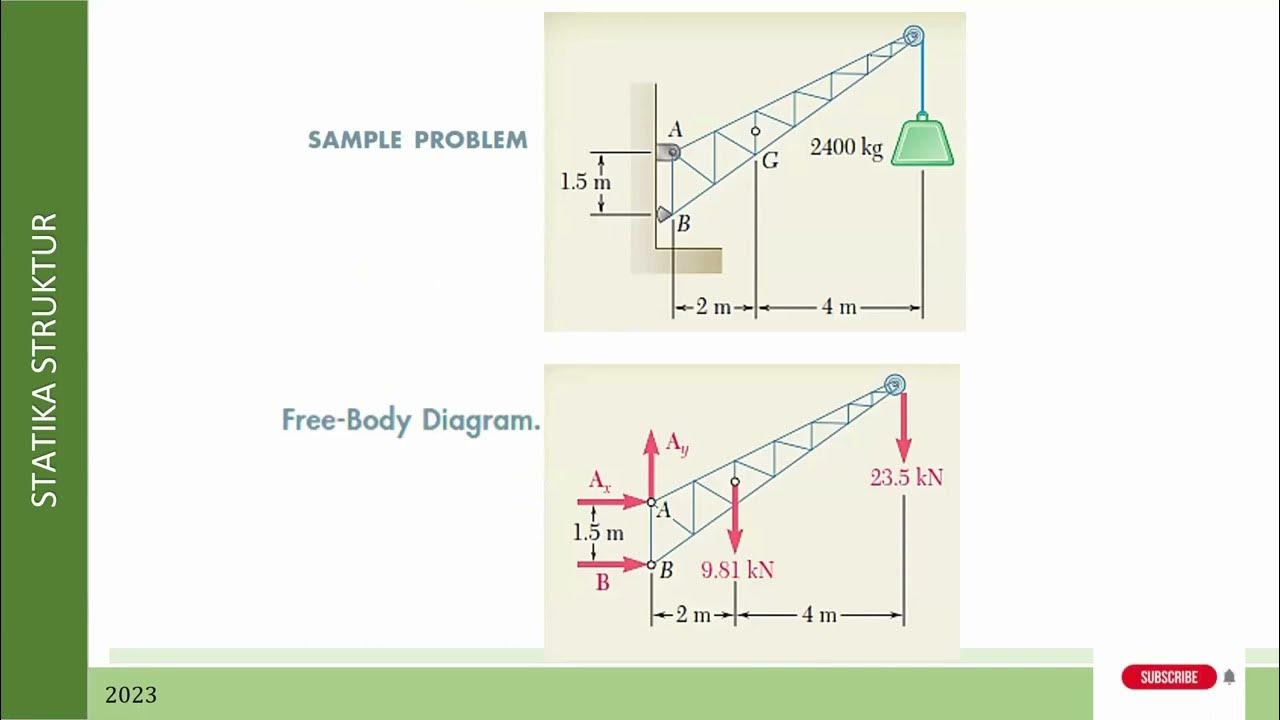
Teori Dasar Struktur Truss: Persamaan/Rumus, Reaksi Tumpuan, Gaya tarik atau tekan (T atau C)

VIDEO PEMBELAJARAN ANALISIS STRUKTUR 1 MATERI GAYA DALAM PADA KONSTRUKSI BALOK SEDERHANA

APA SAJA JENIS -JENIS ELEMEN STRUKTUR BANGUNAN

S-10 Pengenalan Truss
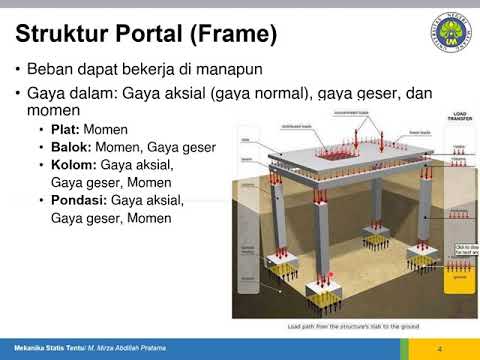
Mekanika Statis Tentu: Klasifikasi Struktur Bangunan

Building Structural System
5.0 / 5 (0 votes)
