SIMPLIFYING EXPRESSIONS WITH RATIONAL EXPONENTS || GRADE 9 MATHEMATICS Q2
Summary
TLDRThis video tutorial explains how to simplify expressions with rational exponents. It covers essential properties such as the product of powers, power of a power, quotient of powers, and the power of a quotient. Additionally, the video illustrates how to handle negative exponents, simplify expressions with positive exponents, and apply the rules of exponents to solve various examples. Viewers will learn to simplify complex expressions step by step, with practical examples to reinforce understanding, ensuring a strong grasp of simplifying rational exponents.
Takeaways
- 😀 Understanding rational exponents allows us to simplify expressions with fractional exponents.
- 😀 The product of powers rule: when multiplying like bases, add the exponents (e.g., a^(4/3) * a^(2/3) = a^6/3 = a^2).
- 😀 The power of a power rule: multiply exponents when raising a power to another power (e.g., (2^(2/3))^3 = 2^(2/3 * 3) = 2^2).
- 😀 The quotient rule for exponents: when dividing like bases, subtract the exponents (e.g., a^4 / a^1 = a^(4-1) = a^3).
- 😀 Negative exponents represent reciprocals (e.g., a^(-n) = 1/a^n), so apply this rule to convert negative exponents to positive ones.
- 😀 Power of a quotient rule: distribute the exponent to both the numerator and the denominator (e.g., (4/16)^(1/2) = 4^(1/2) / 16^(1/2)).
- 😀 Simplify expressions with fractional exponents by expressing roots as powers (e.g., 27^(-1/3) = 1/27^(1/3) = 1/3).
- 😀 Use the least common denominator (LCD) when working with exponents with fractions to simplify expressions (e.g., 4/3 - 2/3 = 2/3).
- 😀 Apply exponent rules step-by-step: start by simplifying individual parts before combining them (e.g., (2m^2)^(-1) * 4m^(3/2) = 1/(2m^2) * 4m^(3/2)).
- 😀 When simplifying expressions with variables, always assume positive real values for variables to avoid undefined results (e.g., no negative bases in fractional exponents).
Q & A
What is the main objective of the lesson discussed in the transcript?
-The objective of the lesson is to simplify expressions involving rational exponents using exponent rules.
How do you simplify a product of powers with the same base?
-To simplify a product of powers with the same base, copy the base and add their exponents.
What is the rule for simplifying a power of a power?
-When simplifying a power of a power, multiply the exponents.
How do you simplify an expression where two quantities multiplied together are raised to a power?
-Apply the exponent to each factor inside the parentheses by multiplying the exponent with the exponents of each factor.
What is the quotient rule for exponents?
-For a quotient of powers with the same base, copy the base and subtract the exponent of the denominator from that of the numerator.
How do you apply the power of a quotient rule?
-When a quotient is raised to an exponent, apply the exponent to both the numerator and the denominator.
What does a negative exponent indicate?
-A negative exponent indicates the reciprocal of the base raised to the corresponding positive exponent.
How is 27 raised to the power of -1/3 simplified?
-27⁻¹/³ becomes 1 divided by 27¹/³, which simplifies to 1/3 because the cube root of 27 is 3.
What is the first step when simplifying expressions like 5^(1/4) × 5^(4/5)?
-Use the product rule by adding the exponents while keeping the base the same.
How do you simplify an expression with mixed coefficients and variables, such as 4x² / 2x^(1/2)?
-Divide the coefficients, then subtract the exponents of like bases, applying fraction rules when necessary.
How do you handle expressions with an overall negative exponent, such as (x² / y^(1/3))⁻¹/²?
-Multiply each exponent inside the parentheses by the outside exponent, then move any factors with negative exponents to the denominator or numerator as needed.
What is an important assumption made throughout the examples in the lesson?
-The lesson assumes that all variables represent positive real numbers.
Outlines

Dieser Bereich ist nur für Premium-Benutzer verfügbar. Bitte führen Sie ein Upgrade durch, um auf diesen Abschnitt zuzugreifen.
Upgrade durchführenMindmap

Dieser Bereich ist nur für Premium-Benutzer verfügbar. Bitte führen Sie ein Upgrade durch, um auf diesen Abschnitt zuzugreifen.
Upgrade durchführenKeywords

Dieser Bereich ist nur für Premium-Benutzer verfügbar. Bitte führen Sie ein Upgrade durch, um auf diesen Abschnitt zuzugreifen.
Upgrade durchführenHighlights

Dieser Bereich ist nur für Premium-Benutzer verfügbar. Bitte führen Sie ein Upgrade durch, um auf diesen Abschnitt zuzugreifen.
Upgrade durchführenTranscripts

Dieser Bereich ist nur für Premium-Benutzer verfügbar. Bitte führen Sie ein Upgrade durch, um auf diesen Abschnitt zuzugreifen.
Upgrade durchführenWeitere ähnliche Videos ansehen
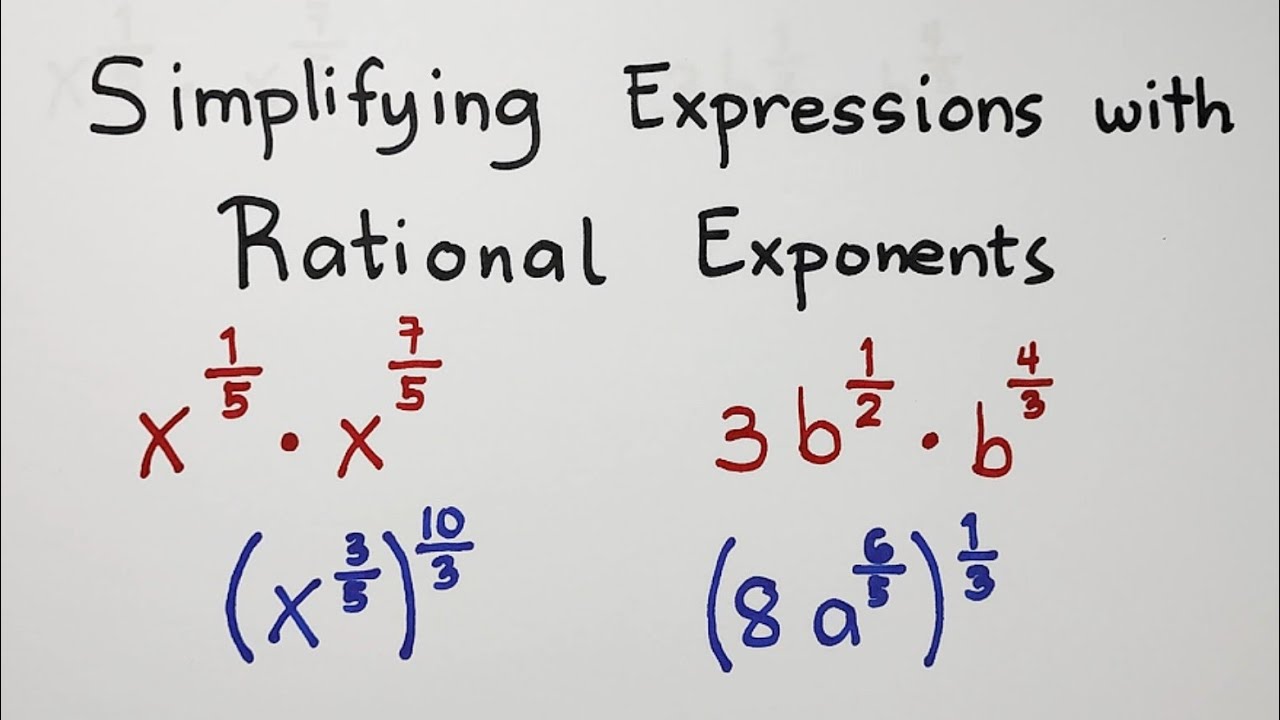
How to Simplify Expressions with Rational Exponents? Grade 9 Math - Second Quarter
🦿 Langkah 027: Sifat Bentuk Akar | Fundamental Matematika Alternatifa

🔥 EKSPONEN: Definisi, Sifat, dan Contoh Soal | Matematika Dasar

Bentuk Akar Matematika Kelas X Matematika Peminatan Paling mudah
WEEK 5&6: WRITING EXPRESSIONS WITH RATIONAL EXPONENTS AS RADICALS AND VICE-VERSA
MULTIPLICATION AND DIVISION OF RATIONAL ALGEBRAIC EXPRESSIONS || GRADE 8 MATHEMATICS Q1
5.0 / 5 (0 votes)

