Matematika Kelas 9 Bab 4 Peluang dan Pemilihan Sampel - A. Peluang hal. 218 - 223 Kurikulum Merdeka
Summary
TLDRThis video lesson covers the basics of probability for 9th-grade students, focusing on activities involving dice rolls, coin tosses, and sample spaces. The teacher presents different game scenarios and asks students to choose rules based on probability outcomes, helping them understand the concept of favorable events. It includes examples like rolling dice to get specific sums, tossing coins to get heads or tails, and calculating the total number of possible outcomes. The video aims to make students comfortable with calculating and comparing probabilities using practical examples and exercises.
Takeaways
- 😀 Probability is the likelihood of an event happening, and it can be calculated by identifying all possible outcomes.
- 😀 In probability experiments like rolling a die or tossing a coin, each possible outcome can be represented as part of the sample space.
- 😀 When rolling a single die, there are 6 possible outcomes, each corresponding to a different number (1 to 6).
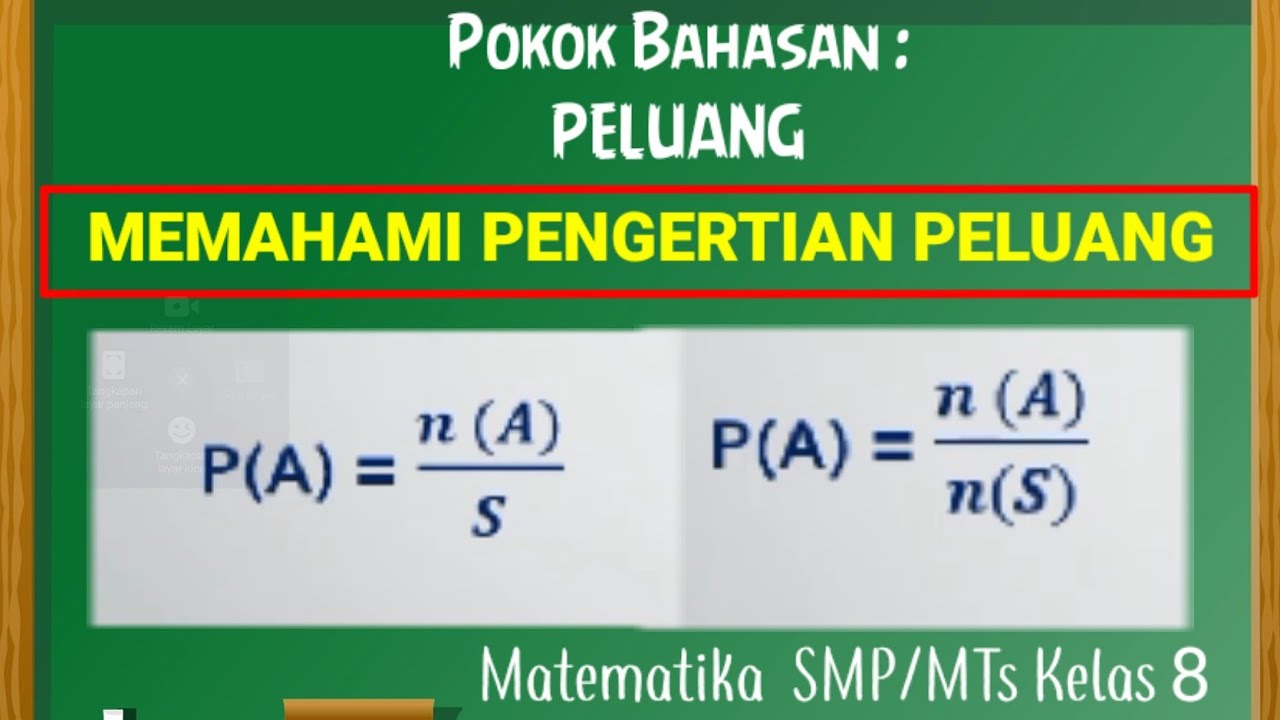
- 😀 The probability of an event is calculated by dividing the number of favorable outcomes by the total number of possible outcomes.
- 😀 In a game involving a die, different rules can alter the probability of winning based on the outcomes (e.g., rolling an even number or a specific number).
- 😀 A probability experiment can involve multiple trials or events, like tossing two coins or rolling two dice, which expands the number of possible outcomes.
- 😀 Tree diagrams are a useful tool for visualizing all possible outcomes of a probability experiment, especially with multiple trials like tossing two coins.
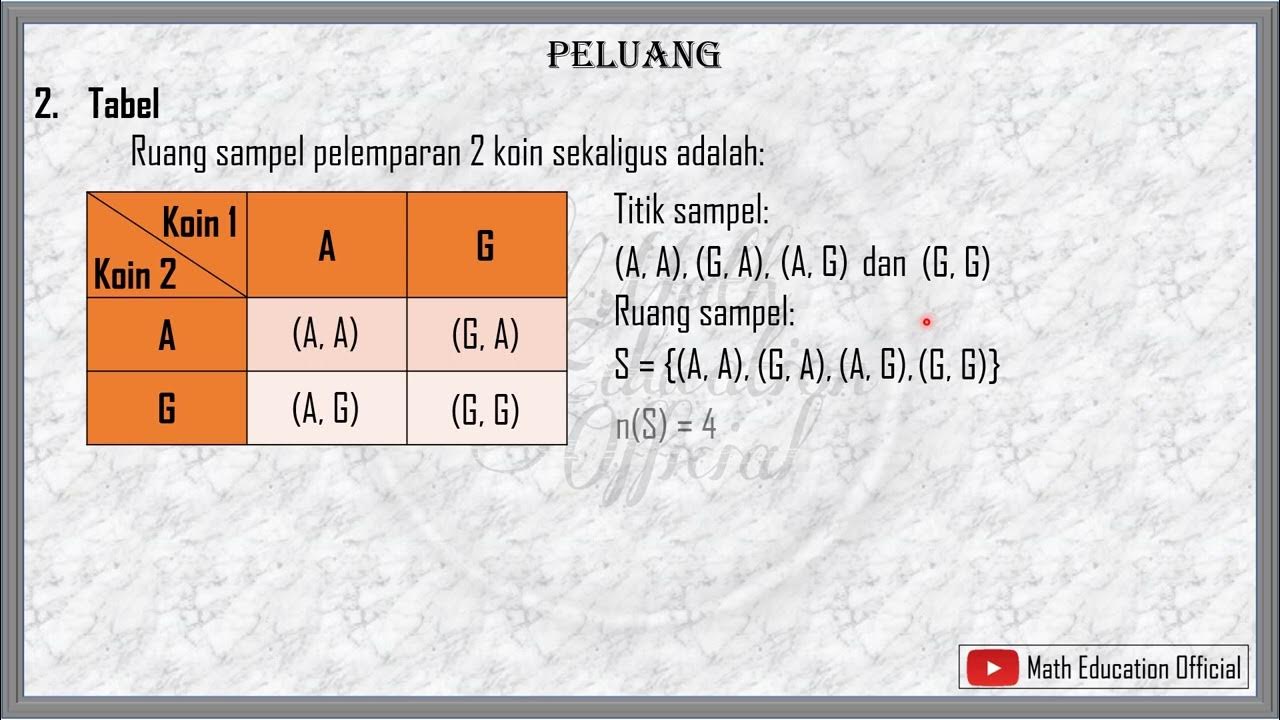
- 😀 The sample space is the set of all possible outcomes in a probability experiment. For example, when tossing two coins, the sample space consists of four outcomes: (Heads, Heads), (Heads, Tails), (Tails, Heads), and (Tails, Tails).
- 😀 Abel’s method of listing all possible outcomes in a table and summing probabilities is an effective way to understand probability problems.
- 😀 Probability experiments are often modeled using tables, diagrams, or by calculating the number of favorable outcomes relative to the total outcomes.
- 😀 The concept of 'sample space' and 'events' is fundamental in determining the probability of specific outcomes, like achieving a sum of 7 or 11 in a dice-rolling game.
Q & A
What is the main topic of the lesson in this script?
-The main topic of the lesson is mathematics, specifically focusing on probability and selection methods, which is a part of the curriculum for 9th-grade students.
What is the primary objective of exploring probability through games in the lesson?
-The objective is to help students understand the concept of probability by exploring it through games, such as rolling a die or tossing coins, and learning how to make strategic choices based on probabilities.
What are the three game rules provided to the students in the first game involving a die roll?
-The three game rules are: (A) Win if you roll a 2, (B) Win if you roll an even number, (C) Win if you roll a 1 or 5.
Which game rule did the teacher choose for the first game, and why?
-The teacher chose rule B, which involves winning if an even number is rolled, because it has the highest probability (three possible outcomes: 2, 4, 6).
What is the setup of the second game involving two coins?
-In the second game, two coins are tossed, each with two possible outcomes: heads (H) or tails (T). The rules are: (A) Win if you get one head and one tail, (B) Win if both coins show heads.
How many possible outcomes are there when tossing two coins?
-There are four possible outcomes when tossing two coins: (H, H), (H, T), (T, H), and (T, T).
Which game rule did the teacher choose for the second game, and why?
-The teacher chose rule A, where students win if they get one head and one tail, because it has two possible outcomes (H, T) and (T, H), compared to rule B which only has one (H, H).
What is the setup of the third game involving two dice?
-In the third game, two dice are rolled, and the rules are: (A) Win if the sum of the dice equals 11, (B) Win if the sum equals 1, (C) Win if the sum equals 7.
How many total possible outcomes are there when rolling two dice?
-When rolling two dice, there are 36 possible outcomes, as each die has 6 faces and the outcomes are combinations of the numbers on the two dice.
How did Abel determine the best game rule to choose in the third game involving two dice?
-Abel calculated the number of possible outcomes for each rule: Rule A (sum = 11) has 2 possible outcomes, Rule B (sum = 1) has 0 possible outcomes, and Rule C (sum = 7) has 6 possible outcomes. Abel chose Rule C, as it had the highest number of outcomes.
Outlines

此内容仅限付费用户访问。 请升级后访问。
立即升级Mindmap

此内容仅限付费用户访问。 请升级后访问。
立即升级Keywords

此内容仅限付费用户访问。 请升级后访问。
立即升级Highlights

此内容仅限付费用户访问。 请升级后访问。
立即升级Transcripts

此内容仅限付费用户访问。 请升级后访问。
立即升级浏览更多相关视频
Mengenal Ruang Sampel, Titik Sampel dan Kejadian

PELUANG: MATEMATIKA KELAS 8 SMP
MEMAHAMI PENGERTIAN PELUANG | Matematika SMP/MTs Kelas 8

Peluang | Matematika Kelas X SMA/SMK FASE E | Materi dan Latihan Soal
BELAJAR DARI RUMAH (MATEMATIKA MATERI PELUANG KELAS 8, LENGKAP CONTOH SOAL DAN PEMBAHASAN)
Overview, Sample Space & Types of Events | Statistics and Probability | By GP Sir
5.0 / 5 (0 votes)

