Menentukan Peluang Suatu Kejadian ||Materi, Soal & Pembahasan||
Summary
TLDRThis educational video explains the concept of probability, focusing on sample spaces, events, and how to calculate the probability of various outcomes. It covers practical examples such as rolling a die, drawing a card from a deck, and calculating the chance of specific events like prime numbers or dice sums. The video also explores combinations and how to determine probabilities with multiple events, such as drawing colored marbles or having children of certain genders. The clear step-by-step explanations and examples aim to make the concept of probability accessible and engaging for viewers.
Takeaways
- 😀 Understanding probability involves calculating the likelihood of an event based on its favorable outcomes and total possible outcomes.
- 😀 The basic formula for probability is P(A) = n(A) / n(S), where n(A) is the number of favorable outcomes and n(S) is the number of outcomes in the sample space.
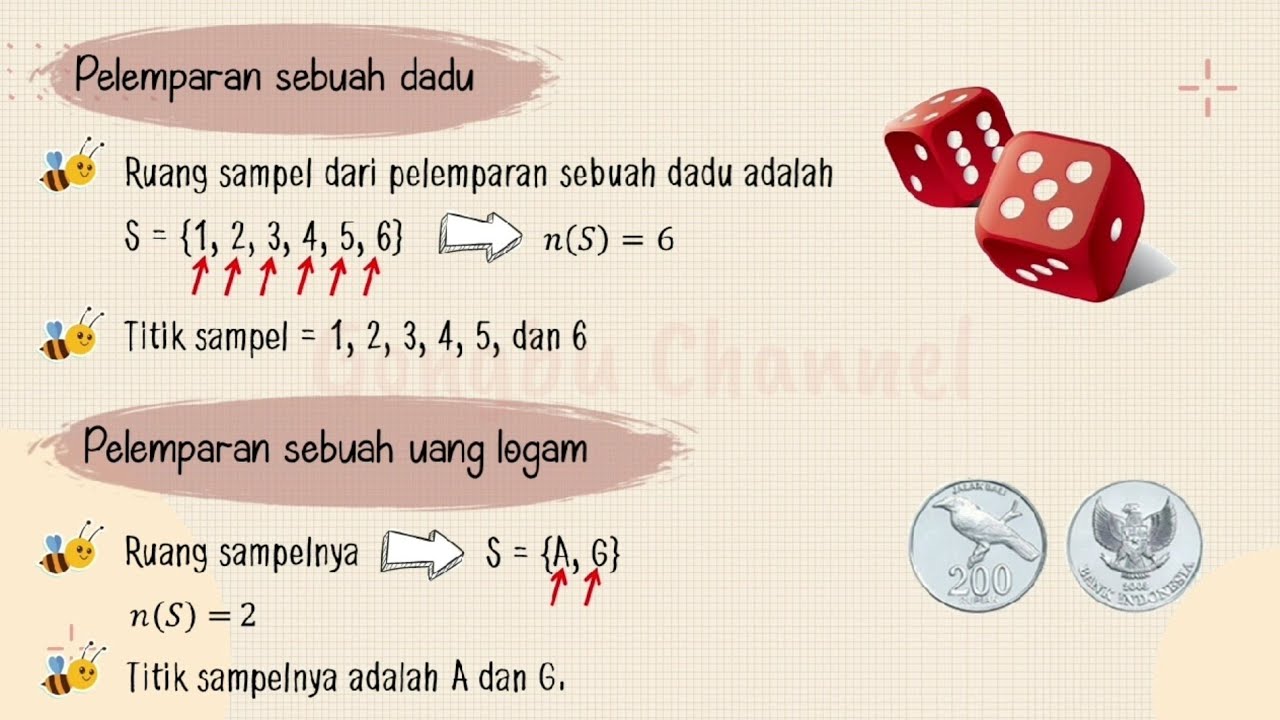
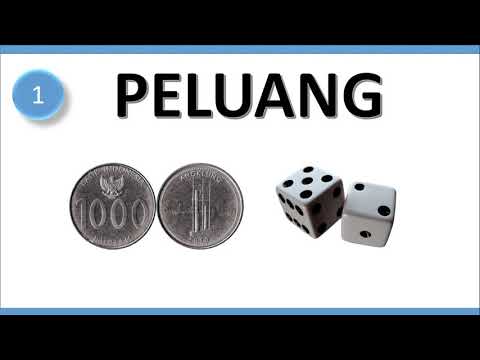
- 😀 A sample space is the set of all possible outcomes for a given experiment, such as the numbers on a die or the outcomes of flipping two coins.
- 😀 The probability of rolling a prime number on a six-sided die is 1/2, since the prime numbers (2, 3, 5) make up half the possible outcomes.
- 😀 In the case of rolling two dice, the probability of getting a sum of 9 is 4/36 (or 1/9), calculated by finding the pairs that sum to 9.
- 😀 For card games, the probability of drawing a King from a standard deck of 52 cards is 1/13, as there are 4 Kings in the deck.
- 😀 When spinning a wheel numbered 1 to 12, the probability of landing on a factor of 12 is 1/2, since the factors of 12 are 1, 2, 3, 4, 6, and 12.
- 😀 Probability can also apply to real-life scenarios, such as determining the likelihood of having three boys or two boys and one girl in a family of three children.
- 😀 For probability involving combinations, like drawing marbles from a bag, use the formula for combinations to calculate the number of favorable outcomes.
- 😀 In the case of drawing 4 marbles from a set of 11 (6 red and 5 white), the probability of drawing only red marbles is 1/22, and the probability of drawing 3 red marbles and 1 white is 10/33.
Q & A
What is the formula to calculate the probability of an event?
-The probability of an event A is calculated using the formula: P(A) = n(A) / n(S), where n(A) is the number of outcomes in event A, and n(S) is the number of outcomes in the sample space S.
In a dice roll, how do you calculate the probability of rolling a prime number?
-To calculate the probability of rolling a prime number on a six-sided die, first identify the prime numbers (2, 3, and 5). The sample space is {1, 2, 3, 4, 5, 6}, so the probability is P(A) = 3/6, which simplifies to 1/2.
How do you calculate the probability of rolling a 5 on a die?
-To calculate the probability of rolling a 5, note that the sample space for a single die roll is {1, 2, 3, 4, 5, 6}. The event 'rolling a 5' has only 1 outcome, so the probability is P(B) = 1/6.
When rolling two dice, how do you calculate the probability of the sum of the dice being 9?
-To calculate the probability of the sum of two dice being 9, list the pairs of dice rolls that sum to 9: (3, 6), (4, 5), (5, 4), and (6, 3). There are 4 successful outcomes, and the total number of possible outcomes is 36. So, P(A) = 4/36, which simplifies to 1/9.
What is the probability of drawing a King from a deck of 52 playing cards?
-In a deck of 52 playing cards, there are 4 Kings. The probability of drawing a King is P(A) = 4/52, which simplifies to 1/13.
How do you calculate the probability of the spinning arrow landing on a factor of 12?
-The factors of 12 are 1, 2, 3, 4, 6, and 12. The sample space is {1, 2, 3, 4, 5, 6, 7, 8, 9, 10, 11, 12}, which has 12 possible outcomes. Since there are 6 favorable outcomes (the factors of 12), the probability is P(A) = 6/12, which simplifies to 1/2.
In a family with three children, how do you calculate the probability that all children are boys?
-For a family with three children, the sample space is all possible combinations of boys (B) and girls (G): {BBB, BBG, BGB, BGG, GBB, GBG, GGB, GGG}. The event 'all boys' has only one favorable outcome (BBB). Therefore, the probability is P(A) = 1/8.
What is the probability of having at least one girl in a family with three children?
-The event 'at least one girl' includes all outcomes except for 'all boys' (BBB). So, the favorable outcomes are {BBG, BGB, BGG, GBB, GBG, GGB, GGG}, which are 7 out of 8 possible outcomes. Therefore, the probability is P(C) = 7/8.
How do you calculate the probability of drawing 4 red marbles from a bag containing 6 red and 5 white marbles?
-To calculate the probability of drawing 4 red marbles, use combinations. The total number of ways to choose 4 marbles from 11 is C(4, 11) = 330. The number of ways to choose 4 red marbles from 6 is C(4, 6) = 15. Thus, the probability is P(A) = 15/330, which simplifies to 1/22.
What is the probability of drawing 3 red marbles and 1 white marble from a bag with 6 red and 5 white marbles?
-To calculate this probability, first calculate the number of ways to choose 3 red marbles from 6 (C(3, 6) = 20) and 1 white marble from 5 (C(1, 5) = 5). The total number of ways to choose 4 marbles from 11 is C(4, 11) = 330. Therefore, the probability is P(B) = (20 * 5) / 330 = 100/330, which simplifies to 10/33.
Outlines

此内容仅限付费用户访问。 请升级后访问。
立即升级Mindmap

此内容仅限付费用户访问。 请升级后访问。
立即升级Keywords

此内容仅限付费用户访问。 请升级后访问。
立即升级Highlights

此内容仅限付费用户访问。 请升级后访问。
立即升级Transcripts

此内容仅限付费用户访问。 请升级后访问。
立即升级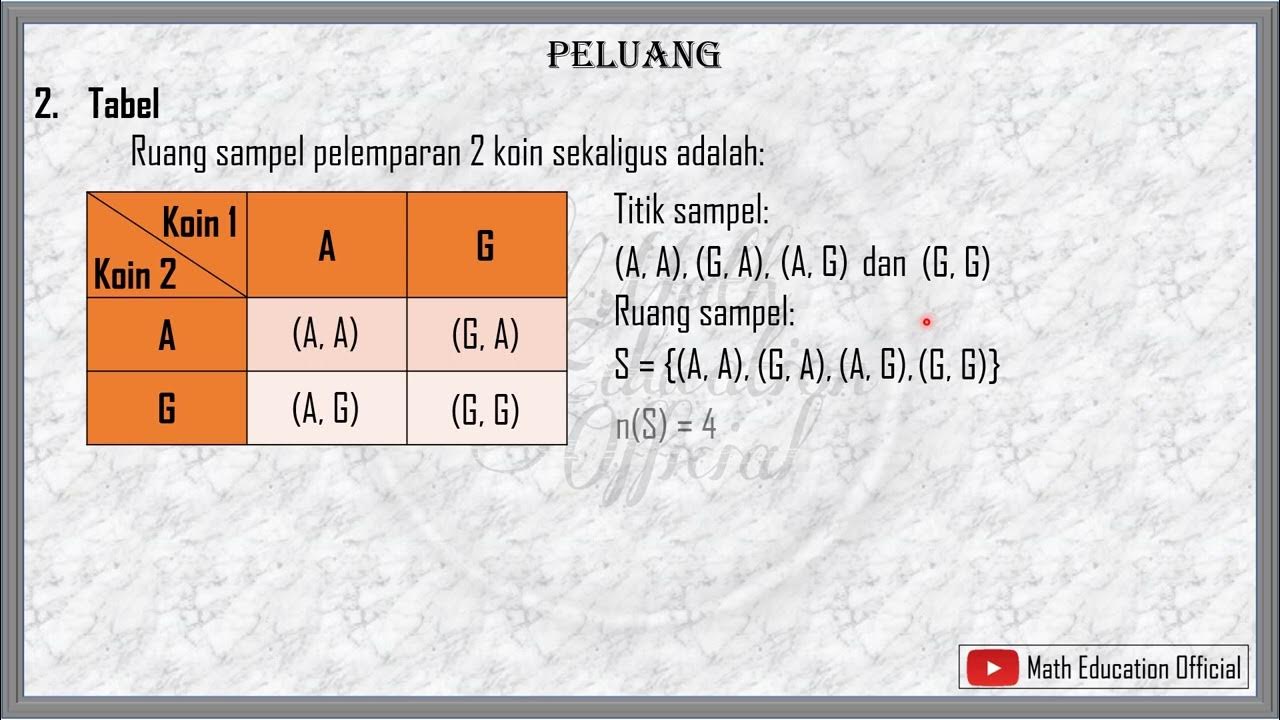

5.0 / 5 (0 votes)

