GARIS DAN HUBUNGAN ANTAR GARIS | VIDEO PEMBELAJARAN
Summary
TLDRThis educational video introduces viewers to the concept of lines and their relationships in geometry. It explains different types of lines, including straight lines, rays, and line segments, as well as vertical and horizontal lines. The video then explores relationships between lines, covering parallel lines, coincident lines, and intersecting lines. Key properties of parallel lines are highlighted, such as drawing exactly one parallel through a point outside a line and the behavior when intersected by another line. Everyday examples like railway tracks and clock hands are used to illustrate these concepts, making geometry more relatable and practical for learners.
Takeaways
- 📏 A line is a collection of points arranged continuously in a straight path.
- ➡️ A straight line extends infinitely in both directions.
- 🔦 A ray starts at one endpoint and extends infinitely in one direction.
- 📐 A line segment is a part of a line bounded by two endpoints.
- ↕️ A vertical line is an upright line that runs up and down.
- ↔️ A horizontal line is a flat line that runs from left to right.
- 🔗 There are three main relationships between lines: parallel, coincident, and intersecting.
- 🚆 Parallel lines lie on the same plane and never meet, even when extended infinitely.
- ✍️ Parallel lines are represented using the symbol ∥.
- 🛤️ Railway tracks are a common real-life example of parallel lines.
- 📍 Through a point outside a line, exactly one line can be drawn parallel to the original line.
- ✂️ If a line intersects one of two parallel lines, it will also intersect the other.
- 📚 If two lines are each parallel to a third line, then they are parallel to each other.
- 📌 Coincident lines overlap completely, sharing at least two points and appearing as a single line.
- 🕛 The hands of a clock at 12:00 are an example of coincident lines.
- ❌ Intersecting lines cross each other at exactly one point, called the point of intersection.
- 🚦 Railroad crossings and traffic cross signs are everyday examples of intersecting lines.
Q & A
What is a straight line, and how is it defined?
-A straight line is a line that extends infinitely in both directions without any curvature. It is defined by the concept of an unbroken collection of points that follow a consistent and continuous path.
What is the difference between a ray and a line segment?
-A ray begins at a specific point and extends infinitely in one direction, whereas a line segment has two endpoints and does not extend beyond them.
What are vertical and horizontal lines, and how do they differ?
-Vertical lines are straight lines that run up and down, while horizontal lines run left to right. They are perpendicular to each other, forming a 90-degree angle.
What does it mean for two lines to be parallel?
-Parallel lines are lines that lie on the same plane but never intersect, regardless of how far they are extended. They remain equidistant from each other at all points.
Can you give an example of parallel lines in daily life?
-An example of parallel lines in daily life is the tracks of a railway, where the two rails run alongside each other without crossing.
What is the first property of parallel lines?
-The first property of parallel lines is that through any point outside a given line, exactly one line can be drawn that is parallel to the original line.
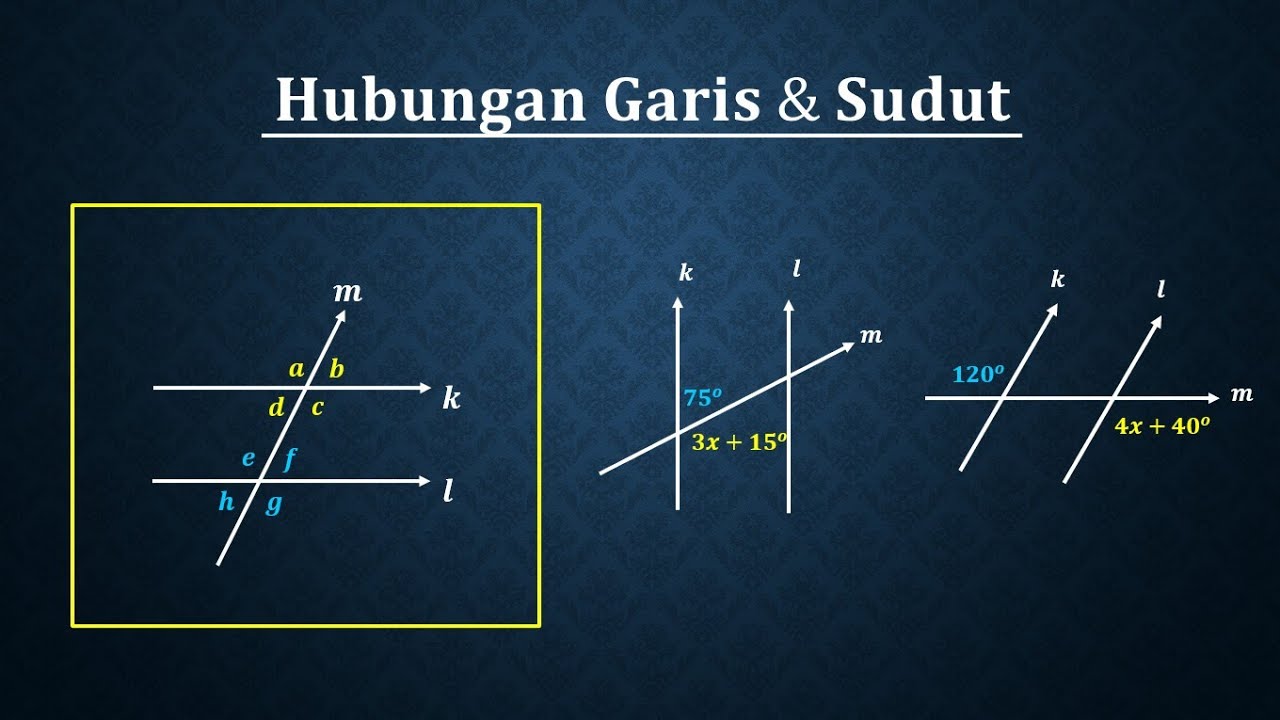
How do parallel lines interact with a transversal line?
-If a transversal line cuts across one of two parallel lines, it will also intersect the second parallel line at the same angle, meaning that the transversal will cross both lines in the same manner.
What happens if two lines are coincident?
-Coincident lines are two lines that lie on top of each other, sharing at least two points. Essentially, they are the same line and appear as one when viewed.
Where can we observe coincident lines in real life?
-An example of coincident lines in real life is the hands of a clock at 12:00, where both the minute hand and the hour hand overlap, forming a single line.
What does it mean for two lines to intersect?
-When two lines intersect, they meet or cross at a specific point. This point is known as the point of intersection, and the lines are said to be 'intersecting lines.'
What is an example of intersecting lines in daily life?
-An example of intersecting lines in daily life is the crossroads of two roads, where they cross each other, creating a point of intersection.
Outlines

This section is available to paid users only. Please upgrade to access this part.
Upgrade NowMindmap

This section is available to paid users only. Please upgrade to access this part.
Upgrade NowKeywords

This section is available to paid users only. Please upgrade to access this part.
Upgrade NowHighlights

This section is available to paid users only. Please upgrade to access this part.
Upgrade NowTranscripts

This section is available to paid users only. Please upgrade to access this part.
Upgrade Now


5.0 / 5 (0 votes)
