ଆସିଗଲା +2 Board Education Selection MCQ|+2 board 2026 education MCQ|Unit 4|Mcq|Unit 4|Plus two exam|
Summary
TLDRThis video lecture covers Unit 4 of a statistics course, focusing on measures of central tendency such as mean, median, and mode. The instructor explains calculations using both individual data points and grouped data, including numerical examples and step-by-step methods for finding midpoints and applying formulas. Concepts like data distribution, variability, and reliability of central measures are discussed, along with practical problem-solving techniques. The session also highlights how to interpret results, apply formulas to different types of datasets, and connect statistical concepts to real-world applications. Students are guided through exercises to reinforce understanding and ensure mastery of key concepts.
Takeaways
- 😀 The script focuses on teaching concepts of central tendency, including mean, median, and mode.
- 😀 The session covers the calculation of central tendency measures using sample data.
- 😀 The discussion emphasizes how to compute the mean by adding all data points and dividing by the number of data points.
- 😀 The median is explained as the middle value in an ordered data set, with a focus on how to find it in both even and odd data sets.
- 😀 The script covers various methods for calculating the mode, highlighting that it’s the most frequent value in a data set.
- 😀 The session explains how to handle ungrouped data and grouped data differently when calculating central tendency measures.
- 😀 There is a mention of using formulas for the median and mean in grouped data, which requires understanding class intervals and frequencies.
- 😀 The importance of knowing different central tendency measures is discussed in terms of their reliability for summarizing data distributions.
- 😀 The script highlights the importance of consistency and accuracy when calculating these statistical measures for effective data interpretation.
- 😀 The video provides a step-by-step guide for computing central tendency measures, reinforcing concepts with practical examples.
Q & A
What is the main topic of Unit 4 covered in the video?
-Unit 4 focuses on measures of central tendency in statistics, including mean, median, and mode, along with their applications and calculation methods.
What are the key central tendency measures discussed in the video?
-The key measures discussed are Mean (average), Median (middle value), and Mode (most frequent value).
How is the mean calculated according to the video?
-The mean is calculated by summing all numerical values and dividing by the total number of observations.
How is the median determined for a set of numbers?
-The median is the middle value of a dataset when the numbers are arranged in ascending order. For an even number of values, it is the average of the two middle numbers.
What formula is used for calculating the median in a grouped frequency distribution?
-The median formula for grouped data is: Median = L + [(n/2 - F)/f] * h, where L is the lower boundary of the median class, n is the total frequency, F is cumulative frequency before the median class, f is the frequency of the median class, and h is the class width.
What is the mode, and how is it identified?
-The mode is the value that appears most frequently in a dataset. In grouped data, it can be estimated using the formula: Mode = L + [(f1 - f0) / (2f1 - f0 - f2)] * h, where L is the lower boundary of the modal class, f1 is the frequency of the modal class, f0 is the frequency before it, f2 is the frequency after it, and h is the class width.
Why is the median considered more reliable in skewed distributions?
-In skewed or asymmetrical distributions, extreme values can distort the mean. The median represents the central value and is less affected by outliers, making it a more reliable measure of central tendency in such cases.
What role does central tendency play in understanding student performance?
-Central tendency measures help summarize and interpret the performance of a group of students, providing insights into average performance (mean), typical performance (median), and most common performance levels (mode).
How does the video explain the concept of variability among individuals?
-The video mentions that statistics captures individual differences through numerical data, and measures of central tendency help understand the typical value within that variability.
What resources are suggested for further study and practice?
-The video suggests PDF materials and a Telegram channel link where students can join for additional study resources and clarification of problems.
What is the difference between organized and unorganized data in calculating central tendency?
-Unorganized data can be calculated using simple formulas like mean = sum of values / number of values. Organized data, such as frequency distributions, requires formulas that account for class intervals and frequencies for accurate mean, median, and mode calculations.
What is the significance of the midpoint in grouped data calculations?
-The midpoint of a class interval represents the average value of that class and is used in calculations for mean and sometimes for estimating other measures of central tendency in grouped data.
Outlines

This section is available to paid users only. Please upgrade to access this part.
Upgrade NowMindmap

This section is available to paid users only. Please upgrade to access this part.
Upgrade NowKeywords

This section is available to paid users only. Please upgrade to access this part.
Upgrade NowHighlights

This section is available to paid users only. Please upgrade to access this part.
Upgrade NowTranscripts

This section is available to paid users only. Please upgrade to access this part.
Upgrade NowBrowse More Related Video
Statistik Deskriptif

STATISTIKA: Ukuran gejala pusat dan ukuran letak 1
Statistika Dasar Ukuran Pemusatan Data (Mean, Modus, Median) Data Tunggal dan Data Kelompok
2.5 Medidas descriptivas

Statistics: The average | Descriptive statistics | Probability and Statistics | Khan Academy
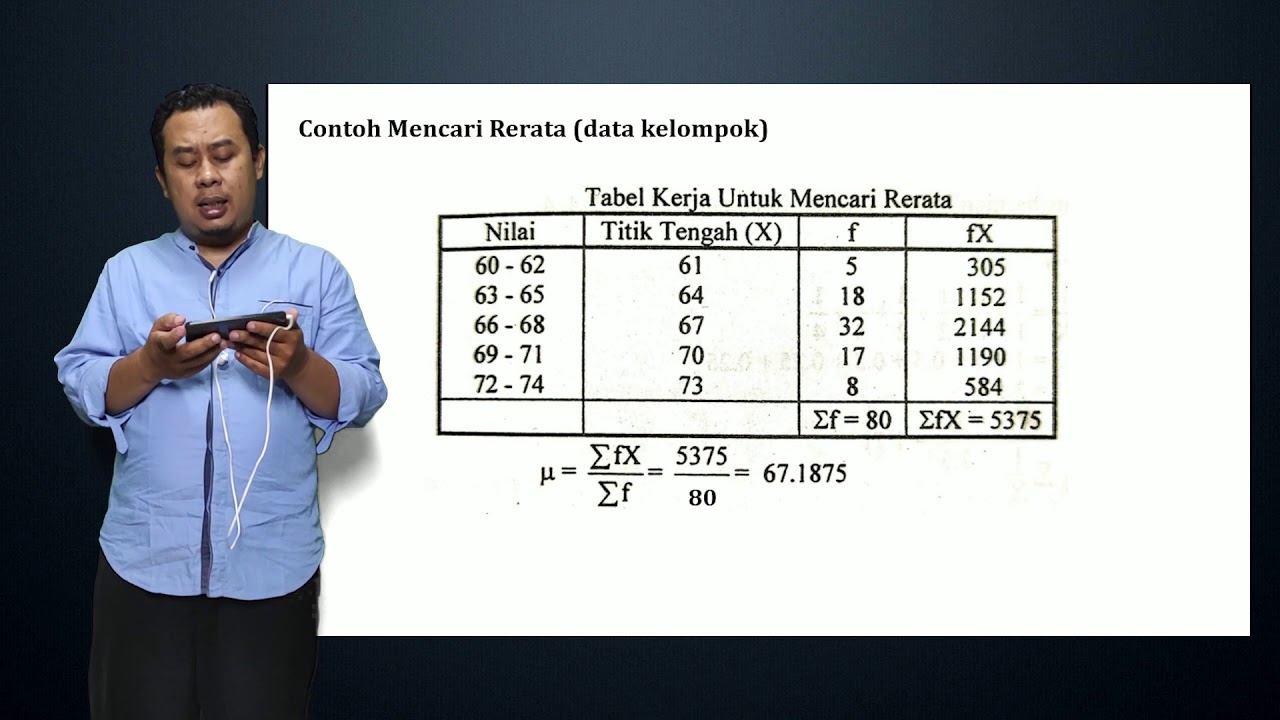
STATISTIKA PENELITIAN # 7 # (MATERI) TENDENSI SENTRAL (rerata, median, dan modus)
5.0 / 5 (0 votes)
