BE2001 Mass and Energy Balance for Biosystem Module 3 Segment 3
Summary
TLDRIn this segment, Lily explains the principles of conservation and the use of accounting equations to track extensive properties within a system. She introduces the conservation law, highlighting the distinction between conserved and non-conserved properties, such as total mass and species mass. The accounting equation is presented as a mathematical tool to track the movement, generation, and accumulation of these properties. Using a bank example, she illustrates how input, output, generation, and consumption terms work. Lily concludes by noting that future modules will explore the mathematical framework behind accounting equations.
Takeaways
- 😀 The conservation principle states that the total amount of conserved extensive properties, like mass, remains constant in the universe.
- 😀 Accounting equations track the movement, generation, consumption, and accumulation of extensive properties within a system.
- 😀 The conservation equation (Input - Output = Accumulation) applies when a property is conserved, with no generation or consumption within the system.
- 😀 Extensive properties are transferred across system boundaries in various ways: bulk movement, direct contact, and non-direct contact (e.g., potential fields).
- 😀 An example of bulk movement is the circulation of money in a bank, where currency deposits and withdrawals transfer money without changing its total amount.
- 😀 In the bank example, input refers to customer deposits, and output refers to customer withdrawals, with no generation or consumption of money.
- 😀 Generation terms describe the creation of an extensive property within a system, while consumption terms describe the destruction or use of the property.
- 😀 Accumulation terms quantify the change in an extensive property within a system, either as positive (increase) or negative (decrease).
- 😀 The accumulation term can be determined by finding the difference between the initial and final conditions of the system.
- 😀 The next segment will discuss the mathematical framework for accounting equations, building on the principles outlined here.
Q & A
What is the conceptual framework for accounting and conservation equations?
-The conceptual framework for accounting and conservation equations is used to track the movement of extensive properties within a system and across its boundaries. These equations describe how an extensive property is generated, consumed, accumulated, or moved in and out of a system.
What is the main difference between accounting and conservation equations?
-The accounting equation tracks the movement of extensive properties, including generation and consumption, whereas the conservation equation describes the movement and accumulation of an extensive property when it is conserved. In the conservation equation, there is no generation or consumption, and the amount remains constant over time.
How is the conservation of mass illustrated in the script?
-The conservation of mass is illustrated by stating that the total mass in a system remains constant and is equivalent to the mass exchanged with the surroundings. Mass is conserved in the system, while species mass (specific types of mass) may not be conserved and needs to be described using an accounting equation.
What does the accounting equation represent mathematically?
-The accounting equation is represented as: Input - Output + Generation - Consumption = Accumulation. This equation tracks how extensive properties are transferred into and out of the system, as well as their generation and consumption.
What is the significance of the input and output terms in the accounting equation?
-The input term represents the amount of extensive property added to the system, while the output term represents the amount lost by the system. These terms describe the exchange or transfer of an extensive property into or out of the system, capturing the net movement across its boundaries.
How can an extensive property be transferred by bulk movement?
-An extensive property can be transferred by bulk movement when the material physically moves across the system boundary, such as in the case of physical withdrawals and deposits of currency in the bank example.
What are the different methods of transferring extensive properties across system boundaries?
-Three primary methods of transfer are described: 1) Bulk movement, where material physically moves across the system boundary; 2) Direct contact, where material is transferred to or from an object physically touching the system; and 3) Non-direct contact, where a system is acted on at a distance, such as through a potential field.
Can you explain the banking example in the context of accounting and conservation?
-In the banking example, the extensive property is dollars. The system is the bank, and the boundary is the physical exterior of the bank. The input term consists of all currency deposited by customers, and the output term consists of all currency withdrawn. Since the money remains the same in the system, it represents bulk transfer without generation or consumption.
What is the difference between generation and consumption terms in the context of a system?
-The generation term describes the creation of an extensive property within the system, while the consumption term describes the usage or destruction of the property within the system. These terms capture the internal production and elimination of the extensive property.
How is the accumulation term defined and calculated?
-The accumulation term quantifies the net gain or loss of an extensive property within the system. It can be positive, indicating an increase in the property, or negative, indicating a decrease. The accumulation is determined by the difference in the property’s quantity between the initial and final conditions of the system.
Outlines

This section is available to paid users only. Please upgrade to access this part.
Upgrade NowMindmap

This section is available to paid users only. Please upgrade to access this part.
Upgrade NowKeywords

This section is available to paid users only. Please upgrade to access this part.
Upgrade NowHighlights

This section is available to paid users only. Please upgrade to access this part.
Upgrade NowTranscripts

This section is available to paid users only. Please upgrade to access this part.
Upgrade NowBrowse More Related Video

BE2001 Mass and Energy Balance for Biosystem Module 3 Segment 2

BE2001 Mass and Energy Balance for Biosystem Module 4 Segment 1

BE2001 Mass and Energy Balance for Biosystem Module 3 Segment 1

BE2001 Mass and Energy Balance for Biosystem Module 4 Segment 3
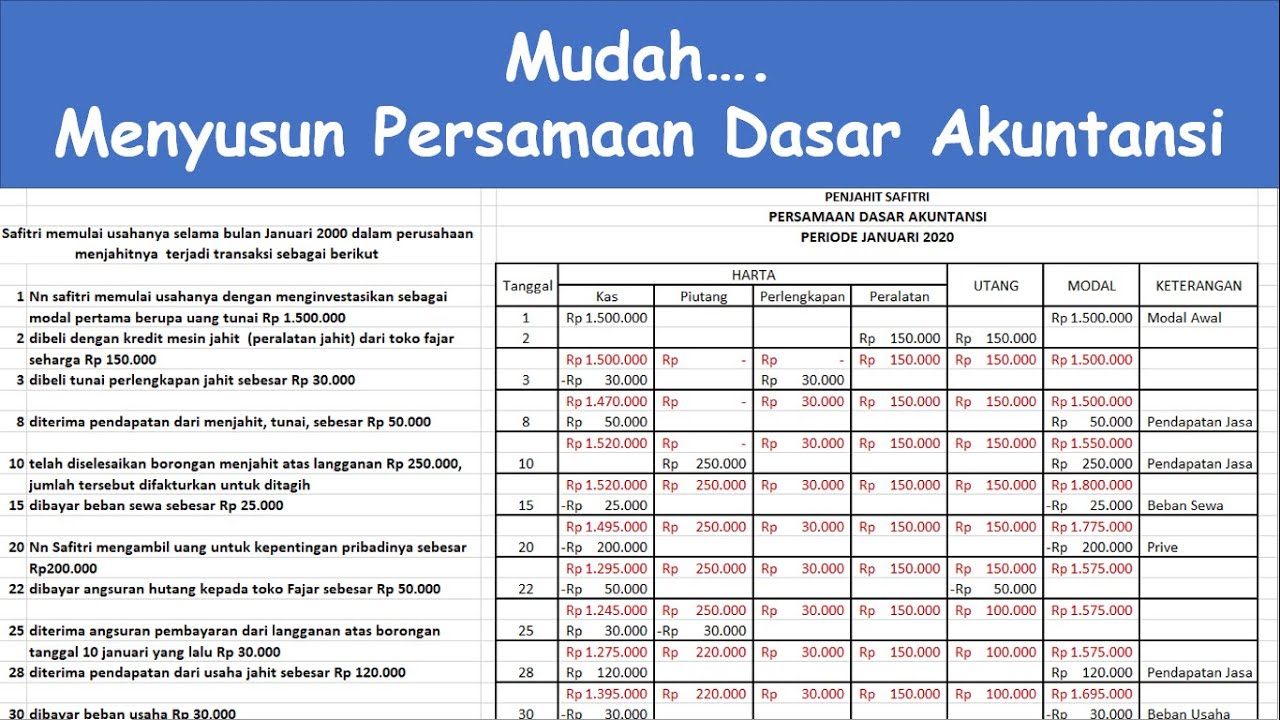
PERSAMAAN DASAR AKUNTANSI -Studi kasus Penjahit Safitri

Piutang Karyawan untuk Akun Piutang (AR) pada Accurate Dekstop
5.0 / 5 (0 votes)
