Business Math - Finance Math (1 of 30) Simple Interest
Summary
TLDRThis video introduces the concept of simple interest in finance, explaining key terms such as principal, interest, accumulated amount, rate, and time. It highlights how simple interest is calculated using the formula Interest = Principal × Rate × Time, and contrasts it with compounded interest. The video also includes a practical example of investing $2,000 at a 5% interest rate over 3 years, resulting in $300 in interest and a total accumulated amount of $2,300. The content aims to clarify how simple interest works and its application in real-world scenarios.
Takeaways
- 😀 Simple interest is a basic concept in finance, where you earn interest only on your initial investment (the principal), not on the interest already earned.
- 😀 The 'P' in simple interest formulas stands for principal, which is the initial amount of money invested.
- 😀 Interest is the money earned in return for your investment, and its unit is typically in dollars.
- 😀 The 'A' stands for accumulated amount, which is the sum of your principal and the interest earned over time.
- 😀 The 'R' is the interest rate, usually expressed as a percentage or decimal, which determines how fast your investment grows.
- 😀 'T' represents the time in years for which the investment is held and is a factor in how much interest you will earn.
- 😀 Simple interest means you only earn interest on the principal, unlike compound interest where interest is earned on both the principal and previously earned interest.
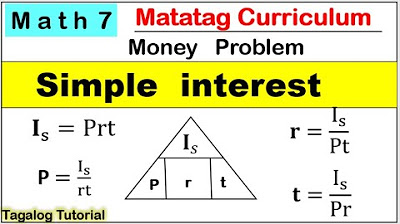
- 😀 The formula for calculating simple interest is: Interest = Principal × Rate × Time.
- 😀 The accumulated amount after the investment period is the initial principal plus the interest earned.
- 😀 Example: If you invest $2,000 at 5% simple interest for 3 years, you will earn $300 in interest, making the accumulated amount $2,300 after 3 years.
- 😀 Simple interest is not as commonly used as compound interest today because compound interest generally leads to higher returns over time.
Q & A
What is simple interest?
-Simple interest is the type of interest where the amount earned is calculated only on the initial principal amount, not on the interest accumulated over time.
Why is simple interest not commonly used today?
-Simple interest is not commonly used today because compound interest is more advantageous, as it allows interest to be earned on both the principal and the accumulated interest over time.
What does 'P' represent in the context of simple interest?
-'P' represents the principal, which is the initial amount of money you invest or deposit.
How is interest calculated in simple interest?
-Interest is calculated by multiplying the principal (P) by the rate (R) and the time (T). The formula is: Interest = P × R × T.
What is the meaning of the term 'accumulated amount'?
-The accumulated amount is the total sum you end up with after a period of time, which includes both your principal and the interest you earned.
What does the 'R' in the formula stand for?
-'R' stands for the interest rate, usually expressed as a percentage or decimal, and it determines how much interest you will earn on your investment.
How does the time factor (T) affect the amount of interest earned?
-The longer you leave your money invested, the more interest you will earn. The time factor is usually expressed in years.
What is the difference between simple interest and compound interest?
-The key difference is that simple interest only calculates interest on the initial principal, while compound interest calculates interest on both the principal and the accumulated interest over time.
What does the accumulated amount equal to in simple interest?
-The accumulated amount equals the principal plus the interest earned. The formula for this is: Accumulated Amount = P × (1 + R × T).
Can you provide an example of how to calculate simple interest?
-Sure! For example, if you invest $2,000 at a 5% interest rate for 3 years, the interest earned would be $2,000 × 0.05 × 3 = $300. The accumulated amount would then be $2,000 (principal) + $300 (interest) = $2,300.
Outlines

This section is available to paid users only. Please upgrade to access this part.
Upgrade NowMindmap

This section is available to paid users only. Please upgrade to access this part.
Upgrade NowKeywords

This section is available to paid users only. Please upgrade to access this part.
Upgrade NowHighlights

This section is available to paid users only. Please upgrade to access this part.
Upgrade NowTranscripts

This section is available to paid users only. Please upgrade to access this part.
Upgrade NowBrowse More Related Video

ILLUSTRATING SIMPLE AND COMPOUND INTEREST || GRADE 11 GENERAL MATHEMATICS Q2

Kelas XI - Matematika Keuangan Part 1 - Bunga Tunggal dan Bunga Majemuk

Simple Interest | Numbers | Maths | FuseSchool

Bunga majemuk dan anuitas kelas XI | Matematika
MATH 7 Solving simple interest week 5 #matatag #matatagcurriculum #simpleinterest #solvinginterest

Matematika Keuangan (Bunga Tunggal, Bunga Majemuk) MATEMATIKA 12 SMA
5.0 / 5 (0 votes)
