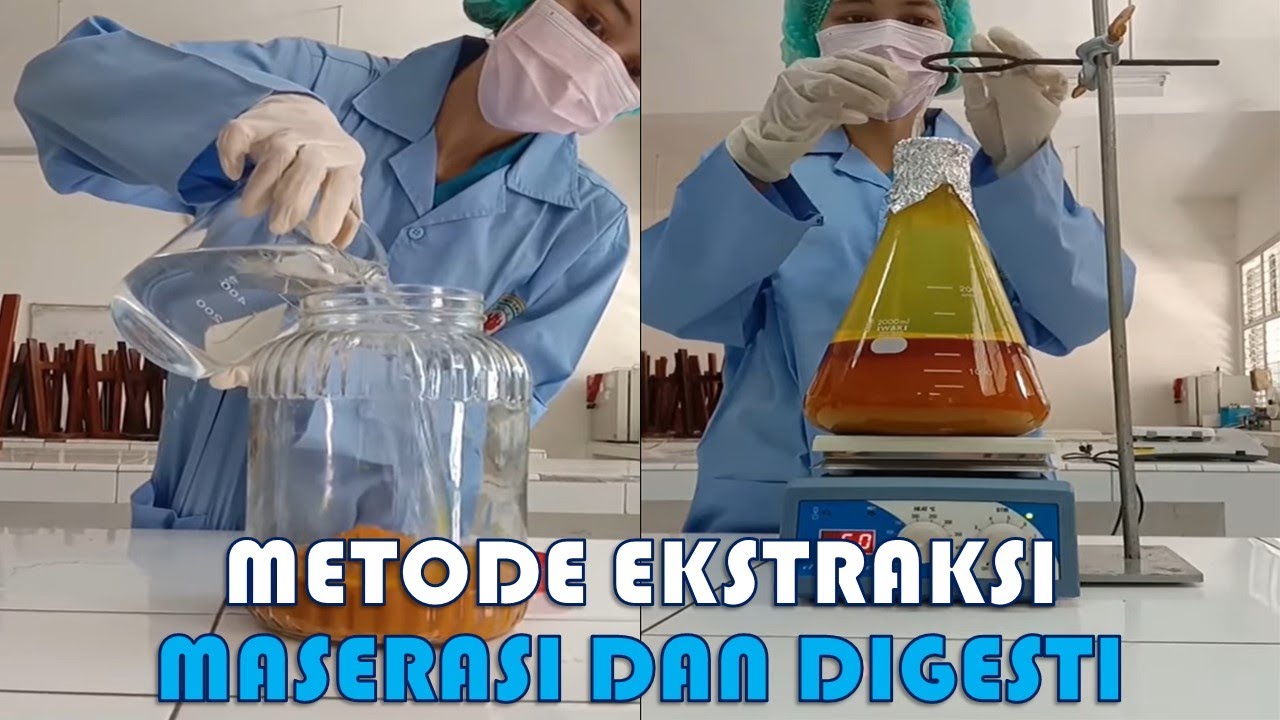
cara ekstraksi maserasi
Summary
TLDRIn this video, Nur Annisa explains the process of extracting flavonoid compounds from bay leaves using maceration. She describes how to prepare the plant material, grind it into powder, and weigh it before adding methanol as a solvent. The process involves soaking the powder, shaking it regularly, and filtering the extract. The final step includes evaporating the solvent to obtain a concentrated extract using a rotary evaporator. The explanation covers the principles behind each step, including the function of various laboratory equipment like the rotary evaporator and condenser, as well as the advantages and disadvantages of maceration.
Takeaways
- 😀 Extraction is the process of isolating soluble chemical compounds from a powdered plant material, separating them from the insoluble parts.
- 😀 Maseration is a specific extraction method that involves soaking plant material in a solvent to dissolve active compounds, without heating.
- 😀 The key advantage of the maseration method is its simplicity and ease of execution, with minimal equipment required.
- 😀 A downside of maseration is that it takes a long time, requiring significant amounts of solvent for the extraction process.
- 😀 The extraction of flavonoids from daun salam (Indonesian bay leaf) involves drying, grinding, and soaking the leaves in methanol for two days at 32°C.
- 😀 The ratio of daun salam powder to methanol is 1:6, with periodic shaking every 2 hours for 5 minutes during the soaking period.
- 😀 After extraction, the mixture is filtered, separating the extract (filtrate) from the solid residue (pulp), which is then subjected to a second round of soaking and filtration.
- 😀 The combined filtrates are evaporated using a rotary evaporator at a temperature of approximately 40°C and a vacuum pressure of 100 mbar to remove the solvent.
- 😀 The rotary evaporator works by heating the mixture while rotating the flask, and the vacuum lowers the boiling point of the solvent, causing it to evaporate more easily.
- 😀 The condensed vapor is collected in a separate container, leaving behind a concentrated extract free of the solvent.
- 😀 The evaporator’s design includes a round-bottomed flask, a water bath chamber for heating, and a condenser to cool the vapor and convert it back to liquid.
Q & A
What is extraction in the context of this script?
-Extraction is the process of isolating chemical compounds that are soluble from a substance (simplisia), separating them from the insoluble materials.
What is maceration, and how does it work in extraction?
-Maceration is a method of extraction where the raw material is soaked in a solvent without heat, allowing the soluble chemical compounds to dissolve into the solvent. This process breaks down cell walls and membranes due to pressure differences.
What is the main advantage of maceration?
-The main advantage of maceration is that it requires simple equipment and is easy to perform.
What are the disadvantages of maceration?
-Maceration has the disadvantage of requiring a long soaking period and uses a large volume of solvent.
What example is given in the script for a substance extracted using maceration?
-An example provided in the script is the extraction of flavonoids from bay leaves (daun salam).
How is simplisia prepared before extraction?
-Simplisia is prepared by drying the bay leaves either in an oven or by air-drying. Once dry, the leaves are ground into a fine powder using a blender.
What solvent is used in the extraction process described in the script?
-The solvent used in the extraction process is methanol, with a ratio of 1 part bay leaf powder to 6 parts methanol.
What is the purpose of using a rotary evaporator in the extraction process?
-The rotary evaporator is used to remove the solvent from the extracted solution, concentrating the extract by evaporating the solvent under controlled heat and vacuum conditions.
What are the main components of a rotary evaporator, and how do they function?
-A rotary evaporator consists of a round-bottomed flask (labu alas bulat) to hold the solution, a water bath (Chamber waterbit) for heating, and a condenser that cools the evaporated solvent so it can be collected. The rotating flask helps increase the surface area for evaporation.
Why is a vacuum applied during the evaporation process?
-A vacuum is applied to lower the boiling point of the solvent, allowing it to evaporate at a lower temperature, which helps preserve the chemical compounds in the extract.
Outlines

This section is available to paid users only. Please upgrade to access this part.
Upgrade NowMindmap

This section is available to paid users only. Please upgrade to access this part.
Upgrade NowKeywords

This section is available to paid users only. Please upgrade to access this part.
Upgrade NowHighlights

This section is available to paid users only. Please upgrade to access this part.
Upgrade NowTranscripts

This section is available to paid users only. Please upgrade to access this part.
Upgrade NowBrowse More Related Video

Materi Fitokimia - Praktikum Ekstraksi Metode Maserasi

Natural Products Chemistry - In the Lab: How Do We Figure Out What Our Natural Product Looks Like?

FRAKSINASI DAN APLIKASINYA

Cara Uji Fitokimia Alkaloid Sampel Segar dengan Reagen Mayer

SIMULASI EKSTRAKSI CAIR CAIR UNTUK FRAKSINASI
MASERASI DAN DIGESTI - RIRIN
5.0 / 5 (0 votes)
