Aplikasi Integral • Part 9: Fungsi Biaya dan Fungsi Penerimaan / Fungsi Pendapatan
Summary
TLDRThis educational video explains how integral calculus applies to economics, focusing on cost and revenue functions. It breaks down key concepts such as fixed cost, variable cost, total cost, average cost, and marginal cost, highlighting how they relate to production levels. The video also introduces total revenue and marginal revenue, emphasizing their connection through derivatives and integrals. A detailed example demonstrates how to derive total cost from a marginal cost function, determine constants using fixed cost, and calculate both total and average costs for a given production level. The lesson provides a clear, practical understanding of how calculus supports economic analysis.
Takeaways
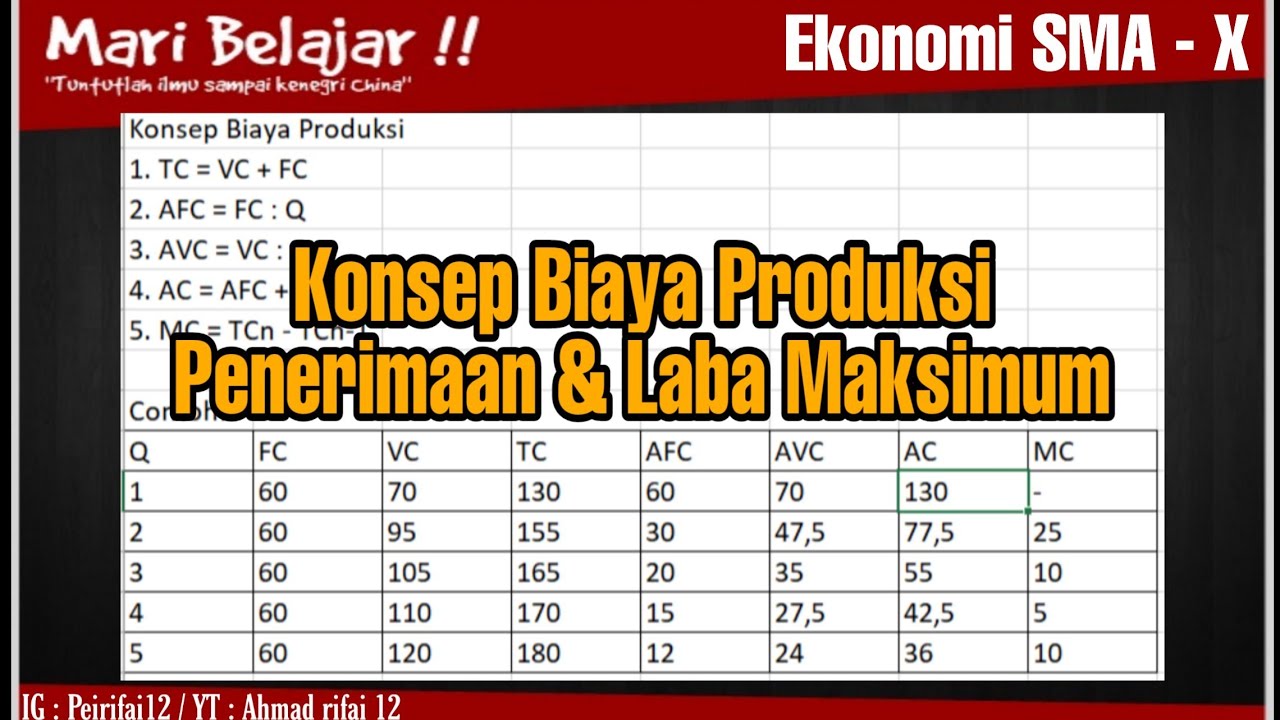
- 😀 Fixed costs (FC) do not depend on the quantity of goods produced, such as rent and employee salaries.
- 😀 Variable costs (VC) increase with the quantity of goods produced, like raw materials and employee wages tied to production levels.
- 😀 Total cost (TC) is the sum of fixed and variable costs, calculated as TC = FC + VC.
- 😀 Average cost (AC) is the cost per unit of production, found by dividing total cost (TC) by the number of units (Q): AC = TC / Q.
- 😀 Marginal cost (MC) measures the change in total cost with the production of one additional unit, represented as the derivative of TC with respect to quantity.
- 😀 The relationship between total cost and marginal cost can be reversed: TC is the integral of MC, and MC is the derivative of TC.
- 😀 Total revenue (TR) is the total income a company generates from sales, calculated as TR = P × Q, where P is price per unit and Q is quantity sold.
- 😀 Marginal revenue (MR) measures the change in total revenue when producing and selling one additional unit, represented as the derivative of TR with respect to quantity.
- 😀 The integral of marginal cost (MC) allows you to find the total cost function, but you must determine the constant of integration using fixed costs.
- 😀 In a practical example, when given a marginal cost function and fixed cost, you can calculate total cost (TC) and average cost (AC) for a specific production level (e.g., 2,000 units).
Q & A
What is fixed cost (FC) and can you give examples?
-Fixed cost (FC) is a cost that does not depend on the quantity of goods produced. It remains constant regardless of production levels. Examples include rent and the basic salary of employees.
What is variable cost (VC) and can you provide examples?
-Variable cost (VC) is a cost that depends on the quantity of goods produced. Examples include raw material costs and wages or bonuses that are paid per unit produced.
How do you calculate total cost (TC)?
-Total cost (TC) is calculated by adding fixed costs and variable costs: TC = FC + VC.
What is average cost (AC) and how is it determined?
-Average cost (AC) is the cost per unit of production, calculated as AC = TC / Q, where Q is the total number of units produced.
What is marginal cost (MC) and how is it mathematically expressed?
-Marginal cost (MC) is the increase in total cost when producing one additional unit of output. Mathematically, MC = d(TC)/dQ. Conversely, TC can be obtained by integrating MC over quantity: TC = ∫ MC dQ + C.
What is total revenue (TR) and how do you calculate it?
-Total revenue (TR) is the total income a company receives from selling its products. It is calculated as TR = P × Q, where P is the price per unit and Q is the quantity sold.
What is marginal revenue (MR) and its relationship to total revenue?
-Marginal revenue (MR) is the additional revenue received from selling one more unit of a product. It is the derivative of total revenue with respect to quantity: MR = d(TR)/dQ. Total revenue can also be obtained by integrating MR: TR = ∫ MR dQ + C.
In the given example, how do you find the constant C when integrating MC to get TC?
-The constant C can be found using the fixed cost (FC). Since TC = VC + FC, and FC is the total cost at zero production, you set TC(0) = FC. In the example, C = 1500 (in thousands of rupiah).
How is the total cost for producing 2000 units calculated in the example?
-First, integrate MC to get TC: TC = 0.002x^3 - 0.75x^2 + 8x + 1500. Then substitute x = 2000 units: TC(2000) = 13,017,500 thousand rupiah = Rp13,017,500,000.
How do you calculate average cost for 2000 units in the example?
-Average cost (AC) is calculated by dividing the total cost by the number of units: AC = TC / Q = 13,017,500 / 2000 = 6,508.75 thousand rupiah = Rp6,508,750 per unit.
Why is it important to distinguish between fixed and variable costs in economic analysis?
-Distinguishing between fixed and variable costs helps a company understand cost behavior, make production decisions, calculate break-even points, and determine pricing strategies for profitability.
What is the main purpose of using integrals in cost and revenue functions?
-Integrals are used to calculate total cost from marginal cost and total revenue from marginal revenue. This allows companies to determine the overall cost and revenue based on incremental changes per unit.
Outlines

Этот раздел доступен только подписчикам платных тарифов. Пожалуйста, перейдите на платный тариф для доступа.
Перейти на платный тарифMindmap

Этот раздел доступен только подписчикам платных тарифов. Пожалуйста, перейдите на платный тариф для доступа.
Перейти на платный тарифKeywords

Этот раздел доступен только подписчикам платных тарифов. Пожалуйста, перейдите на платный тариф для доступа.
Перейти на платный тарифHighlights

Этот раздел доступен только подписчикам платных тарифов. Пожалуйста, перейдите на платный тариф для доступа.
Перейти на платный тарифTranscripts

Этот раздел доступен только подписчикам платных тарифов. Пожалуйста, перейдите на платный тариф для доступа.
Перейти на платный тариф

5.0 / 5 (0 votes)

