O QUE É O FLIP FLOP? | Como Funcionam os Flip Flops JK, SR, D e T | Eletrônica Digital
Summary
TLDRThis video provides a comprehensive introduction to digital electronics with a focus on flip-flops, a fundamental component for storing and transferring binary states. The instructor explains different types, including SR, JK, D, and T flip-flops, detailing their inputs, outputs, and behavior according to truth tables. Practical demonstrations using a protoboard show how flip-flops operate in real circuits, including counters, data buffers, and state inversion. Key features like preset and clear functions are highlighted, along with step-by-step visualizations of state transitions. The tutorial is beginner-friendly, offering clear explanations, hands-on examples, and insights into applications in microcontrollers and digital systems.
Takeaways
- 😀 Flip-flops are essential components in digital electronics, used to store binary states (0 or 1) in systems like microcontrollers and microprocessors.
- 😀 The SR flip-flop has Set (S) and Reset (R) inputs that maintain or change the state of the output (Q), depending on the inputs.
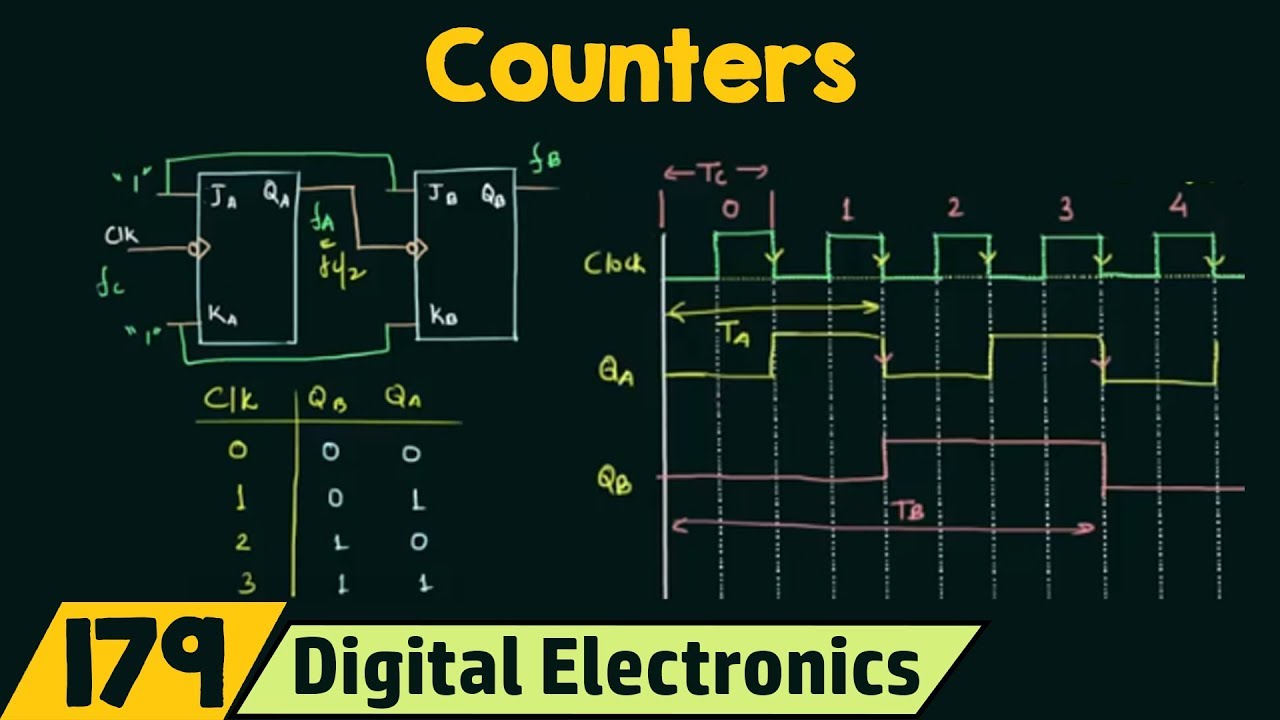
- 😀 The JK flip-flop allows toggling between states by using J and K inputs, with a toggling effect when both inputs are 1, making it suitable for counters.
- 😀 The D flip-flop serves as a data buffer, storing input data and transferring it to the output when the clock signal is triggered.
- 😀 Flip-flops can store data, transfer data, or create logical operations, playing a crucial role in systems that require memory or state tracking.
- 😀 A flip-flop's state is controlled by a clock signal, and its output remains stable until a clock pulse or input triggers a change.
- 😀 Flip-flops are commonly used in counters, registers, and devices requiring data storage and processing in digital electronics.
- 😀 The preset and clear inputs on flip-flops are prioritized over other inputs, allowing forced setting or resetting of the output regardless of other conditions.
- 😀 Flip-flop truth tables show the output behavior for various input combinations and clock transitions, helping understand their functionality.
- 😀 Hands-on breadboard experimentation is key for understanding the practical operation of flip-flops, as demonstrated with LEDs and clock pulses.
- 😀 Testing flip-flops with buttons for J, K inputs and a clock signal on a breadboard shows real-time changes in the output, making it easier to grasp their function.
Q & A
What is a flip-flop in digital electronics?
-A flip-flop is a digital electronic component used to store binary data. It has two stable states (0 and 1) and retains the value until it is changed by an external input, making it a basic memory element in digital circuits.
What are the common types of flip-flops discussed in the video?
-The video discusses four main types of flip-flops: SR (Set-Reset) Flip-Flop, JK Flip-Flop, D Flip-Flop, and T Flip-Flop, each with different functionalities and applications.
How does an SR Flip-Flop work?
-An SR Flip-Flop has two inputs: Set (S) and Reset (R). If both inputs are activated simultaneously, the state becomes invalid. Otherwise, the flip-flop holds the previous state or is forced to 0 or 1 based on the input values.
What makes the JK Flip-Flop unique compared to other flip-flops?
-The JK Flip-Flop is versatile because, depending on the inputs (J and K), it can maintain the current state, toggle between 0 and 1, or invert the output. It is commonly used in counters and other sequential circuits.
What is the role of the clock signal in flip-flops?
-The clock signal controls the timing of when the flip-flop changes its state. In most flip-flops, a negative edge (falling edge) of the clock causes the flip-flop to update its output, based on the current input values.
Why is the D Flip-Flop considered a 'buffer'?
-The D Flip-Flop stores a value from its data input (D) and outputs it when a clock signal is applied. It is essentially a buffer because it only transfers the input data to the output on the clock transition, making it useful for controlling data flow.
What is the advantage of using a T Flip-Flop in counters?
-The T Flip-Flop is useful in counters because it toggles its state every time it receives a clock pulse, which allows it to be used in binary counting circuits. This makes it ideal for building simple binary counters.
What does the Clear and Preset pins do in a flip-flop?
-The Clear pin forces the output to 0, while the Preset pin forces the output to 1, regardless of the other input values. These pins are prioritized and will override the regular flip-flop operation.
Can you explain the behavior of a flip-flop when both Clear and Preset are activated simultaneously?
-When both the Clear and Preset pins are activated at the same time, the situation is invalid because one pin forces the output to 0 while the other forces it to 1. In practice, this can lead to unpredictable behavior.
How is a JK Flip-Flop used in a practical example like a binary counter?
-In a binary counter, multiple JK Flip-Flops are connected in series, with each flip-flop receiving the clock pulse from the previous one. The outputs of these flip-flops represent the binary count, which increments with each clock cycle.
Outlines

Этот раздел доступен только подписчикам платных тарифов. Пожалуйста, перейдите на платный тариф для доступа.
Перейти на платный тарифMindmap

Этот раздел доступен только подписчикам платных тарифов. Пожалуйста, перейдите на платный тариф для доступа.
Перейти на платный тарифKeywords

Этот раздел доступен только подписчикам платных тарифов. Пожалуйста, перейдите на платный тариф для доступа.
Перейти на платный тарифHighlights

Этот раздел доступен только подписчикам платных тарифов. Пожалуйста, перейдите на платный тариф для доступа.
Перейти на платный тарифTranscripts

Этот раздел доступен только подписчикам платных тарифов. Пожалуйста, перейдите на платный тариф для доступа.
Перейти на платный тарифПосмотреть больше похожих видео




5.0 / 5 (0 votes)

