Algorithm Engineer Reveals The Hidden Forces Behind 'Stop Loss Hunts'
Summary
TLDRThis conversation delves into market mechanics, focusing on stop loss hunting and institutional trading strategies. It explores how algorithms identify and exploit predictable areas of retail stop orders to improve trade execution, specifically around high liquidity periods like market opens. A technical trader shares their system, which seeks to ride the momentum of large institutional orders, but struggles to fully understand why the strategy works. The discussion touches on market liquidity, the psychological factors behind stop loss placement, and the prevalence of spoofing as a market manipulation tactic, ultimately concluding that these practices are part of the game.
Takeaways
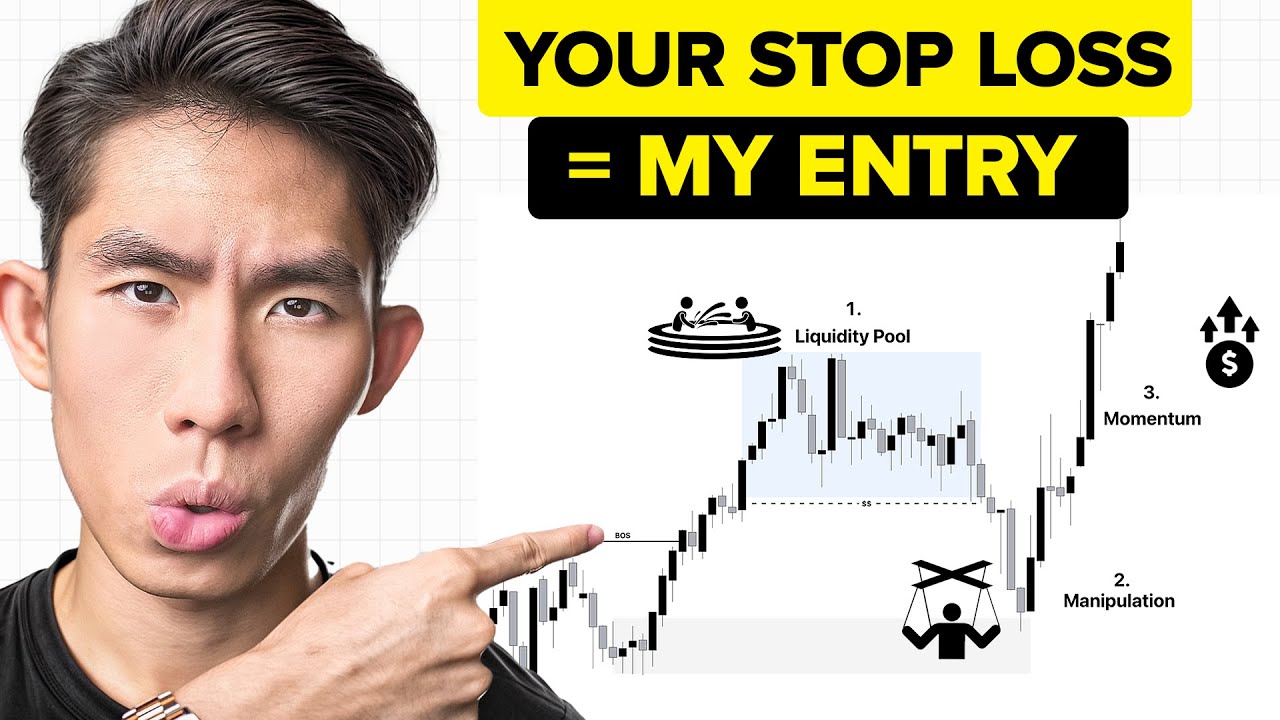
- 😀 **Market Liquidity and Stop Loss Hunts**: Large institutional players and algorithms may push prices to trigger retail traders' stop losses, creating liquidity to fulfill large orders.
- 😀 **Algorithmic Trading with VWAP**: Algorithms like VWAP (Volume Weighted Average Price) are used by institutions to strategically fill large orders at better prices by targeting areas with weak liquidity.
- 😀 **Retail Traders' Predictable Stop Loss Areas**: Retail traders often place stops at predictable levels (e.g., support, resistance), which can be targeted by institutional algorithms to trigger a cascade of price movement.
- 😀 **Whale Trading and Riding the Wave**: Retail traders aim to identify the market moves made by large institutional orders (the 'whales') and trade in the same direction to capture profits during short-term price movements.
- 😀 **Risk Management and Stop Placement**: It's advised not to place stops at obvious levels, such as right below support or at round numbers, as these are commonly targeted by algorithms.
- 😀 **Increased Frequency of Stop Loss Hunts**: Over time, it has become more common to see areas with retail stop losses swept and then retested, possibly due to more sophisticated algorithmic strategies.
- 😀 **Role of the Iceberg Order**: Institutional orders are often like an 'iceberg' where a visible small order masks a much larger underlying order that can move the market once triggered.
- 😀 **Market Manipulation and Spoofing**: Spoofing—faking large orders to manipulate prices—is acknowledged as part of the game, with little that can be done to prevent it in today's algorithmic trading environment.
- 😀 **Liquidity at Specific Points**: At any given moment, market liquidity may be low, meaning even retail stop losses can have a disproportionate impact on price movement.
- 😀 **Smart Order Placement**: To avoid detection by algorithms, retail traders are encouraged to place orders at non-obvious levels, such as using odd numbers or prime numbers, rather than round figures like 100 or 1000.
Q & A
What is stop loss hunting in trading?
-Stop loss hunting refers to the phenomenon where price movements seem to target and trigger stop loss orders placed by retail traders. It appears as if large institutional players or market makers are driving the price to specific levels to take out these stops, but it's often part of a larger algorithmic strategy rather than a targeted attack.
Why do institutional traders exploit stop loss orders?
-Institutional traders use stop loss orders as part of their strategy to improve execution. By knowing where these orders are placed, they can move the market in a way that triggers the stops, allowing them to buy at lower prices or enter better positions for their large orders, reducing slippage.
What is VWAP, and how does it relate to institutional trading?
-VWAP (Volume Weighted Average Price) is a trading indicator used by institutional traders to execute large orders without causing significant market disruption. It helps minimize slippage by ensuring trades are executed at an average price that reflects the true market value over a specific period, typically over the course of a trading day.
How do retail traders influence the market with their stop placements?
-Retail traders tend to place their stop losses at predictable levels, such as below support areas, resistance, or round numbers. This creates liquidity zones that institutional traders can exploit, sometimes leading to the perception that the market is specifically targeting retail stops.
Why are round numbers seen as bad places to set stop losses?
-Round numbers are seen as bad places to set stop losses because they are psychologically predictable. Retail traders often place their stops at these levels, making them more likely to be targeted by market manipulation strategies or algorithmic traders who are aware of these common patterns.
What is the concept of 'iceberg orders' in trading?
-An iceberg order refers to a large institutional order that is partially hidden in the market. Only a small portion of the order is visible at any given time, while the majority is concealed. This allows the institution to avoid impacting the market too much when executing a large trade.
Why is market liquidity important in relation to stop losses?
-Market liquidity is crucial because when liquidity is low, even small orders, like retail stop losses, can have a significant impact on the market. Large institutional orders can struggle to be executed without pushing the price in a direction that causes these small orders to trigger.
What role does psychological behavior play in stop loss placement?
-Psychological behavior plays a major role in stop loss placement because many retail traders tend to place stops at levels that feel 'safe,' such as below support or resistance levels or at round numbers. This predictability is taken advantage of by algorithmic traders, who can identify and target these areas to move the market in their favor.
What is meant by 'riding the whale' in trading?
-'Riding the whale' refers to trading in the same direction as large institutional players (the 'whales') who have the power to move the market with their trades. Retail traders try to identify when these large players are making moves and align their trades with the trend to capitalize on the market momentum.
What advice is given to improve a trader's execution and avoid common mistakes?
-One key piece of advice is to avoid placing stop losses at obvious levels, such as directly below support or resistance or at round numbers. Traders should use unconventional, unpredictable stop loss levels (e.g., prime numbers or unusual values) to avoid falling into common traps set by institutional traders.
Outlines

Этот раздел доступен только подписчикам платных тарифов. Пожалуйста, перейдите на платный тариф для доступа.
Перейти на платный тарифMindmap

Этот раздел доступен только подписчикам платных тарифов. Пожалуйста, перейдите на платный тариф для доступа.
Перейти на платный тарифKeywords

Этот раздел доступен только подписчикам платных тарифов. Пожалуйста, перейдите на платный тариф для доступа.
Перейти на платный тарифHighlights

Этот раздел доступен только подписчикам платных тарифов. Пожалуйста, перейдите на платный тариф для доступа.
Перейти на платный тарифTranscripts

Этот раздел доступен только подписчикам платных тарифов. Пожалуйста, перейдите на платный тариф для доступа.
Перейти на платный тарифПосмотреть больше похожих видео


5.0 / 5 (0 votes)

